A concrete slab calculator sizes one flat pour and prices it two ways: as raw material and as an installed job with labor. Rectangular and round slabs both work. The tool returns the cubic yards to order, bag counts for 80 lb, 60 lb and 40 lb mix, an installed cost range split into material and labor, and an optional #4 rebar count on a grid with 18 inch spacing. Thickness drives most of the swing. A 6 inch slab holds half again as much concrete as a 4 inch slab of the same footprint, yet the installed price rises by only 20 percent, because labor for forming and finishing barely changes.
Concrete to order, with waste
1.36 cu yd
Before waste: 1.23 cu yd (33.33 cu ft)
| Slab area | 100.0 sq ft |
|---|---|
| Volume with waste | 36.67 cu ft |
| 80 lb bags | 62 bags |
| 60 lb bags | 82 bags |
| 40 lb bags | 123 bags |
| Item | Low | Typical | High |
|---|---|---|---|
| Ready mix concrete with delivery | $250 | $324 | $408 |
| 80 lb bags | $310 | $403 | $496 |
| 60 lb bags | $369 | $451 | $574 |
| 40 lb bags | $492 | $554 | $738 |
| Installed slab, material share | $240 | $400 | $560 |
| Installed slab, labor share | $360 | $600 | $840 |
| Installed slab, total | $600 | $1,000 | $1,400 |
Planning estimate only, not a contractor quote. Prices are United States national ranges, updated October 2026. How these estimates are built
Reading the slab results
The headline number is the order volume in cubic yards, waste included. Underneath it sit the surface area, the geometric volume and the bag counts. Ready mix trucks and bag pallets both start from that same order volume, so the two cost rows can be compared line for line.
The installed rows answer a different question: what a contractor typically charges to form, pour, finish and cure the slab. The national baseline runs $6.00 to $14.00 per square foot for a 4 inch slab, with a typical figure of $10.00. The tool splits that rate into a 40 percent material share and a 60 percent labor share. Only the material share grows with thickness. A thicker slab needs more concrete in the same forms, while the crew, the screed and the trowels stay the same.
When the rebar box is checked, two more lines appear: linear feet of bar and the number of 10 foot sticks to buy. The stick count includes a 10 percent allowance for lapped splices. The region menu then scales every cost line. The step by step estimating method explains how quantity, base rate, scope, region and exclusions combine.
The slab formulas, worked through
Area comes first. A rectangle is length times width. A circle is π times the radius squared, with the radius equal to half the diameter. Volume follows: area × thickness in inches ÷ 12 gives cubic feet, and cubic feet ÷ 27 gives cubic yards. The waste percentage multiplies the volume before any bag count or ready mix price is applied.
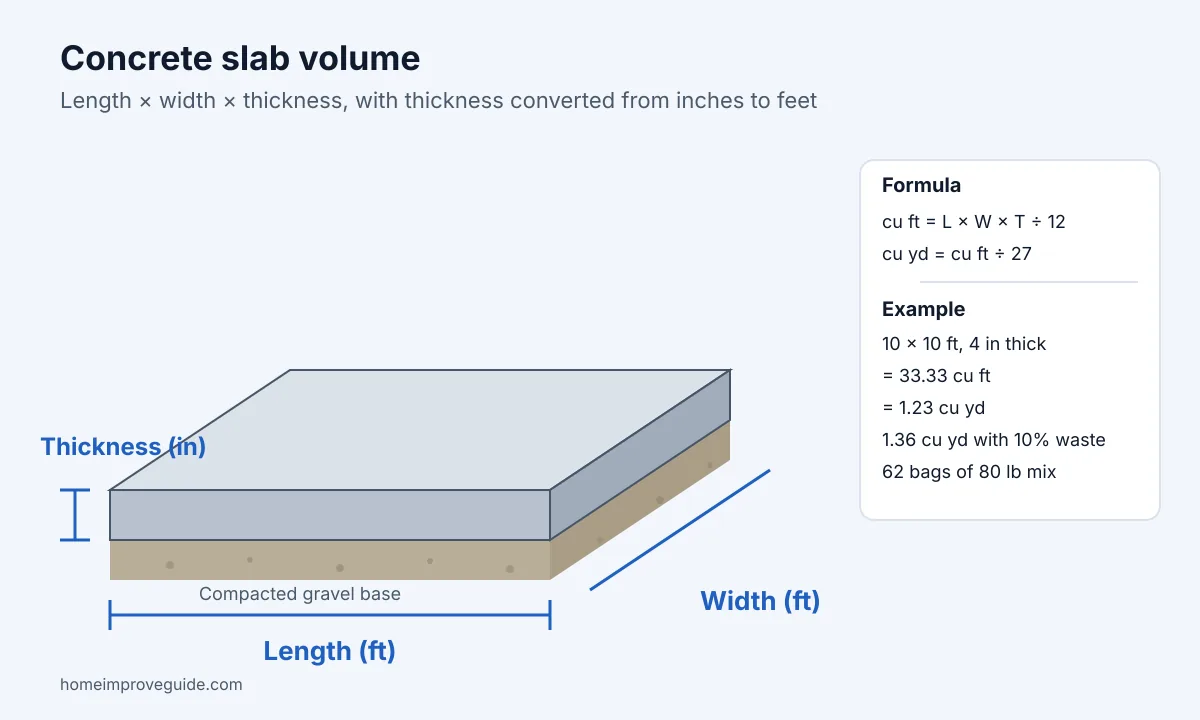
The installed cost uses a thickness factor built on the 40 percent material share:
- Factor = 0.60 + 0.40 × (thickness ÷ 4)
- 4 inch slab: factor 1.00
- 5 inch slab: factor 1.10
- 6 inch slab: factor 1.20
- 8 inch slab: factor 1.40
Installed cost equals area × base rate × factor, and the region multiplier applies after that. A square slab of 100 square feet, 4 inches thick, works out to 100 × $10.00 × 1.00, or $1,000 at the national typical rate, with a range of $600 to $1,400.
Rebar follows a grid with bars every 18 inches in both directions. The bars that run the length of the slab number (width ÷ 1.5 + 1), and each one is as long as the slab. The cross bars follow the same pattern turned 90 degrees. Adding both sets gives total linear feet, and multiplying by 1.1 before dividing by 10 gives the stick count, rounded up.
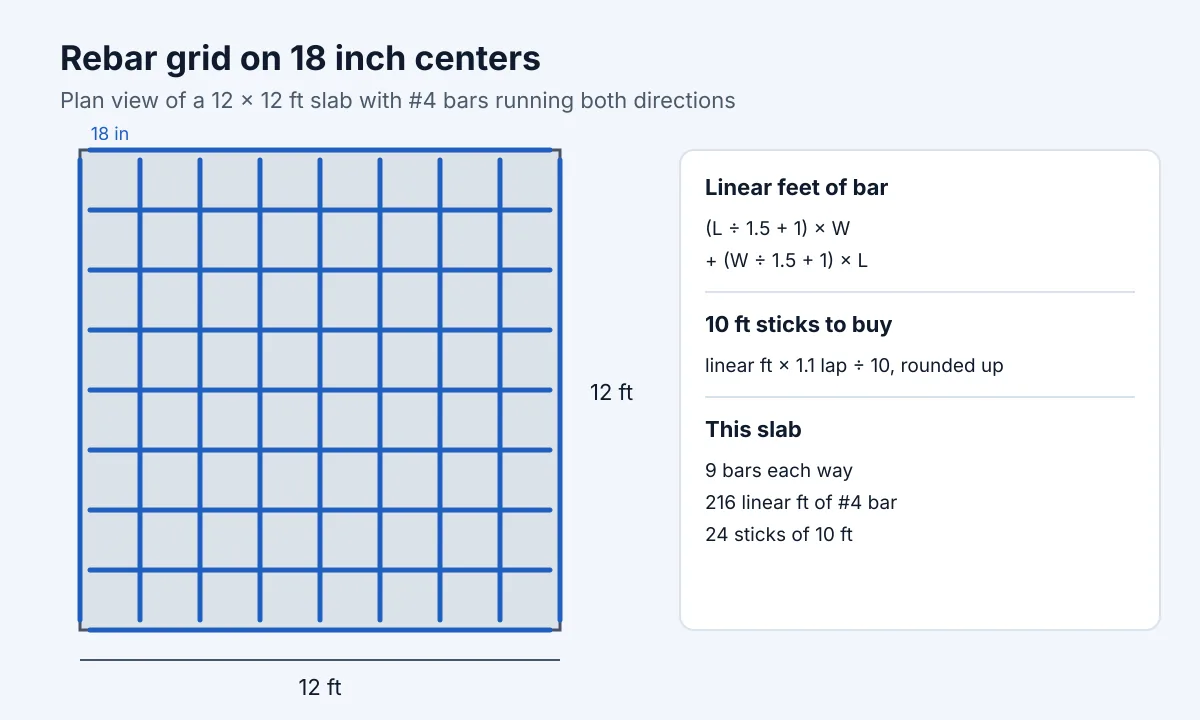
Turning the estimate into a slab
- The process starts with layout. Stakes and a string line mark the slab edges, and the diagonals get measured until they match, which confirms square corners.
- Excavation goes deep enough for the slab plus its gravel base. Soft spots get dug out and refilled rather than bridged, since a void under the slab becomes a crack later.
- The base gets compacted in lifts with a plate compactor and checked against the string line, so the slab thickness stays uniform across the whole pour. Tons of gravel for that layer follow the same math as the gravel base calculator for patios.
- Forms go up next, set to the finished height with a slight fall away from any building for drainage.
- Rebar or wire mesh sits on plastic chairs or concrete blocks so it ends up near the middle of the slab. Steel lying on the gravel adds weight and cost without adding strength.
- The order goes in using the volume with waste. The worked example below shows how one slab converts into a ticket.
- After the pour comes screeding, floating, edging and control joints, then curing under plastic, a curing compound or regular misting.
Worked example: a 12 by 24 foot parking pad
A homeowner adds a parking pad beside a driveway: 12 feet wide, 24 feet long and 5 inches thick, with rebar on the 18 inch grid. Waste stays at 10 percent and the region at the national average.
| Output | Result |
|---|---|
| Area | 288 sq ft |
| Volume before waste | 120.00 cu ft (4.44 cu yd) |
| Order volume with waste | 4.89 cu yd |
| 80 lb bags | 220 |
| Rebar | 420 linear ft, 47 sticks of 10 ft |
| Installed slab, material share | $864 to $2,020 (typical $1,440) |
| Installed slab, labor share | $1,040 to $2,420 (typical $1,730) |
| Installed slab, total | $1,900 to $4,440 (typical $3,170) |
| Rebar material | $329 to $658 (typical $470) |
At 5 inches the thickness factor is 1.10, so the typical installed price lands at $3,170 for 288 square feet. The rebar adds a typical $470 in steel. A contractor who quotes $4,440 or more for this pad is pricing in the High column, which fits tight access, a long carry from the street or a busy season. A bid well under $1,900 often leaves out base work or reinforcement, and the quote checklist below catches that.
What pushes a slab price up or down
Thickness is the most predictable driver. Each inch above the 4 inch baseline adds 10 percent to the installed price through the material share. An 8 inch slab therefore costs 40 percent more than a 4 inch slab of the same size, not double.
Site preparation is the least predictable. Clay soil, a high water table or a slope that needs cut and fill can add more than the concrete itself, and none of that appears in a per square foot rate. Old concrete that has to be broken out and hauled away adds a separate line on any honest bid.
Region shifts the whole number. A high cost state lifts the national figure by 25 percent and a low cost state trims it by 15 percent. Labor rates, plant prices and permit fees all move together across those groups.
Finish and reinforcement round out the list. A broom finish is the baseline, while stamped, colored or exposed aggregate finishes sit in the decorative tier that the Concrete Cost Calculator prices at 1.4 times the base. Rebar adds steel and placing time, and fiber in the mix adds a per yard charge on the concrete ticket.
Planning scenarios: Basic, Standard and Premium
| Scenario | Slab | Order volume | Installed, typical | Installed range |
|---|---|---|---|---|
| Basic | 8 × 10 ft shed base, 4 in | 1.09 cu yd | $800 | $480 to $1,120 |
| Standard | 14 × 20 ft patio, 4 in | 3.80 cu yd | $2,800 | $1,680 to $3,920 |
| Premium | 24 × 24 ft garage, 6 in, rebar | 11.73 cu yd | $6,910 | $4,150 to $9,680 |
The Basic shed base is small enough for a two person crew working from bags, and 49 bags of 80 lb mix cover it. The Standard patio is a one truck pour at 3.80 cubic yards. The Premium garage floor carries cars, so it gets 6 inches of concrete and a full rebar grid: 816 linear feet of bar, or 90 sticks, adding a typical $900 on top of the installed slab.
Quote checklist for an installed slab
- Slab thickness written on the quote, along with the strength of the mix in psi
- Base material, base depth and how the base gets compacted
- Reinforcement type (rebar, wire mesh or fiber) and how it is held at mid depth
- Control joint layout and whether joints are tooled or saw cut
- Finish type and the curing method after the pour
- Who pulls the permit and schedules any inspection
- Demolition and haul away of existing concrete, if any
- Payment schedule and what happens if the pour gets delayed by weather
Costs outside this estimate
- Excavation, grading and gravel base material
- Removal and disposal of an old slab
- Vapor barrier and insulation board under interior or heated slabs
- Wire mesh, fiber additive and rebar chairs (the rebar line covers bar only)
- Decorative finishes, sealer and color
- Pump truck, permits, inspections and engineering
When a licensed contractor is the right call
Garage floors, slabs that carry a structure and any slab inside a living space usually fall under the building code. Inspectors look at base preparation, reinforcement placement and, for interior slabs, the vapor barrier before concrete arrives. A failed inspection after the pour can mean removal.
Size matters as well. A crew finishes a large slab in one continuous effort, and a pour that outruns the people on site ends with cold joints and a rough surface. Contractors bring power screeds, bull floats and trowel machines that a single homeowner rarely owns.
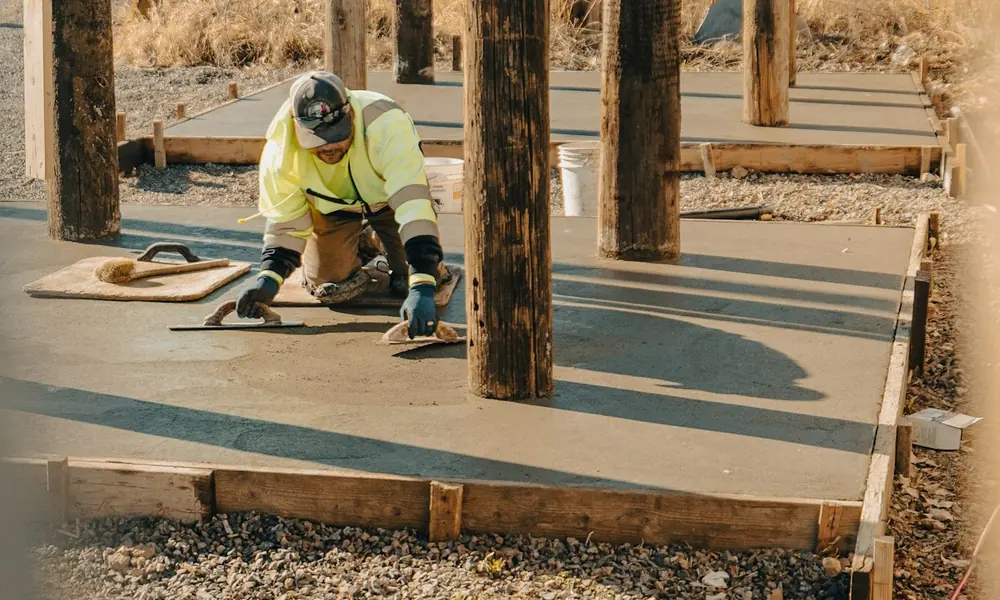
Finishing puts knees and hands in contact with fresh concrete for hours. Its alkalinity damages skin slowly, and the burn often shows up only after the work is done, which is why finishers kneel on boards and wear waterproof knee pads and gloves. Saw cutting control joints the day after the pour throws fine silica dust into the air, so the cut runs wet or through a vacuum shroud, with the operator in a rated respirator.
Cost data note
Every figure on this page is a national planning range for the United States, last updated October 2026. Installed slab work costs $6.00 to $14.00 per square foot at 4 inches, a cubic yard of ready mix costs $140 to $190 before delivery, and a 10 foot stick of #4 rebar runs $7.00 to $14.00. The figures are reviewed every three months. A written local quote always outranks a national range.
Frequently asked questions
How much does a 10 by 10 concrete slab cost?
$1,000 installed at the national typical rate for a 4 inch slab, within a range of $600 to $1,400. Material alone, bought as ready mix with delivery, runs a typical $324.
How much does a 20 by 20 concrete slab cost?
$4,000 typical for a 4 inch slab installed, with a range of $2,400 to $5,600. The slab needs 5.43 cubic yards of concrete with waste.
How much rebar does a 20 by 20 slab need?
573 linear feet of #4 bar on a grid with 18 inch spacing, which comes to 64 sticks of 10 foot rebar after the lap allowance. Typical steel cost is $640.
Does a 6 inch slab cost 50 percent more than a 4 inch slab?
No. The installed price rises by about 20 percent. Concrete volume grows by half, but concrete is only the 40 percent material share of the installed rate, and labor stays nearly flat.
How much concrete does a round slab need?
1.07 cubic yards for a 10 foot diameter circle at 4 inches with 10 percent waste. The circle covers 78.5 square feet, about 79 percent of a 10 by 10 square.
Related calculators
- Concrete volume calculator for slabs, footings, columns and steps for pours that are not a single flat slab
- Concrete cost calculator with material and labor lines for patios, driveways and footings
- Bagged concrete calculator for converting a known volume into bags and pallets
- Footing calculator for the perimeter footing under a garage or shed slab
- Paver count calculator for a patio built from pavers instead of poured concrete
Every concrete tool sits on the concrete calculators hub. Hiring decisions, price factors and contractor questions for slabs are covered in the concrete slab cost guide.