A paver calculator answers the first question on any patio, walkway or driveway job: how many pavers to buy. The count depends on three things, the paved area, the face size of each paver and the laying pattern. A 4 by 8 inch holland stone covers a square foot with 4.50 pieces, while a 12 by 12 inch slab covers it with one. Pattern decides the waste, since every cut at the edge of a herringbone layout scraps part of a paver. Results give the paver count before and after pattern waste, the number of pavers per square foot and a material price range for the pavers, before base, sand and labor.
Pavers to buy, with pattern waste
567 pavers
Before waste: 540 pavers
| Paved area | 120.0 sq ft |
|---|---|
| Pavers per square foot | 4.50 |
| Pattern waste | 5% |
| Area to buy, with waste | 126.0 sq ft |
| Item | Low | Typical | High |
|---|---|---|---|
| Paver stones, material | $378 | $630 | $1,010 |
Planning estimate only, not a contractor quote. Prices are United States national ranges, updated October 2026. How these estimates are built
Reading the paver count
The headline figure is the number to order. It already carries the cut allowance for the chosen pattern: 5 percent for running bond and 15 percent for herringbone. The line underneath is the bare count that would cover the area with no cuts at all, a figure no real job hits.
Pavers per square foot is handy at the yard, where some products are priced per piece and others per square foot or per pallet. The cost table prices the area with waste at $3 to $8 per square foot of paver material, with $5 as the typical figure. A high cost region raises that band to $3.75 to $10.00. The methodology behind every range on the site explains how the region factors and rounding work.
Paver math with the default patio
- Area (sq ft) = length × width
- Pavers per sq ft = 144 ÷ (paver length in inches × paver width in inches)
- Pavers before waste = area × pavers per sq ft, rounded up
- Pavers to buy = area × pavers per sq ft × (1 + pattern waste), rounded up
The 144 converts square inches to square feet. A 4 by 8 inch paver has a 32 square inch face, so 144 ÷ 32 = 4.50 pavers per square foot. The default 12 by 10 foot patio covers 120 square feet and needs 540 pavers before waste. Running bond adds 5 percent, which brings the order to 567. The same patio laid in herringbone needs 621.
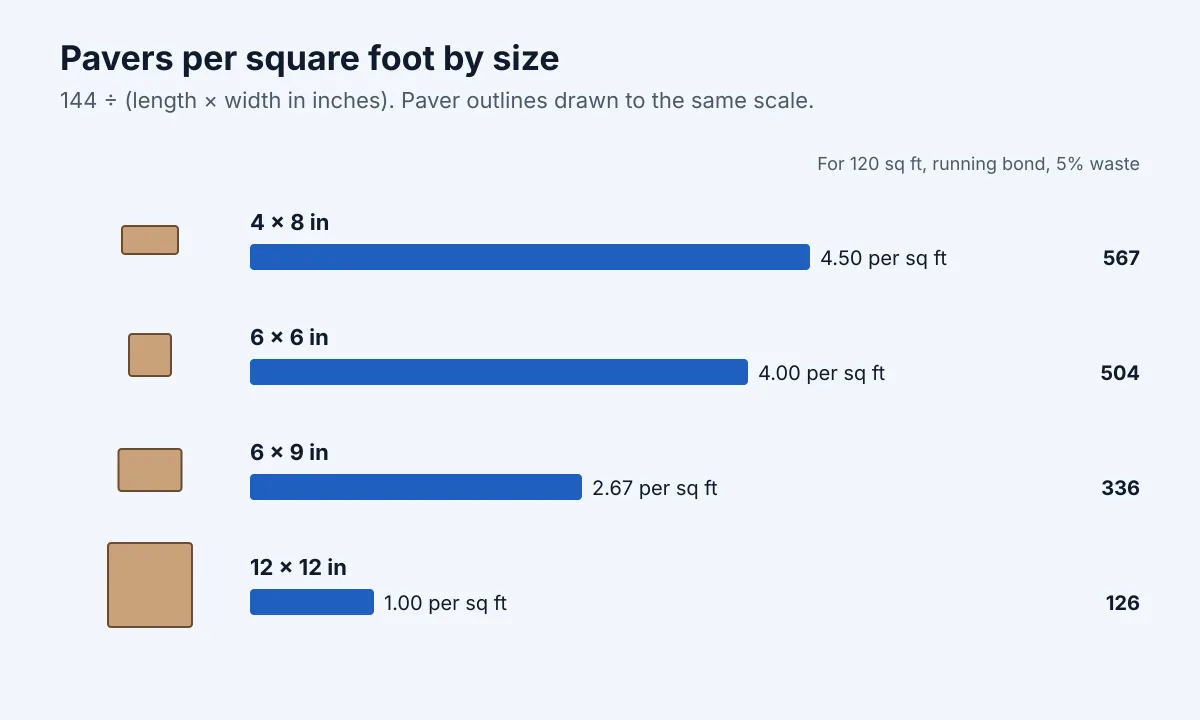
Size changes the piece count far more than the area does. On the same 120 square feet, 6 by 6 inch pavers come to 504 with waste, 6 by 9 inch pavers to 336 and 12 by 12 inch slabs to 126. Material cost per square foot stays in the same band, so the bigger effect of size shows up in labor, since every piece gets placed by hand.
The formula uses the nominal face size and ignores the joint. Most concrete pavers have small spacer bars molded into the sides that hold a narrow joint for sand, so the real coverage per piece runs slightly above the face area and the count leans a little high, a safe direction for an order.
Measuring and ordering, step by step
- The job starts with the outline staked on the ground and measured at the finished edge. Curved beds and L shapes break down into rectangles, and the known area mode accepts the total.
- The paver size comes off the product sheet. Many lines sell a mix of sizes in one bundle, and for those the supplier quotes coverage per pallet instead of a piece count.
- Pattern gets chosen before ordering. Running bond and stack bond keep cuts to two edges, while 45 degree herringbone cuts every edge and needs the larger allowance.
- The excavation depth adds up the paver thickness, the bedding sand and the compacted base. A walkway on a 4 inch base with 1 inch of sand and 2 3/8 inch pavers needs about 7 3/8 inches of digging below finished grade.
- Base gravel and bedding sand get ordered with the pavers. The paver base gravel calculator gives tons of compacted base and the bedding and joint sand calculator covers the sand layer and polymeric joint sand.
- Edge restraints go along every side that does not butt against a wall or slab. Without them, pavers creep outward and joints open.
- The order comes in whole pallets or bundles where possible, with a few spare pavers set aside from the same production run for later repairs.

Worked example: a 16 by 14 foot herringbone patio
A patio off a back door measures 16 by 14 feet. The homeowner picks a 6 by 9 inch paver in a herringbone pattern, with national pricing.
| Output | Result |
|---|---|
| Paved area | 224 sq ft |
| Pavers per square foot | 2.67 |
| Pavers before waste | 598 |
| Pavers to buy, with 15% pattern waste | 687 |
| Area to buy, with waste | 257.6 sq ft |
| Paver material | $773 to $2,060 (typical $1,290) |
Switching the same patio to running bond drops the order to 628 pavers and the typical material figure to $1,180, a saving of the pavers that herringbone loses to cuts. Under the pavers, a 4 inch base over 224 square feet works out to 3.32 cubic yards of gravel to order after compaction, about 4.48 tons.
What moves paver cost
Product line sets the starting price. Plain gray rectangles sit at the bottom of the $3 to $8 band, while tumbled finishes, blended colors and textured slabs push toward the top. Clay brick pavers and natural stone fall outside this band.
Thickness follows the traffic. The Interlocking Concrete Pavement Institute recommends 2 3/8 inch (60 mm) pavers for walks, patios and residential driveways, and 3 1/8 inch (80 mm) pavers for pavements with regular vehicle traffic. Thicker units cost more per square foot and weigh more per pallet.
Pattern costs twice. Herringbone adds pavers to the order, then adds saw time, since nearly every piece along the edge needs an angled cut. It is still the recommended layout for driveways, where it locks pavers against turning tires.

Site work often outweighs the pavers. Removing an old slab, hauling soil, fixing drainage and building steps on a slope all land on top of the material figure. Region applies too, with high cost states at 1.25 times the national range.
Planning scenarios: Basic, Standard and Premium
| Tier | Job | Paver and pattern | Pavers to buy | Paver material, typical |
|---|---|---|---|---|
| Basic | 4 × 36 ft walkway, 144 sq ft | 4 × 8 in, running bond | 681 | $756 |
| Standard | 12 × 16 ft patio, 192 sq ft | 6 × 9 in, running bond | 538 | $1,010 |
| Premium | 16 × 20 ft patio, 320 sq ft | 4 × 8 in, herringbone | 1,656 | $1,840 |
The Basic walkway uses the smallest common paver and the simplest pattern, so its 681 pieces go down quickly once the base is right. The Standard patio covers more ground with fewer pieces thanks to the larger face. The Premium patio needs 1,656 small pavers in herringbone, a count that reflects both the size and the 15 percent cut allowance, with a material range of $1,100 to $2,940.
Paver buying notes
- Pallets of the same color can vary between production runs. Pulling pavers from several pallets at once blends the color across the patio.
- Coverage per pallet differs by product line and thickness. The supplier sheet lists it in square feet, which turns the area with waste into a pallet count.
- Delivery is usually by boom or forklift truck. Pallets set on a lawn can leave ruts, so a driveway drop point saves repairs.
- Edge restraint, geotextile fabric where the design calls for it, and spikes are bought by the linear foot of open edge.
- A wet saw or a block splitter rents by the day. Herringbone jobs justify the saw.
- Extra pavers from the original order make later repairs match. Many installers keep half a bundle.
Paver patio quote checklist
- Paver brand, product line, thickness and color named on the quote
- Laying pattern and border course, since herringbone and soldier borders add cutting
- Excavation depth and disposal of soil, sod and old paving
- Base material, compacted depth and the number of compaction passes
- Edge restraint type along every open side
- Joint sand type, polymeric or plain, and whether sealing is included
- Slope and drainage plan that keeps water away from the house
- Payment schedule and a written warranty on settling and heaving
Costs outside this estimate
- Excavation, soil removal and disposal
- Compacted gravel base and bedding sand
- Polymeric or regular joint sand
- Edge restraints and spikes
- Installation labor, saw and compactor rental
- Drainage, steps, walls, sealing and permits
When a hardscape contractor is the better call
Driveways carry far more load than patios. ICPI guidance puts the aggregate base for driveways at 6 to 8 inches, against 4 to 6 inches for walks, and a vehicle on a thin base leaves ruts within a season. Clay soils and wet sites can need even more.
Grade and water decide whether a patio lasts. Pavers need a slope away from the house so water drains off, and a patio built level against a foundation can push water toward the basement. A contractor can also set a plate compactor heavy enough for the base depth.
Digging is the hidden hazard. A call to 811 before excavation marks buried gas, power and water lines, and a plate compactor and wet saw both need hearing protection, eye protection and, for the saw, dust control, since cutting concrete releases silica dust. Sealing pavers after installation is covered in the paver sealing cost guide.
Cost data note
Paver material prices reflect national planning figures for October 2026: $3 to $8 per square foot, $5 typical. The site reviews every price every three months. Pattern waste allowances of 5 and 15 percent are planning values, and paver thickness and base guidance follow ICPI Tech Spec 10. Local supplier prices for a specific product come first.
Frequently asked questions
How many pavers per square foot?
4.50 for 4 by 8 inch pavers. The figure is 144 divided by the face area in square inches, so a 6 by 9 inch paver gives 2.67 per square foot and a 12 by 12 inch paver gives exactly 1.
How many pavers for a 10 by 10 patio?
473 pavers of 4 by 8 inches in running bond, including 5 percent waste. Without waste the 100 square feet need 450. With 12 by 12 inch pavers the same patio needs 105.
How much extra paver should be ordered for herringbone?
15 percent above the bare count. A 45 degree herringbone cuts pavers along every edge, against 5 percent for running bond, where cuts fall on two edges.
How thick should patio pavers be?
2 3/8 inches, or 60 mm, for patios, walks and residential driveways. ICPI recommends 3 1/8 inch pavers where vehicles drive on the surface regularly.
Does the paver count include base and sand?
No. The count covers the pavers only. Compacted gravel base, bedding sand and joint sand come from their own calculators, and a typical patio needs all three.
Related calculators
- Gravel base calculator for pavers for tons of compacted base under the patio
- Paver sand calculator for the bedding layer and polymeric joint sand
- Concrete slab calculator for comparing a poured patio in the same footprint
- Installed concrete cost estimator to price a concrete patio against pavers
- Brick calculator for a brick border or seat wall beside the patio
The full set of paving tools sits on the paver calculators hub. What a crew charges to build the whole patio, base and labor included, is set out in the paver installation cost guide.