A concrete bag calculator answers the store aisle question: how many bags of premixed concrete a job takes. It accepts slab dimensions or a volume already worked out elsewhere, in cubic yards, cubic feet or cubic meters. The result gives the bag count for the chosen size with waste included, the total weight in pounds and tons, the number of pallets for 80 lb orders and a Low, Typical and High price for the bags. Bag size changes the count more than most buyers expect. A 100 square foot slab poured 4 inches deep calls for 62 of the 80 lb size, 82 of the 60 lb size and 123 of the 40 lb size.
Bags to buy, with waste
62 bags
Volume with waste: 36.67 cu ft (1.36 cu yd)
| Volume before waste | 33.33 cu ft |
|---|---|
| Total bag weight | 4,960 lb |
| Total weight in tons | 2.48 tons |
| Pallets of 80 lb bags | 2 pallets |
| Item | Low | Typical | High |
|---|---|---|---|
| 80 lb bags | $310 | $403 | $496 |
Planning estimate only, not a contractor quote. Prices are United States national ranges, updated October 2026. How these estimates are built
What each result line tells a buyer
The bag count is the number to put in the cart. It already includes the waste allowance from the menu, and it rounds up, since a store sells whole bags only. The line under it shows the volume those bags will produce once mixed.
Weight matters for hauling. Every 80 lb bag adds 80 lb to a truck bed or a cart, so a modest order adds up to a load that a car cannot carry and a small pickup struggles with. The tons figure makes that comparison easier against a vehicle payload rating printed on the door jamb sticker.
The pallet line appears for 80 lb bags only. A standard pallet holds 42 bags, or 3,360 lb, and stores often price and deliver full pallets differently from loose bags. The cost row multiplies the bag count by a national shelf price range for the chosen size, scaled by the region menu. The estimate method page lists what each price includes.
How the bag count is calculated
The math has four short steps. Volume comes first, either typed in or calculated as length × width × thickness ÷ 12 in cubic feet. A volume in cubic yards gets multiplied by 27, and a volume in cubic meters gets divided by 0.0283 to reach cubic feet. The waste percentage then raises that volume. Finally, the volume with waste is divided by the yield of one bag and rounded up.
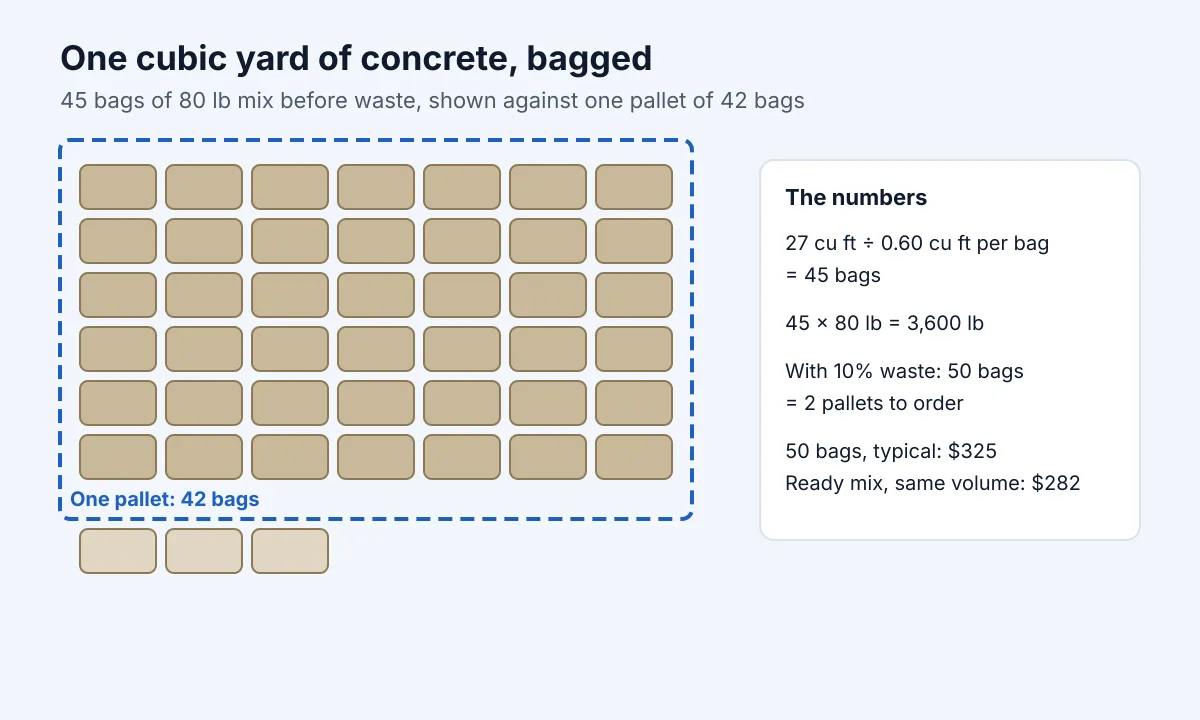
- 80 lb bag: 0.60 cubic feet of mixed concrete, so 45 bags fill one cubic yard
- 60 lb bag: 0.45 cubic feet, so 60 bags fill one cubic yard
- 40 lb bag: 0.30 cubic feet, so 90 bags fill one cubic yard
These yields come from the published data sheet for standard concrete mix, and Quikrete and Sakrete both list 0.60 cubic feet for the 80 lb bag. Weight is the bag count times the bag size, and tons are pounds divided by 2,000. Pallets equal the 80 lb bag count divided by 42, rounded up.

For one cubic yard ordered with 10 percent waste, the volume becomes 29.7 cubic feet. Divided by 0.60, that is 49.5 bags, which rounds up to 50. Those bags weigh 4,000 lb and fill 2 pallets, one full and one partial.
Putting the bag count to work
- The volume gets confirmed before shopping. For anything other than a flat slab, the Concrete Calculator on this site handles footings, columns, steps and curbs, and its cubic yard figure drops straight into the known volume setting here.
- Bag size follows the job. Large 80 lb bags give the lowest cost per cubic foot, while 40 lb bags suit a single person, a long carry or a spot with no wheelbarrow access.
- Hauling gets planned around weight. A store delivery fee often costs less than several trips with an overloaded vehicle.
- Mixing water follows the manufacturer chart. The Quikrete Concrete Mix data sheet calls for about 6 to 9 pints of water per 80 lb bag, 4 to 7 pints per 60 lb bag and 3 to 4.5 pints per 40 lb bag. Extra water makes placing easier and the cured concrete weaker.
- Batches stay small enough to place before they stiffen. A wheelbarrow and hoe handle one or two bags at a time, and a rented drum mixer handles several.
- Curing starts as soon as the surface can take it. The same data sheet calls for about 5 days of moist curing in warm weather and 7 days in cooler weather between 50°F and 70°F, with protection from freezing for the first 48 hours.

Worked example: three quarters of a cubic yard
A set of post footings and a small landing add up to 0.75 cubic yards, worked out with the main concrete calculator. That volume goes into the known volume setting with 80 lb bags, 10 percent waste and the national average region.
| Output | Result |
|---|---|
| Volume before waste | 20.25 cu ft |
| Volume with waste | 22.28 cu ft |
| 80 lb bags | 38 |
| Total weight | 3,040 lb (1.52 tons) |
| Pallets | 1 |
| Bag cost | $190 to $304 (typical $247) |
Switching the bag size shows the tradeoff. The same volume needs 50 bags of 60 lb mix at a typical $275, or 75 bags of 40 lb mix at a typical $338. Total weight barely moves (3,040 lb, 3,000 lb and 3,000 lb), but the cost and the number of bags to open climb with every step down in size.
What changes the price of bagged concrete
Bag size sets the unit cost. At typical shelf prices, concrete from 80 lb bags costs $10.83 per cubic foot, from 60 lb bags $12.22 and from 40 lb bags $15.00. That makes the smallest bag 38 percent more expensive for the same amount of concrete.
Mix type is the second lever. High strength, fast setting and crack resistant mixes sit on the same shelf at higher prices and different yields, and this tool prices standard concrete mix only. Region shifts the shelf price as well, by 15 percent below the national figure in low cost states and 25 percent above it in high cost states.
Volume itself changes the best buying route. Past a pour of 0.69 cubic yards before waste (0.76 cubic yards ordered with 10 percent waste), typical national prices favor a ready mix truck over 80 lb bags, delivery fee included, and the concrete volume and ready mix comparison tool prices both routes side by side.
Planning scenarios: Basic, Standard and Premium
| Scenario | Job | Bags | Weight | Pallets | Typical cost |
|---|---|---|---|---|---|
| Basic | 3 × 3 ft pad, 4 in, 60 lb bags | 8 | 480 lb | none | $44 |
| Standard | 10 × 10 ft slab, 4 in, 80 lb bags | 62 | 4,960 lb | 2 | $403 |
| Premium | 1.5 cu yd known volume, 80 lb bags | 75 | 6,000 lb | 2 | $488 |
The Basic pad is a single session of wheelbarrow mixing at 8 bags. The Standard slab needs a pallet and a half, which most buyers have delivered. The Premium order of 75 bags is a real mixing job, and at that size a ready mix quote deserves a phone call before any bags get loaded.
Buying and storage notes
- Torn or hardened bags have absorbed moisture. A bag that feels lumpy through the paper produces weak concrete and goes back on the shelf.
- Stored bags sit on a pallet or boards, off a concrete floor, under a tarp or indoors.
- Concrete mix, mortar mix and sand mix look alike on the shelf. Only concrete mix contains the gravel that gives a slab or footing its strength.
- One or two spare bags cost little compared with a short pour that leaves a cold joint.
- Many stores take back unopened bags with a receipt, which makes the spare bag a low risk purchase.
Quote checklist for a hand mixed pour
- Bag size and mix type named, such as 80 lb general purpose or high early strength
- Mixer rental, generator or power source and who cleans the drum afterward
- Number of workers on site, since a bag pour depends on steady mixing and placing
- Haul and stacking of bags at the work area, especially for a backyard with no truck access
- Cold joints between batches and how the crew prevents them on a larger pour
- Curing blankets or water for the first days, and protection from rain or frost
- Disposal of empty bags, leftover mix and rinse water
- Price per bag versus a flat job price, so a change in quantity is easy to settle
What the bag estimate leaves out
- Water, tools, a wheelbarrow and any mixer rental
- Store delivery fees and pallet charges
- Forms, gravel base, rebar or mesh
- Specialty mixes such as fast setting or high strength concrete
- Labor for mixing, placing and finishing
When hiring help makes sense
Hand mixing has a practical ceiling. Every bag gets lifted at least twice and mixed by hand or machine before the batch ahead of it sets, and a crew that falls behind ends up with cold joints between batches. Orders past a cubic yard are usually a better fit for a ready mix truck and a hired finisher.
Structural work follows code no matter how the concrete arrives. Footings for decks, additions and garages usually need a permit, a depth below the local frost line and an inspection before the pour.
The bags themselves carry health warnings. Dry mix releases dust containing crystalline silica when bags are opened and dumped, so a dust mask rated for fine particles and an outdoor mixing spot cut exposure. Once water goes in, the mix becomes strongly alkaline, and long contact through wet gloves or kneeling on fresh concrete causes burns that show up hours later. A bag at 80 lb is also a lifting hazard, and many buyers choose 60 lb bags to protect their backs at a modest cost premium.
Cost data note
The bag prices used here are national planning figures for the United States as of October 2026: an 80 lb bag at $5.00 to $8.00, a 60 lb bag at $4.50 to $7.00 and a 40 lb bag at $4.00 to $6.00. Bag yields and mixing water follow the Quikrete Concrete Mix 1101 data sheet. Prices get reviewed every three months, and a local store price always wins over a national range.
Frequently asked questions
How many square feet does an 80 lb bag of concrete cover?
1.80 square feet at 4 inches thick, because one bag mixes to 0.60 cubic feet. At the same depth a 60 lb bag spreads over 1.35 square feet and a 40 lb bag over 0.90 square feet.
How many bags of concrete in a yard?
It takes 45 of the 80 lb bags. The 60 lb size needs 60 and the 40 lb size needs 90, all counted before waste. Adding 10 percent for waste brings the 80 lb count to 50.
How many 60 lb bags are needed for a 10 by 10 slab?
82 bags at a depth of 4 inches, waste included. That slab contains 33.33 cubic feet of concrete, and every 60 lb bag mixes to 0.45 cubic feet.
How much does a pallet of 80 lb concrete bags weigh?
3,360 lb for 42 bags, before the weight of the pallet itself. That load is more than most pickups can carry in a single trip.
How much water goes into an 80 lb bag of concrete?
About 6 to 9 pints, according to the Quikrete Concrete Mix data sheet. The lower end gives stronger concrete, and water beyond the upper end weakens the cured slab.
Related calculators
- Concrete calculator for footings, columns, steps and curbs for volumes that are not a simple slab
- Slab calculator with installed cost and rebar for pricing a hired slab job
- Footing and pier calculator for post holes and strip footings
- Concrete cost estimator for material and labor on patios, driveways and footings
- Mortar bag calculator for block and brick work, where mortar mix replaces concrete mix
All concrete tools are grouped on the concrete calculator hub. The concrete cost per yard guide compares bagged and ready mix pricing from the buyer side.