By Muhammad Awais. Prices reviewed October 2026.
A concrete slab costs $6 to $14 per square foot installed in the United States, with $10 as the typical national price for a 4 inch slab with a plain broom finish. That rate covers concrete, forms, finishing and labor on a prepared site. A 20 by 20 foot slab therefore runs $2,400 to $5,600. Thicker slabs, decorative finishes and high cost regions push the number up, while simple jobs in lower cost states land near the bottom of the range.
| Slab size, 4 in, basic finish | Common use | Low | Typical | High | Decorative, typical |
|---|---|---|---|---|---|
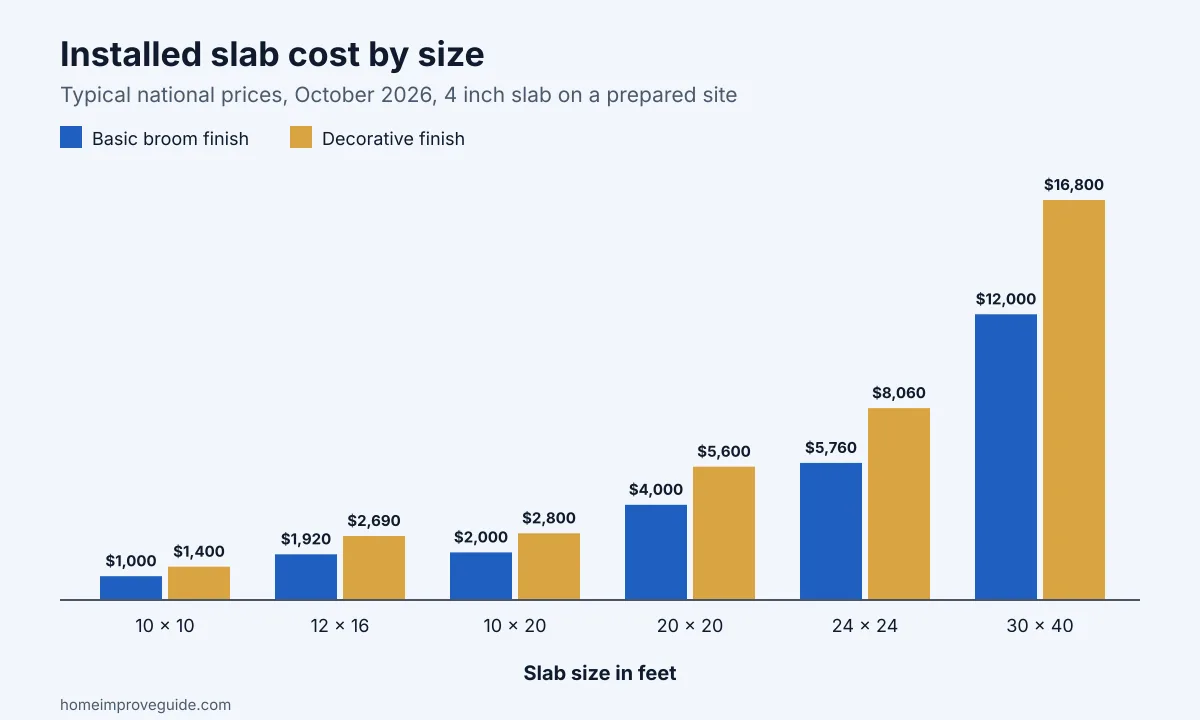
| 10 × 10 ft (100 sq ft) | Shed pad or small patio | $600 | $1,000 | $1,400 | $1,400 |
| 12 × 16 ft (192 sq ft) | Patio | $1,150 | $1,920 | $2,690 | $2,690 |
| 10 × 20 ft (200 sq ft) | Walk up pad or hot tub base | $1,200 | $2,000 | $2,800 | $2,800 |
| 20 × 20 ft (400 sq ft) | Large patio or one car pad | $2,400 | $4,000 | $5,600 | $5,600 |
| 24 × 24 ft (576 sq ft) | Two car garage floor | $3,460 | $5,760 | $8,060 | $8,060 |
| 30 × 40 ft (1,200 sq ft) | Workshop or pole barn floor | $7,200 | $12,000 | $16,800 | $16,800 |
Price per square foot by thickness and finish
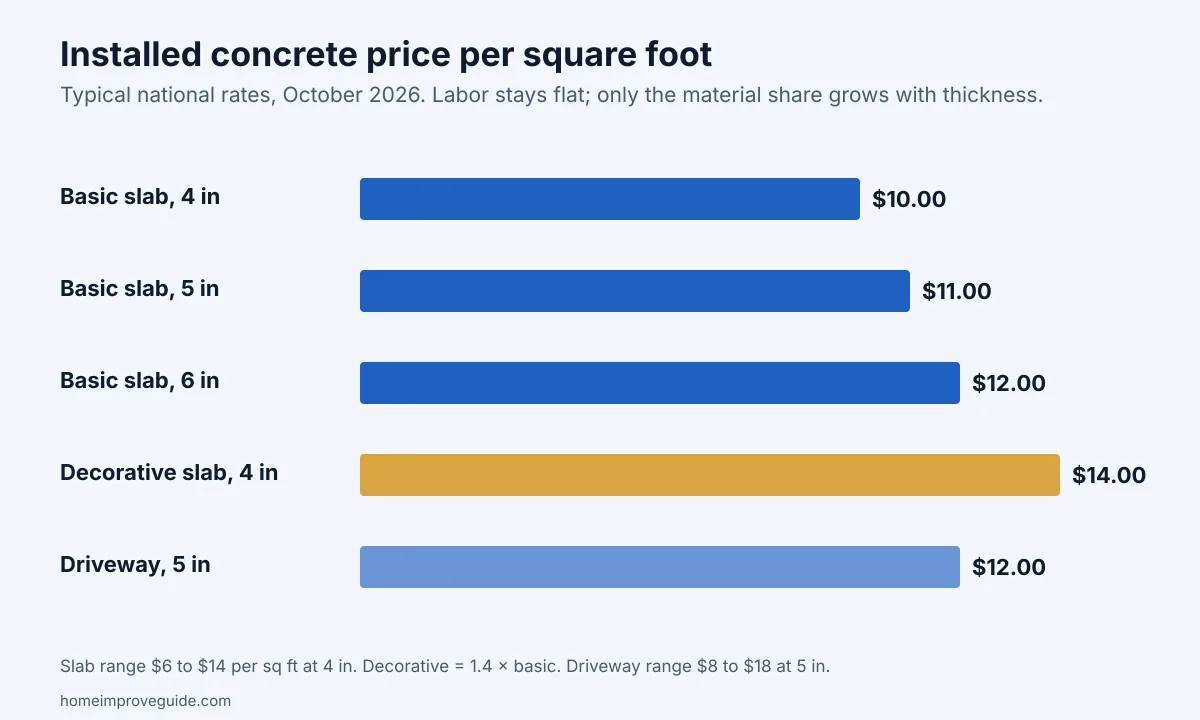
Thickness changes the material, not the crew. On this site about 40 percent of an installed slab price is material and 60 percent is labor, and only the material share scales with depth. A typical 4 inch slab costs $10.00 a square foot, a 5 inch slab $11.00, a 6 inch slab $12.00 and an 8 inch slab $14.00. Stamped, colored and exposed aggregate finishes sit in a decorative tier at 1.4 times the basic price, or $14.00 per square foot typical at 4 inches. Driveways carry their own rate of $8 to $18 per square foot at a 5 inch base, since they need heavier base work and more joints.
Estimating a slab with real measurements
The slab calculator below works out the volume, the bag or truck order, an optional rebar grid and the installed price split into material and labor. Square and round slabs both work, and the region menu applies the state cost level.
Concrete to order, with waste
1.36 cu yd
Before waste: 1.23 cu yd (33.33 cu ft)
| Slab area | 100.0 sq ft |
|---|---|
| Volume with waste | 36.67 cu ft |
| 80 lb bags | 62 bags |
| 60 lb bags | 82 bags |
| 40 lb bags | 123 bags |
| Item | Low | Typical | High |
|---|---|---|---|
| Ready mix concrete with delivery | $250 | $324 | $408 |
| 80 lb bags | $310 | $403 | $496 |
| 60 lb bags | $369 | $451 | $574 |
| 40 lb bags | $492 | $554 | $738 |
| Installed slab, material share | $240 | $400 | $560 |
| Installed slab, labor share | $360 | $600 | $840 |
| Installed slab, total | $600 | $1,000 | $1,400 |
Planning estimate only, not a contractor quote. Prices are United States national ranges, updated October 2026. How these estimates are built
Cost factors that raise or lower a slab price
- Thickness: each extra inch over 4 adds about 10 percent to the installed price. A 20 by 20 foot slab at 6 inches runs a typical $4,800, against $4,000 at 4 inches.
- Finish: decorative work adds 40 percent. The same 20 by 20 slab with a stamped or colored surface runs about $5,600 typical.
- Region: lower cost states come in about 15 percent under the national price, and high cost states about 25 percent over it.
- Reinforcement: a #4 rebar grid at 18 inch spacing under a 20 by 20 slab takes 64 ten foot sticks, about $448 to $896 in steel before the labor to tie it.
- Gravel base: a 4 inch compacted base under the same slab needs about 8.0 tons of gravel once the 1.2 compaction factor is applied, or $240 to $520 in material.
- Site work: removing an old slab, cutting a slope or hauling soil adds a separate charge that no per square foot rate captures, and it often decides whether a bid sits in the Low or the High column.
- Access: a backyard that a mixer cannot reach needs a pump or a crew with wheelbarrows, and either one adds hours to the bill.
Where the money goes on a 20 by 20 slab
At the typical rate, a 4 inch slab of 400 square feet splits into $1,600 of material and $2,400 of labor. Pouring it 6 inches thick raises the material share to $2,400 while the labor stays at $2,400. The concrete alone for the 4 inch version comes to 5.43 cubic yards with a 10 percent allowance, a typical $996 delivered by truck. The rest of the material share pays for forms, base, joint material and the finishing supplies.
Contractor or owner built
An owner who forms, pours and finishes a slab without a contractor pays for material and equipment and keeps the labor share. On a 20 by 20 slab that share is about $2,400 at typical rates. The concrete itself would cost a typical $996 by truck, or $1,590 for the 245 bags of 80 lb mix the same volume needs. Bags at that size mean many hours of mixing and a real risk of cold joints between batches.
The skill gap shows up in the finish. Screeding a slab flat, floating it at the right time and cutting joints before random cracks form takes practice, and mistakes stay in the concrete for decades. Small pads for a shed, a grill or an air conditioner suit a first project. Garage floors, patios against a house and anything larger than a single truckload are where a finishing crew earns its fee.

Mistakes that cost money later
- Skipping the base: concrete poured on soft or wet soil settles and cracks, and the repair usually means breaking out the slab and starting over.
- Thin edges: a slab that tapers at its edges cracks first where wheels and furniture load it. A thickened edge costs a little more concrete and saves a corner.
- Too few control joints: concrete shrinks as it cures. Joints placed too far apart leave the slab to crack wherever it chooses.
- No slope: a patio that drains toward the house sends water against the foundation. A slight fall away from the wall belongs in the forms before the truck arrives.
- Rushing the cure: a slab that dries in hot wind loses strength at the surface and dusts or scales within a few winters.
Concrete slab quote checklist
Bids for the same slab can vary widely because each contractor includes different work. Lining up two or three bids against these points shows what each price actually buys.
- Square footage measured on site and matched to the plan, not estimated from a photo
- Edge thickening at the perimeter and under any post or column load
- Vapor barrier under slabs that will sit inside a heated garage or shop
- Isolation joints where the slab meets the house, steps or existing concrete
- Drainage slope direction and amount written on the bid
- Form removal, backfill along the edges and lawn repair after the trucks leave
- Where the crew washes out tools and chutes, and who cleans up the spill
- How the warranty treats hairline shrinkage cracks against structural cracks
- Whether sealing is included, and when the first coat goes on
When a licensed contractor is needed
A slab that supports a structure, such as a garage, a workshop or a home addition, normally needs a permit, a footing design that meets the local frost depth and an inspection before the pour. Many towns also require a permit for a driveway apron that meets the street. A licensed concrete contractor carries insurance for the crew and the trucks on the property and handles those inspections. Wet concrete burns skin, and saw cutting joints raises silica dust, so the trade relies on gloves, boots, eye protection and water on the blade.
Cost data note
Every slab figure here reflects October 2026 national pricing, with a fresh review on a 3 month cycle. The ranges assume a prepared site with clear access. Removal of old concrete, excavation and permits sit outside the ranges, and the methodology page explains the thickness factor and the region adjustment used here.
Frequently asked questions
What is the installed price of a 20 by 20 slab?
A 20 by 20 foot slab at 4 inches costs $2,400 to $5,600 installed, with $4,000 typical for a broom finish. A decorative finish raises the typical figure to about $5,600.
What should a two car garage slab cost?
A 24 by 24 foot slab at 4 inches runs $3,460 to $8,060, with $5,760 typical. Garage floors often need a permit, a thickened edge and a vapor barrier, and those items belong on the written bid.
Is a 6 inch slab much more expensive than a 4 inch slab?
The thicker pour costs about 20 percent more. The concrete volume grows by half, but labor stays about the same, so the installed price moves from $10.00 to $12.00 per square foot typical.
What does a 10 by 10 concrete pad cost installed?
A 10 by 10 foot pad costs $600 to $1,400 installed, with $1,000 typical. Small pads often carry a minimum charge, so the price per square foot can run higher than on a large slab.
Does rebar add much to a slab price?
Rebar adds $448 to $896 in steel for a 20 by 20 slab on an 18 inch grid, about 64 sticks of #4 bar. Labor to cut, tie and support the grid comes on top, and some contractors use wire mesh or fiber in its place.
Related calculators and guides
The concrete slab calculator sizes the pour and the rebar, and the concrete cost calculator prices patios, driveways and footings as well. All concrete tools are on the concrete calculators page. The guide to concrete cost per yard covers material prices on their own, and the guides to foundation costs and sidewalk replacement cover related work. Every guide is listed on the cost guides page.