A concrete cost calculator prices a hired concrete job, labor included, and splits the answer into material, labor and total. It covers four project types: slabs, patios, driveways and strip footings. Flat work is priced per square foot with a thickness factor and an optional decorative finish. Footings are priced two ways at once, with material by the cubic yard and labor by the linear foot. Every figure appears as a Low, Typical and High range, scaled by a regional factor, because two honest quotes for the same driveway can sit thousands of dollars apart. The range shows where a fair bid should land.
Estimated installed cost
$600 to $1,400
Typical $1,000
| Area | 100.0 sq ft |
|---|---|
| Thickness factor | ×1.00 |
| Finish factor | ×1.00 |
| Item | Low | Typical | High |
|---|---|---|---|
| Material | $240 | $400 | $560 |
| Labor | $360 | $600 | $840 |
| Total | $600 | $1,000 | $1,400 |
Planning estimate only, not a contractor quote. Prices are United States national ranges, updated October 2026. How these estimates are built
Reading the installed cost
The large range at the top is the total installed cost, with the typical figure under it. The table breaks that total into a material line and a labor line, each with its own range. On flat work the split follows a fixed share of the installed rate: 40 percent material and 60 percent labor at the base thickness. On footings the two lines come from separate rates, so their proportions shift with the size of the footing.
The quantity lines explain the math. For slabs, patios and driveways they show the area, the thickness factor and the finish factor. For footings they show the length and the concrete volume before and after waste. The region menu moves every line by the same multiplier: 0.85 in lower cost states, 1.00 at the national average and 1.25 in high cost states. The five step estimating method covers how base rates, scope and region combine.
Rates and formulas behind each project type
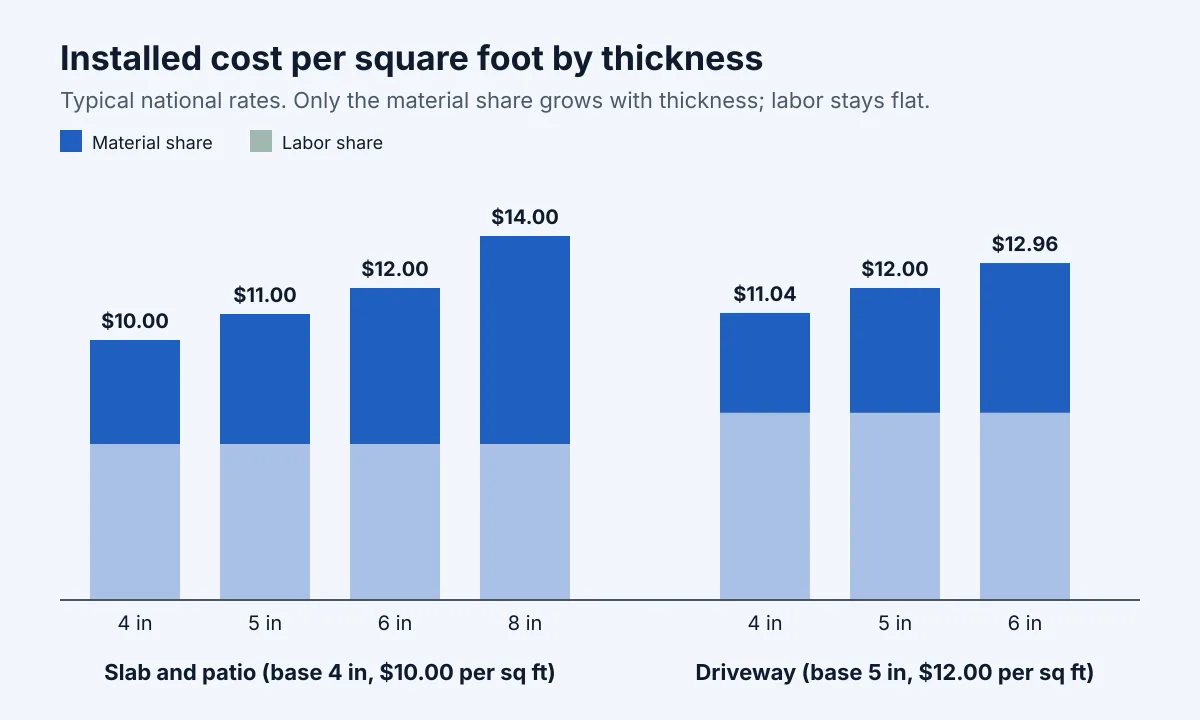
Slabs and patios share one installed rate, typical $10.00 a square foot within a band of $6.00 to $14.00, at a 4 inch base thickness. Driveways carry their own rate of $8.00 to $18.00, typical $12.00, at a 5 inch base thickness, reflecting heavier subgrade work, wider pours and the reinforcement vehicles call for.
- Thickness factor, slab or patio = 0.60 + 0.40 × (thickness ÷ 4)
- Thickness factor, driveway = 0.60 + 0.40 × (thickness ÷ 5)
- Flat work cost = area × base rate × thickness factor × finish factor × region
- Footing material = cubic yards with waste × ready mix rate + delivery fee
- Footing labor = footing length × labor rate per linear foot
Those factors produce a predictable ladder. A slab or patio sits at 1.00 at 4 inches, 1.10 at 5, 1.20 at 6 and 1.40 at 8. A driveway sits at 0.92 at 4 inches, 1.00 at 5 and 1.08 at 6. A decorative finish multiplies the flat work rate by 1.4, adding 40 percent for stamping, color or exposed aggregate.
On a ten by ten slab at the 4 inch base with a basic finish, the material line comes to $240 to $560 (typical $400), the labor line to $360 to $840 (typical $600) and the total to $600 to $1,400 (typical $1,000).
Footings work differently. A strip footing 40 feet long, 16 inches wide and 8 inches deep holds 1.32 cubic yards, or 1.45 with 10 percent waste. That volume at the ready mix rate plus one delivery fee gives the material line, typical $339. The labor line is simply 40 feet at $14.00 per foot, typical $560.

Using the estimate when collecting bids
- The process starts with the project type and the finished size, measured at the outside edge of the planned concrete.
- Thickness follows the use: foot traffic, light vehicles or heavier loads. The estimate updates the price as soon as the thickness menu changes.
- The finish setting stays on Basic unless the plan calls for stamping, integral color or an exposed aggregate surface.
- The region setting matches the state of the project. High and low cost state lists appear right under the menu.
- The resulting range goes into the first conversation with contractors. A bid inside the range needs only the checklist below. A bid far outside it gets a question about scope before a question about price.
- Footing estimates feed the larger budget for a wall, addition or garage, where the footing is one line among many.
Worked example: a 20 by 24 foot driveway
A two car driveway measures 20 by 24 feet, planned at the 5 inch driveway baseline with a broom finish, at national pricing.
| Output | Result |
|---|---|
| Area | 480 sq ft |
| Thickness factor | ×1.00 |
| Material | $1,540 to $3,460 (typical $2,300) |
| Labor | $2,300 to $5,180 (typical $3,460) |
| Total installed | $3,840 to $8,640 (typical $5,760) |
The typical bid lands near $5,760. Raising the thickness to 6 inches moves the typical total to $6,220. Switching to a stamped decorative finish at 5 inches lifts it to $8,060, inside a range of $5,380 to $12,100. Location matters as much as finish: the same driveway prices at a typical $7,200 in a high cost state and $4,900 in a low cost state.
What pushes concrete prices up or down
Access and demolition top the list of hidden costs. A driveway that replaces an old one pays for breakout and haul away, and a backyard patio with no truck access may need a pump or a long run of wheelbarrows. Neither shows in a per square foot rate until a contractor walks the site.
Subgrade decides how long a slab lasts and how much prep it needs. Soft clay, fill soil and poor drainage call for more excavation and a thicker gravel base. A low bid that skips this step often explains itself a few winters later as cracking.
Finish and reinforcement are the visible upgrades. Stamped patterns, color and exposed aggregate carry the 1.4 times multiplier here, and rebar or fiber adds steel or a per yard charge. Saw cut control joints, sealing and cure compounds show up as separate lines on detailed bids.
Season and demand move the rest. Spring and early summer fill concrete crews quickly, and late season pours in cold regions may need blankets or heated water that push quotes toward the High column.
Planning scenarios: Basic, Standard and Premium
| Scenario | Project | Material, typical | Labor, typical | Total, typical | Total range |
|---|---|---|---|---|---|
| Basic | 10 × 12 ft patio, 4 in, broom finish | $480 | $720 | $1,200 | $720 to $1,680 |
| Standard | 12 × 40 ft single lane driveway, 5 in | $2,300 | $3,460 | $5,760 | $3,840 to $8,640 |
| Premium | 16 × 20 ft stamped patio, 5 in | $2,240 | $2,690 | $4,930 | $2,960 to $6,900 |
The Basic patio is the kind of job many crews fit into a single morning pour. The Standard driveway is a full day with a truck or two of concrete and a crew of several. The Premium stamped patio costs more than the driveway despite covering less ground, because the decorative factor and the thicker slab stack on the same square footage.
Quote checklist
- Thickness, mix strength and reinforcement written into the bid
- Base material, base depth and compaction method
- Demolition, haul away and any grading included or excluded
- Finish type and joint spacing, with joints tooled by hand or cut by saw
- Curing method and whether sealing is part of the price
- Permit, inspection and who schedules them
- Payment schedule, start date and a written warranty on workmanship
- For footings: depth below frost line, rebar size and inspection before the pour
What the estimate excludes
- Removal of existing concrete, asphalt or pavers
- Excavation beyond normal base preparation, and soil haul away
- Rebar on flat work, which the Concrete Slab Calculator prices separately
- Pump truck time and access equipment
- Permits, engineering and surveys
- Sealers, heating cables, drains and edging
- Formwork and reinforcement for footings beyond the concrete and placing labor
When a licensed contractor is required
Driveway aprons that meet a public sidewalk or street, garage slabs and any footing under a structure usually need a permit. Many cities set their own thickness, joint and slope rules for the section inside the right of way, and an inspector may check forms and reinforcement before the truck arrives.
Footings carry the most risk. Depth below the local frost line, the size and placement of rebar and the bearing capacity of the soil all come from the building code or an engineer, and a footing that fails inspection gets removed before anything sits on it.
Concrete work itself has hazards that drive the labor rate. Crews handle wet concrete, which burns skin on long contact, run saws that throw silica dust, and work around trucks and pumps backing onto the site. Licensed contractors carry the insurance that covers those risks, which is part of what a quote pays for.
Cost data note
Rates on this page are United States national planning ranges as of October 2026: slabs and patios at $6.00 to $14.00 a square foot, driveways at $8.00 to $18.00 a square foot, $140 to $190 per cubic yard of ready mix plus a $60 to $150 delivery fee, and $9.00 to $20.00 per linear foot of footing labor. All rates go through a review every three months. Written local bids always override these planning ranges.
Frequently asked questions
How much does a 12 by 12 concrete patio cost?
$1,440 typical for a 4 inch patio with a broom finish, within a range of $864 to $2,020. A decorative finish raises every figure by 40 percent.
How much does a concrete driveway cost per square foot?
$12.00 typical at 5 inches thick, within $8.00 to $18.00. At 4 inches the typical rate falls to $11.04, and at 6 inches it rises to $12.96.
How much does a 24 by 24 garage slab cost?
$6,910 typical for a 6 inch slab, within $4,150 to $9,680, before rebar, demolition or a vapor barrier.
How much do concrete footings cost per linear foot?
Labor alone runs $9.00 to $20.00 per linear foot. A 40 foot footing, 16 inches wide and 8 inches deep, totals a typical $899 once concrete is added, and labor makes up about 62 percent of that.
Why does a stamped patio cost more than a plain one?
Stamping, coloring and sealing take extra crew time and materials, which this tool reflects with a 1.4 times finish factor on the installed rate.
Related calculators
- Slab volume, rebar and installed cost calculator for slabs that need a reinforcement count
- Concrete volume calculator for cubic yards and bags on any shape
- Footing and pier volume calculator for detailed footing quantities
- Bagged concrete counter for small jobs done without a truck
- Paver calculator for a patio priced in pavers instead of poured concrete
The concrete calculators hub lists every concrete tool. For the buyer view of ready mix prices, the concrete cost per yard guide pairs with this calculator, and the concrete foundation cost guide covers footings and foundations as hired work. Published per square foot prices, set beside this calculator’s rate, are compared in the concrete cost per square foot guide.