A concrete footing calculator works out how much concrete goes under a wall, a shed, a deck or a garage. It handles two shapes: continuous strip footings that follow the line of a wall, and round piers poured in tube forms or augered holes. Strip footings come in standard widths of 12, 16 and 24 inches and depths of 8 and 12 inches. Piers take any diameter, depth and count. Each result gives the cubic yards to order with waste, the bag count for three bag sizes and a material cost range for ready mix against bagged mix, before any placing labor.
Concrete to order, with waste
1.45 cu yd
Before waste: 1.32 cu yd (35.56 cu ft)
| Volume with waste | 39.11 cu ft |
|---|---|
| 80 lb bags | 66 bags |
| 60 lb bags | 87 bags |
| 40 lb bags | 131 bags |
| Item | Low | Typical | High |
|---|---|---|---|
| Ready mix concrete with delivery | $263 | $339 | $425 |
| 80 lb bags | $330 | $429 | $528 |
| 60 lb bags | $392 | $479 | $609 |
| 40 lb bags | $524 | $590 | $786 |
Planning estimate only, not a contractor quote. Prices are United States national ranges, updated October 2026. How these estimates are built
What the footing numbers mean
The order volume at the top includes the waste allowance. Footing trenches rarely come out perfectly square, and a trench dug an inch wider than planned swallows concrete fast, so the 10 percent default suits most digs. Ragged soil walls or hand dug holes justify 15 percent.
The bag counts show how many 80, 60 or 40 lb bags would fill the same volume. Piers for a deck often fit within a few dozen bags, while a perimeter footing for a garage nearly always calls for a truck. The cost table compares ready mix with delivery against each bag size, material only. Placing labor, forms and steel appear in the installed estimate on the concrete cost tool, and the method page for every estimate explains how ranges and region factors get built.
Footing formulas with worked math
- Strip footing volume (cu ft) = length × (width ÷ 12) × (depth ÷ 12)
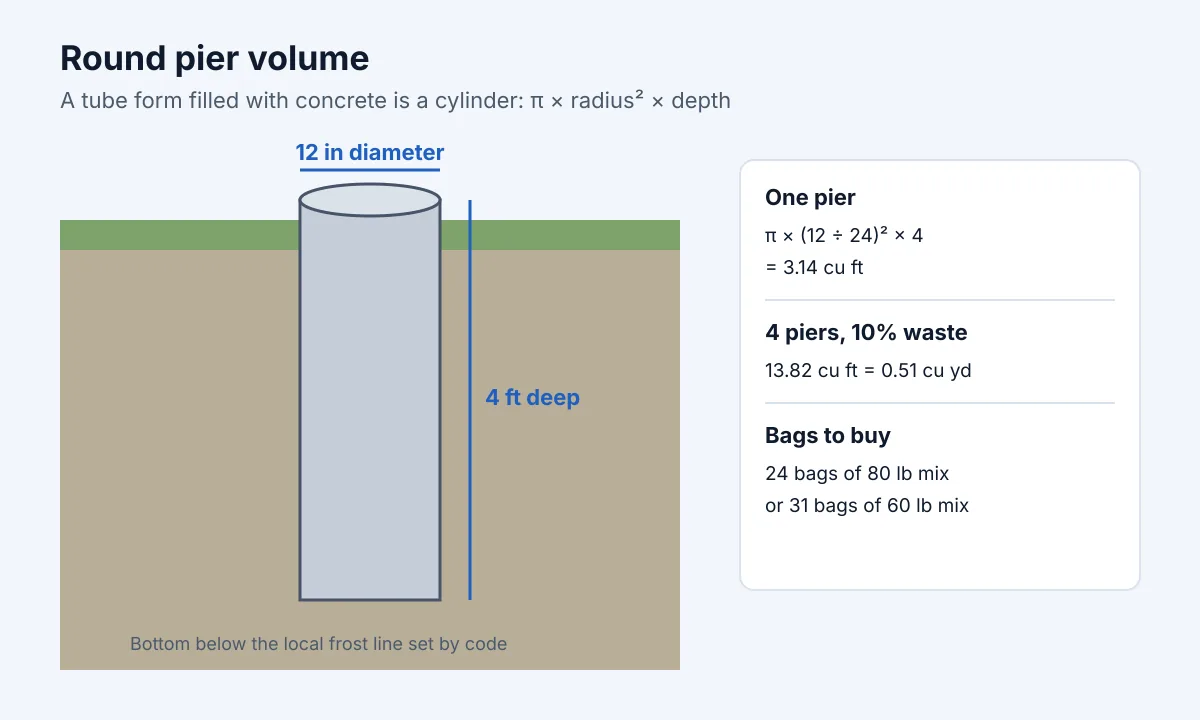
- Round pier volume (cu ft) = π × (diameter ÷ 24)² × depth × number of piers
- Cubic yards = cubic feet ÷ 27, then × (1 + waste)
- Bags = cubic feet with waste ÷ bag yield, rounded up
Dividing the diameter by 24 turns inches into a radius in feet in one step. For the default strip footing of 40 feet at 16 by 8 inches, the volume is 40 × 1.333 × 0.667, or 35.56 cubic feet. That equals 1.32 cubic yards, and 1.45 with waste. Each standard cross section holds a fixed amount of concrete per foot of length:
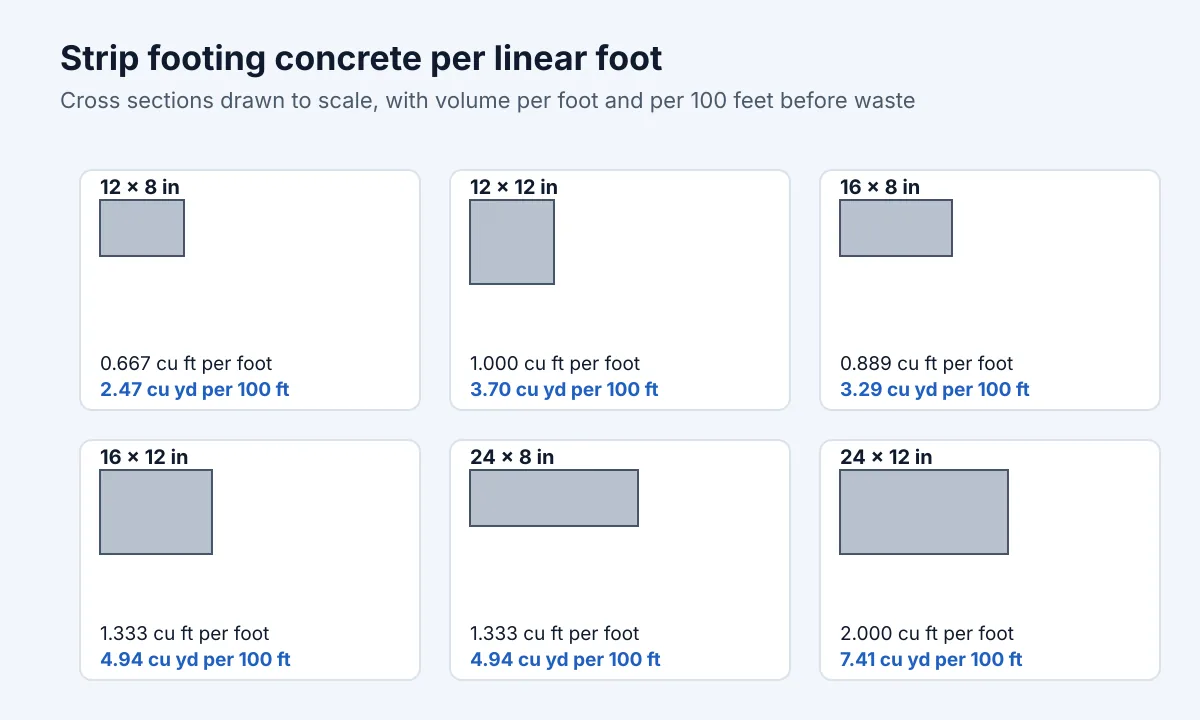
A 12 by 8 inch footing holds 0.667 cubic feet per foot, a 16 by 8 inch footing 0.889 and a 24 by 12 inch footing 2.000. Per 100 feet of footing, those sections need 2.47, 3.29 and 7.41 cubic yards before waste.
Piers follow the cylinder formula. A 12 inch pier 4 feet deep holds 3.14 cubic feet, and four of them with waste come to 0.51 cubic yards.
Using the estimate on site
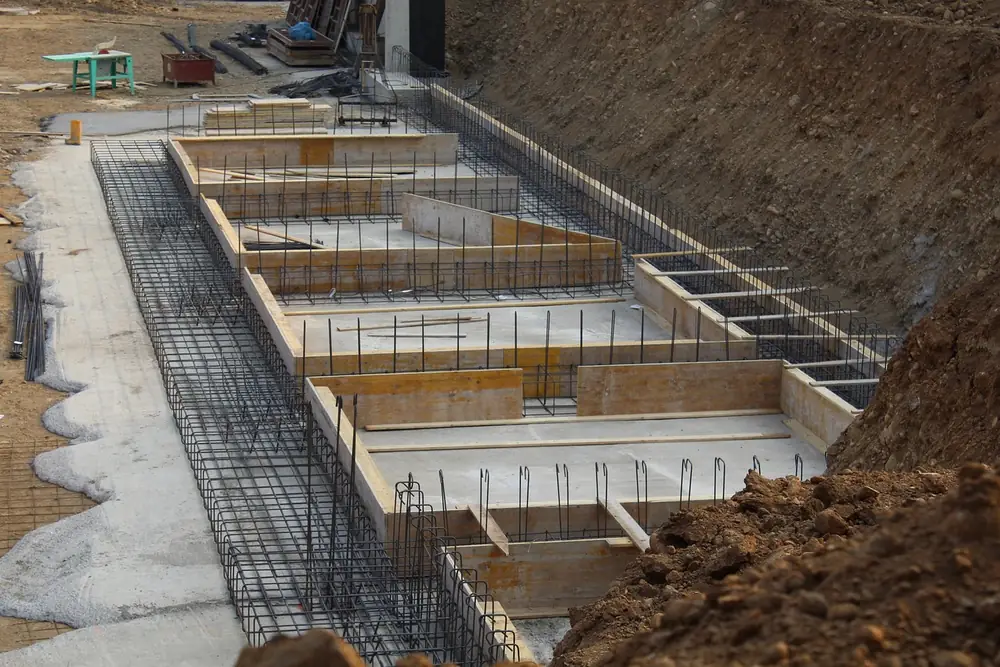
- The footing plan comes first: wall lines for strip footings, post locations for piers. A building footing follows the full perimeter, plus any interior bearing lines.
- Width and depth come from the plans or the local building department. Frost depth, soil type and the load above all set them, and the calculator presets cover the common residential sizes.
- The trench or holes get dug to firm, undisturbed soil. Loose material at the bottom gets cleaned out, since concrete poured on loose soil settles.
- Rebar goes in on supports so it sits off the soil, and any inspection happens before concrete arrives.
- The order uses the volume with waste. Small pier jobs suit bags, while most perimeter footings suit a single truck.
- The top of the footing gets screeded level, and anchor bolts or rebar dowels go in while the concrete is still workable.
Worked example: footing for a 12 by 16 foot shed
A shed on a perimeter footing needs a trench around all four sides: 12 + 16 + 12 + 16 = 56 feet. The plan calls for a 12 inch wide, 8 inch deep footing, with the default waste and national pricing.
| Output | Result |
|---|---|
| Volume before waste | 37.33 cu ft (1.38 cu yd) |
| Order volume with waste | 1.52 cu yd |
| 80 lb bags | 69 |
| 60 lb bags | 92 |
| Ready mix with delivery | $273 to $439 (typical $351) |
| 80 lb bagged mix | $345 to $552 (typical $449) |
At 1.52 cubic yards the job sits close to the point where a truck and a stack of bags cost about the same: a typical $351 for ready mix against $449 for 69 bags. The truck wins on labor, since a trench this long takes hours to fill by wheelbarrow. A deck on nine piers, 10 inches across and 3.5 feet deep, needs 0.70 cubic yards, or 32 bags of 80 lb mix at a typical $208, a job that stays with bags.
What moves footing cost and volume
Depth below grade drives everything else. A colder region with a deeper frost line means deeper trenches or taller piers, more excavation and more concrete per foot. The calculator reflects the concrete part once the depth is entered.
Soil decides the width. Soft or expansive soils call for wider footings that spread the load. A 24 inch footing holds half again as much concrete per foot as a 16 inch footing of the same depth.
Access and delivery change the buying route. A truck that reaches the trench can pour straight from the chute, while a backyard footing behind a house may need a pump or a line of wheelbarrows. Region applies on top, with high cost states 25 percent above the national range.
Overdig is the silent driver. Trenches dug by machine often run wider than the bucket width suggests, and every extra inch of width adds concrete along the full length.
Planning scenarios: Basic, Standard and Premium
| Scenario | Footing | Concrete with waste | Bags of 80 lb | Truck, typical | Bags, typical |
|---|---|---|---|---|---|
| Basic | 6 piers, 8 in × 3 ft | 0.26 cu yd | 12 | $142 | $78 |
| Standard | 56 ft strip, 12 × 8 in | 1.52 cu yd | 69 | $351 | $449 |
| Premium | 88 ft strip, 16 × 12 in | 4.78 cu yd | 216 | $889 | $1,400 |
The Basic piers suit a small deck or a pergola and stay well within bag territory. The Standard strip is the shed example above. The Premium strip follows the perimeter of a 20 by 24 foot garage at a size many plans specify for frost and load, and its 4.78 cubic yards make a truck the only practical choice.
Buying and ordering notes
- Tube forms are sold by diameter and length. Buying one size up from the hole leaves no gaps around the form.
- Ready mix for footings is often ordered at the strength the plans call for. The ticket should match the plan.
- Footing pours usually need a truck that can reach the trench. A site visit by the supplier avoids surprises on delivery day.
- Bagged jobs go faster with a rented mixer and a second person carrying bags.
- Rebar, chairs and tie wire come from the same yard as the concrete in many areas, which saves a trip.
Footing quote checklist
- Footing width, depth and depth below grade written for each wall line or pier
- Excavation method, spoil disposal and repair of the yard after digging
- Rebar size, number of bars, laps and support chairs
- Tube forms or trench pour, and how the top of the footing gets leveled
- Anchor bolts, hold downs or dowels set while the concrete is wet
- 811 utility locate, permit and the inspection before concrete arrives
- Ready mix ordering, pump charges and short load fees
- Payment schedule and responsibility if soil conditions require a redesign
Items outside this estimate
- Excavation, trenching and spoil removal
- Rebar, chairs, dowels and anchor bolts
- Tube forms, form boards and stakes
- Placing labor (the concrete cost calculator adds labor per linear foot)
- Pump truck time, permits and inspections
- Drainage, waterproofing and backfill
When a licensed contractor or engineer is needed
Footings for additions, garages, retaining walls and most decks attached to a house fall under the building code. Minimum width, depth below frost, reinforcement and the soil they bear on are all specified there or on engineered drawings, and an inspection before the pour is standard.
Poor soil changes the design entirely. Expansive clay, fill or a high water table can call for wider footings, deeper piers or a different foundation system, decisions that belong with an engineer rather than a calculator.
Trenches carry their own hazards. Deep trenches can collapse without warning, and digging near buried utilities requires a call to 811 before work starts. Wet concrete in a trench still burns skin on long contact, so waterproof boots and gloves stay on through the pour.
Cost data note
Footing material figures follow national planning ranges, current as of October 2026. A cubic yard of ready mix is priced at $140 to $190, plus $60 to $150 per delivery, and bagged mix follows the shelf ranges listed on the concrete bag tool. Rates get reviewed every three months. A supplier quote for the specific site comes first.
Frequently asked questions
How much concrete does a footing need per linear foot?
0.889 cubic feet per foot for a 16 by 8 inch footing. A 12 by 8 inch footing needs 0.667 cubic feet per foot and a 24 by 12 inch footing needs 2.000.
How many bags of concrete fill a 12 inch tube form 4 feet deep?
6 bags of 80 lb mix with 10 percent waste. A form of that size holds 3.14 cubic feet of concrete, against 0.60 cubic feet from one 80 lb bag.
How many yards of concrete for 100 feet of footing?
3.62 cubic yards for a 16 by 8 inch footing with 10 percent waste. Without waste the figure is 3.29 cubic yards.
Strip footing or piers for a deck?
Most residential decks sit on individual piers, one under each post, because a deck carries load at points rather than along a wall. Strip footings suit walls, sheds with sill plates and garages.
How deep should a footing be?
Below the local frost line, at a depth the building department sets. Frost depth varies widely across the United States, so the local code or permit office gives the number for a specific address.
Related calculators
- Concrete calculator for slabs, columns, steps and curbs for the rest of the pour
- Installed footing and slab cost estimator for labor per linear foot plus material
- Block wall calculator for a CMU wall built on the footing
- Concrete bag counter for pier jobs mixed by hand
- Slab calculator for the floor that sits inside a perimeter footing
All concrete tools sit on the concrete calculator hub, while hiring a crew for footings and full foundations is the subject of the foundation cost guide.