A concrete block calculator counts the concrete masonry units, or CMU, that a wall needs from just its length and height. Standard blocks share an 8 by 16 inch nominal face, so every square foot of wall takes 1.125 blocks no matter which width goes into the wall. The tool adds a waste allowance, estimates 80 lb bags of mortar and prices the blocks for 4, 6, 8 and 12 inch widths with a Low, Typical and High range. The count covers the gross wall area. Door and window openings, pilasters and cap blocks get handled separately, as the notes further down explain.
Blocks to buy, with waste
198 blocks
Before waste: 180 blocks
| Wall area | 160.0 sq ft |
|---|---|
| Blocks before waste | 180 blocks |
| Mortar, 80 lb bags | 15 bags |
| Item | Low | Typical | High |
|---|---|---|---|
| Blocks | $396 | $545 | $693 |
| Mortar, 80 lb bags | $165 | $210 | $255 |
| Material total | $561 | $755 | $948 |
Planning estimate only, not a contractor quote. Prices are United States national ranges, updated October 2026. How these estimates are built
What the block count includes
The headline figure is the number of blocks to buy with waste added. Below it sits the raw count for the wall area, which is the number of blocks the finished wall actually contains. The gap between the two covers broken units, cuts at corners and ends, and the odd block that turns out chipped on the pallet.
The mortar line follows the QUIKRETE Mortar Mix data sheet, which puts the coverage of one 80 lb bag at about 12 standard blocks. The tool divides the laid block count, before waste, by that figure and rounds up. Joint thickness, the mortar dropped while laying and how full the head joints are all move the real number, so a spare bag on site is cheap insurance.
The cost table prices blocks at the selected width, mortar at a national bag rate and a material total for both. Labor, footing concrete, rebar and grout stay outside these numbers. The estimating method behind every tool describes how base rates, region and exclusions fit together.
The block formula, step by step
A block sold as 8 by 8 by 16 inches measures 7.625 by 7.625 by 15.625 inches in the box, as retail listings such as the Quikrete standard cored block at Lowe’s state. A 3/8 inch mortar joint brings it up to the full 8 by 16 inch module. That module covers 128 square inches of wall face, and a square foot holds 144 square inches, so 144 ÷ 128 gives 1.125 blocks per square foot.
- Wall area = length × height, in square feet
- Blocks = wall area × 1.125, rounded up
- Blocks to buy = blocks × (1 + waste), rounded up
- Mortar bags (80 lb premixed) = blocks ÷ 12, rounded up
A wall 20 feet long and 8 feet tall covers 160 square feet. Multiplied by 1.125, that comes to 180.0 blocks. With 10 percent waste the order becomes 198 blocks, and 180 ÷ 12 equals 15.00, which rounds up to 15 bags of mortar.
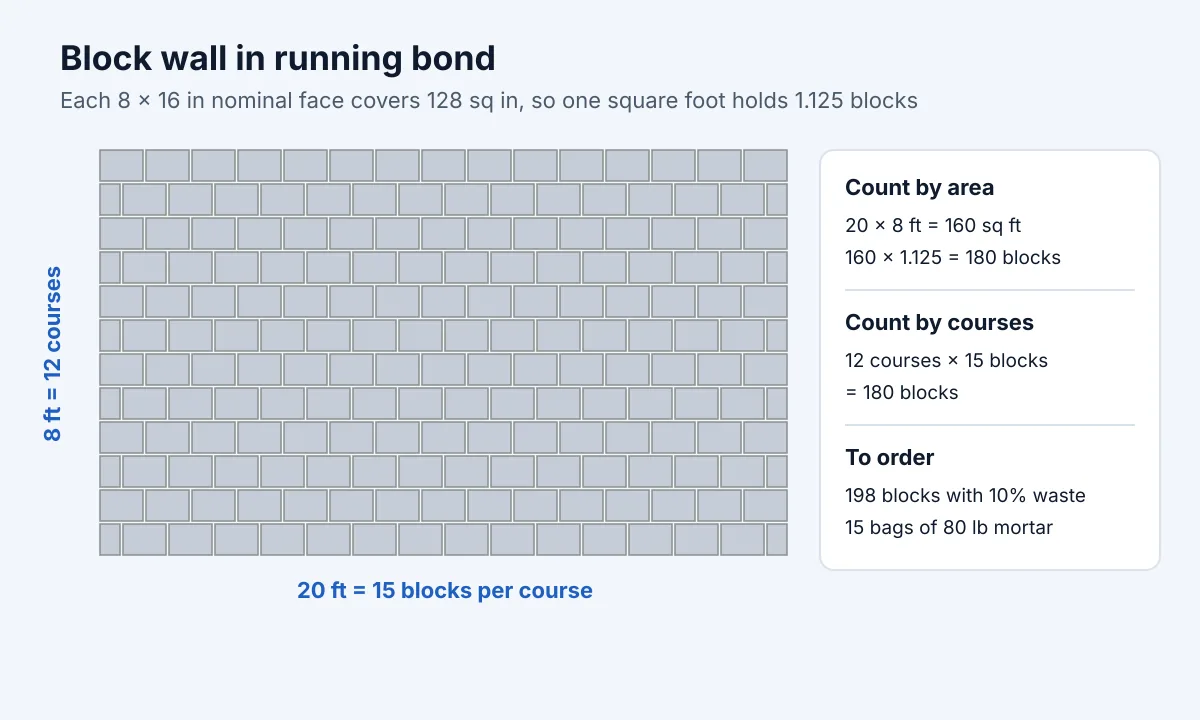
The course method gives the same answer and works well as a check in the field. Height in inches ÷ 8 gives the number of courses, and length in inches ÷ 16 gives the blocks per course. The 20 by 8 foot wall has 12 courses of 15 blocks, which multiplies out to 180.
Choosing a block width
Width changes strength, weight and price, but not the count. A 4 inch unit serves as a partition block or as a veneer over another wall. Six inch block shows up in garden walls, screen walls and non bearing interior partitions. The 8 inch unit is the general purpose block for most bearing walls and many foundation walls. Twelve inch block appears in taller foundation walls and walls that carry more soil or load, and its larger cores leave room for more reinforcement.

At typical national prices, block material costs $2.36 per square foot of wall at 4 inches, $2.76 at 6 inches, $3.09 at 8 inches and $4.61 at 12 inches. Mortar, waste and labor come on top.
How a block wall goes up
- The wall starts on a footing. The footing volume calculator sizes the concrete under the first course, and the footing has to cure before blocks go on.
- Layout follows. Chalk lines on the footing mark the wall face, and a dry run of the first course shows where cut blocks will fall.
- Corners, called leads, go up first, set plumb and level and stepped back a few courses.
- A mason’s line stretched between the leads guides every block in between, course by course.
- Joints get tooled once the mortar stiffens to a thumbprint, which seals the joint face against water.
- Where the plans call for it, vertical rebar sits in chosen cores and those cores get filled with grout, often with horizontal joint reinforcement every few courses.
- The top course gets caps or a grouted bond beam, depending on what sits on the wall.

Worked example: a 40 foot garden wall
A freestanding garden wall runs 40 feet long and stands 4 feet tall in 8 inch block. The inputs keep the default waste of 10 percent and national pricing.
| Output | Result |
|---|---|
| Wall area | 160 sq ft |
| Blocks before waste | 180 |
| Blocks to buy | 198 |
| Mortar, 80 lb bags | 15 |
| Blocks | $396 to $693 (typical $545) |
| Mortar | $165 to $255 (typical $210) |
| Material total | $561 to $948 (typical $755) |
The course check confirms the count: 6 courses of 30 blocks equals 180. Material for the wall lands at a typical $755. The same wall in 6 inch block drops to a typical $695, and in 12 inch block it rises to $1,020. A freestanding wall this tall normally needs a proper footing and some reinforcement, which the material total leaves out.
What moves the block estimate
Block width is the biggest price lever, since the count stays fixed. Switching 8 inch units for 12 inch units raises the typical unit price by 49 percent.
Wall shape adds cuts. Every corner, end and opening produces cut blocks and offcuts, so a short wall with several corners burns through its waste allowance faster than a long straight run. Fifteen percent waste fits walls with many corners or openings.
Specialty units carry their own prices: half blocks, corner and end units, bond beam blocks, pilaster blocks and solid caps. A takeoff for a full wall lists them separately once the layout is settled.
Region and delivery round out the list. Block is heavy and bulky, so yard delivery charges and local supply set much of the final price, and high cost states run 25 percent above the national figure.
Planning scenarios: Basic, Standard and Premium
| Scenario | Wall | Blocks to buy | Mortar bags | Material, typical | Material range |
|---|---|---|---|---|---|
| Basic | 12 × 3 ft raised bed, 6 in block | 46 | 4 | $169 | $131 to $211 |
| Standard | 20 × 8 ft wall, 8 in block | 198 | 15 | $755 | $561 to $948 |
| Premium | 60 × 8 ft foundation wall, 12 in block | 594 | 45 | $3,070 | $2,400 to $3,850 |
The Basic raised bed is a weekend project with a few dozen blocks. The Standard wall matches the acceptance test for this tool and fills a typical delivery. The Premium foundation wall moves into permit territory, with engineered reinforcement, grout and an inspection before backfill.
Buying notes for block and mortar
- Blocks for one exposed wall come from one production run where possible, since color shifts between batches.
- Cracked or chipped units get set aside on delivery, before they end up in a visible course.
- Mortar type matters: Type S for walls below grade and retaining work, Type N for most above grade walls.
- Stacks stay covered and off the ground, because wet block shrinks as it dries and can crack the joints.
- Half blocks and corner units cost more per piece than standard stretchers but save cutting time.
Block wall quote checklist
- Block width and type, including any split face, bond beam or cap units
- Footing size, depth below frost line and who inspects it before the first course
- Vertical rebar spacing, horizontal joint reinforcement and which cores get grouted
- Mortar type, such as Type S below grade or Type N above grade
- Waterproofing and drainage on any wall that holds back soil
- Scaffolding, mixer and saw rental included or billed separately
- Cleanup of mortar droppings and haul away of broken block
- Payment stages tied to footing, wall height and grout, plus a workmanship warranty
Costs outside this estimate
- Footing concrete and footing excavation
- Rebar, joint reinforcement and grout for filled cores
- Cap blocks, bond beam units and other specialty shapes
- Waterproofing, drainage and backfill on foundation walls
- Furring, insulation and board inside a finished basement, sized with the drywall sheet and mud calculator
- Delivery fees, scaffolding and mixer rental
- Mason labor
Where a licensed mason or engineer comes in
Foundation walls, walls that hold back soil and any wall that carries a roof or floor follow the building code. Reinforcement size, spacing and grout requirements usually come from engineered drawings, and an inspector checks the steel before the cores get filled.
Height raises the stakes. A tall freestanding wall acts like a sail in the wind, and a retaining wall carries the pressure of saturated soil behind it. Both fail without the right footing and reinforcement, often years after construction.
Cutting block with a masonry saw produces silica dust, so wet cutting and a fitted respirator are standard practice. Mortar is alkaline, and lifting thousands of heavy units over a few days strains backs and wrists, which is why crews rotate tasks and stage pallets close to the wall.
Cost data note
Block and mortar figures on this page reflect national planning ranges, last updated October 2026. An 8 inch block runs $2.00 to $3.50, a 12 inch block $3.20 to $5.20, and an 80 lb bag of mortar $11.00 to $17.00. Every rate gets reviewed on a three month cycle. A quote from a local block yard takes priority over these ranges.
Frequently asked questions
How many concrete blocks are in a square foot?
1.125 blocks per square foot of wall face, based on the 8 by 16 inch nominal size with a 3/8 inch joint. Eight square feet of wall hold 9 blocks.
How many blocks does a 10 by 10 wall need?
113 blocks for the 100 square foot wall, or 125 with 10 percent waste. The wall also takes 10 bags of 80 lb mortar.
How many blocks does one bag of mortar lay?
About 12 standard 8 by 8 by 16 inch blocks per 80 lb bag of premixed mortar mix, per the QUIKRETE data sheet. A 60 lb bag lays about 9.
What does a block wall cost per square foot in materials?
About $4.84 per square foot for 8 inch block and mortar at typical national prices, before waste, reinforcement and labor.
Does block width change how many blocks a wall needs?
No. Standard 4, 6, 8 and 12 inch blocks share the same 8 by 16 inch face, so the count per square foot stays at 1.125. Width changes the price, the weight and the strength.
Related calculators
- Cinder block calculator for the same count under the cinder block name
- Mortar calculator by block or brick count for checking mortar on a known number of units
- Concrete footing calculator for the footing under the first course
- Brick calculator for veneer and garden walls for walls faced in clay brick
- Concrete volume calculator for slabs and piers that sit next to the wall
The concrete calculators hub groups this tool with the other concrete estimators, and the masonry calculators hub covers brick, block and mortar work.