By Muhammad Awais. Prices reviewed October 2026.
The main signs of roof damage are missing, cracked or curled shingles, shingle granules collecting in the gutters, loose or rusted flashing, a sagging ridge or deck, daylight or damp wood in the attic and water stains on ceilings. One or two of these on a small area usually mean a repair. When they spread across a whole slope, the roof is close to replacement, and asphalt shingles cost $325 to $575 per square installed, plus $75 to $150 per square for each layer torn off. One square covers 100 square feet of roof.
| Asphalt replacement, one layer torn off | Roof squares | Low | Typical | High |
|---|---|---|---|---|
| 1,500 sq ft footprint, 4 in 12 | 15.8 | $6,320 | $8,930 | $11,460 |
| 1,500 sq ft footprint, 8 in 12 | 18.0 | $7,210 | $10,190 | $13,070 |
| 2,000 sq ft footprint, 4 in 12 | 21.1 | $8,430 | $11,910 | $15,280 |
| 2,000 sq ft footprint, 8 in 12 | 24.0 | $9,610 | $13,580 | $17,430 |
The figures above use the pitch multiplier to turn a house footprint into roof area and stop before waste, ridge caps and decking repairs, so a contractor’s measured bid will sit somewhat higher.
Damage visible from the ground
A pair of binoculars and a walk around the house reveal most outside damage without a ladder.
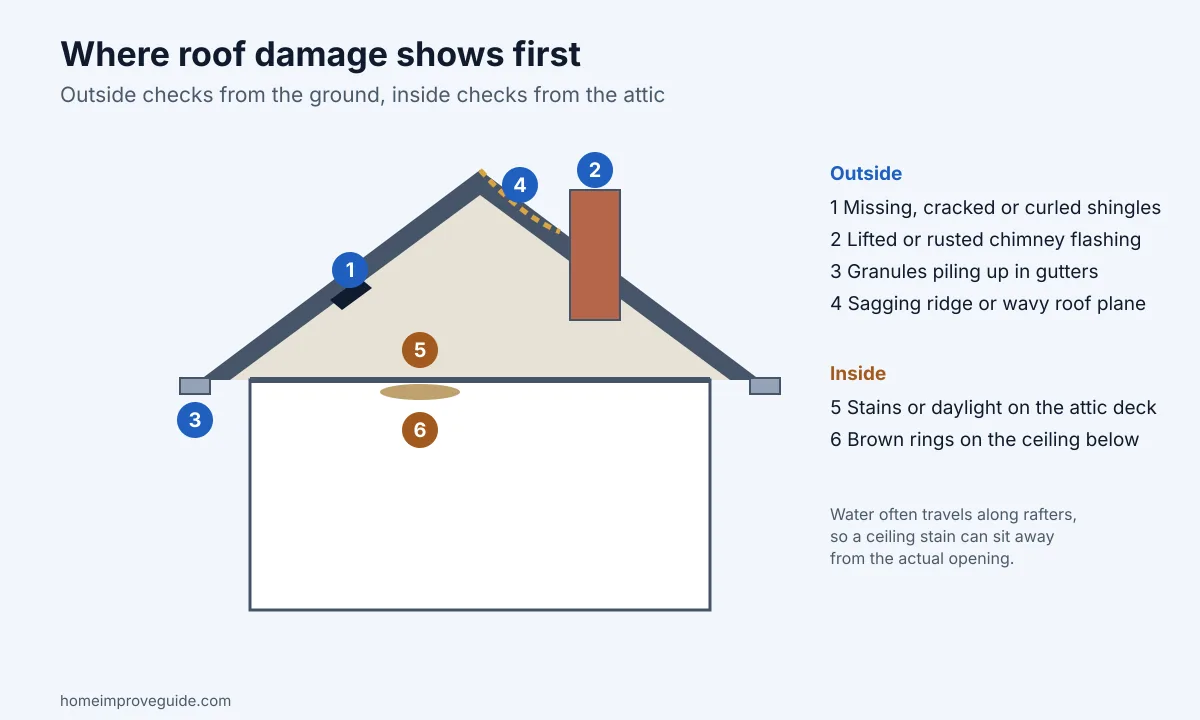
- Missing shingles: dark gaps or exposed felt where tabs have blown off, often near ridges, rakes and eaves where wind lifts the edges.
- Curling and cupping: shingle edges that turn up or corners that lift, a sign of age, heat or poor attic ventilation.
- Cracks and creases: straight lines across a tab show where wind bent it back. A creased shingle has lost its seal and tends to tear off in the next storm.
- Bald patches: areas where the colored granules have worn away and the black asphalt shows through. Bare asphalt breaks down quickly in sunlight.
- Flashing problems: bent, lifted or rusted metal around chimneys, vents, skylights and wall joints, or dried caulk pulling away from it.
- Moss and dark streaks: moss holds water against the roof and lifts shingle edges. Algae streaks are mostly cosmetic, yet they mark a damp, shaded slope.
- Sagging lines: a ridge that dips or a roof plane that looks wavy suggests wet or broken decking or rafters below.

Clues inside the attic and the house
Many leaks show up indoors long before anything looks wrong outside. An attic check with a flashlight, ideally during or right after rain, finds most of them.
- Water stains, dark rings or soft spots on the underside of the roof deck and on rafters
- Pinpoints of daylight through the boards, especially around nails, vents and the chimney
- Wet or matted insulation, which also loses much of its R value
- Mold or a musty smell in the attic space
- Brown rings on ceilings, bubbling paint near the top of walls and damp spots around light fixtures
Signs after a storm
Storm damage has its own pattern. Hail leaves round dark bruises where granules were knocked off, along with dents in gutters, metal vents and downspouts, which are easier to spot from the ground than marks on the shingles themselves. Wind tears off tabs along edges and ridges and leaves creased shingles in rows. Fallen limbs can puncture the deck. Photos taken before any cleanup, with dates, help an insurance adjuster and a roofer see the same damage.
Pitch and the size of the job
A steeper roof has more surface over the same house, which raises the materials and the labor for any repair or replacement. The multiplier below turns a footprint into roof area. A 1,500 square foot footprint becomes the roof area shown in the fourth column.
| Pitch | Angle | Area multiplier | Roof area over 1,500 sq ft | Slope band |
|---|---|---|---|---|
| 3 in 12 | 14.0° | 1.031 | 1,546 | Low slope |
| 4 in 12 | 18.4° | 1.054 | 1,581 | Low slope |
| 5 in 12 | 22.6° | 1.083 | 1,625 | Standard |
| 6 in 12 | 26.6° | 1.118 | 1,677 | Standard |
| 7 in 12 | 30.3° | 1.158 | 1,737 | Standard |
| 8 in 12 | 33.7° | 1.202 | 1,803 | Standard |
| 9 in 12 | 36.9° | 1.250 | 1,875 | Standard |
| 10 in 12 | 39.8° | 1.302 | 1,953 | Steep |
| 12 in 12 | 45.0° | 1.414 | 2,121 | Steep |
Roof Pitch Calculator: the roof pitch calculator works out the pitch from a rise and run or an angle, gives the multiplier and rafter length, and shows the slope band for any roof. Those numbers make a replacement bid easy to check.
What drives the cost once damage is confirmed
- Roof pitch: an 8 in 12 roof has 14 percent more surface than a 4 in 12 roof over the same footprint, and steep slopes also need roof jacks and harnesses that slow the crew.
- Layers to remove: each layer torn off costs $75 to $150 per square. On a 2,000 square foot footprint at 6 in 12, about 22.4 squares, a second layer adds $1,680 to $3,350.
- Shingle grade and material: architectural shingles cost about $2,240 more than standard asphalt shingles on that same roof at typical prices. Metal runs about $27,950 against $10,060 for standard asphalt, before tear off.
- Decking and rot: boards that are soft or delaminated get replaced sheet by sheet, so a long hidden leak raises the bill once the old shingles come off.
- Region: lower cost states run below the national range and high cost states above it, by the same factors the rest of the site uses.
- Underlayment and ventilation: new underlayment runs $30 to $65 per square, and adding ridge or soffit vents to fix the cause of curling adds labor on top.

Checking the roof without a roofer, and when to call one
A homeowner can do the ground and attic checks safely and for free. Climbing onto the roof is a different matter. Ladders and roof edges are a leading source of falls at home, wet or mossy shingles are slick, and any slope steeper than 4 in 12 counts as a steep roof under OSHA rules for workers. Walking on a hot asphalt roof can also scuff granules off and cause the very damage under inspection.
A roofing contractor brings ladders, fall protection and the experience to tell wear from damage. Roofers often inspect as part of bidding on the repair, and an independent inspector or a public adjuster helps when an insurance claim is involved. The value of a professional look rises with the stakes: a few missing tabs on a low slope suit a handyman, while widespread bruising, soft decking or a sagging ridge call for a licensed roofer.
Mistakes that turn small damage into big bills
- Waiting on a small leak: water runs along rafters before it drips, so the wet area is usually larger than the stain. Rot in decking and framing costs far more than a flashing repair.
- Pressure washing shingles: high pressure strips granules and shortens the life of an asphalt roof. Soft washing with a cleaner made for roofs avoids that damage.
- Roofing over a damaged layer: a second layer hides soft decking, adds weight and doubles the tear off cost later.
- Sealing every gap with caulk: caulk dries and cracks within a few seasons and often traps water behind failed flashing.
- Cleaning up before documenting: after a storm, debris and damaged shingles thrown away before photos weaken an insurance claim.
Roof damage quote checklist
A written repair or replacement bid after an inspection should spell out each item below, so two bids can be compared line by line.
- Photos of each damaged area with its location on the roof
- Roof area in squares, the pitch used and the waste allowance
- Number of layers to tear off and the disposal method
- Price per sheet for any decking replacement, with an estimated sheet count
- Flashing at chimneys, walls and valleys: reused, repaired or replaced
- Underlayment type, ice and water barrier at eaves and valleys, and ventilation changes
- Shingle brand and product line, with the manufacturer warranty and the separate workmanship warranty
- Permit, cleanup with a magnet sweep for nails, and the payment schedule
When a licensed roofer is needed
Sagging decks, broken rafters and water in the walls point to structural damage, and those jobs need a licensed roofer and sometimes an engineer. Full replacements usually require a building permit and, in many areas, a final inspection. Damage near power lines or a service mast is a job for the utility and a licensed electrician before any roof work starts.
Cost data note
Replacement prices in this guide are national planning ranges for October 2026, revised every 3 months. They cover installed shingles and tear off before waste, ridge caps, decking and permits. The methodology page lists the sources and the region factors behind each range.
Frequently asked questions
How can a homeowner tell if a roof is damaged?
Missing or curled shingles, granules in the gutters, rusted or lifted flashing and stains on the attic deck are the most common signs. A ground check with binoculars and an attic check with a flashlight find most problems without climbing onto the roof.
Are shingle granules in the gutters a sign of roof damage?
A small amount of loose granules is normal on a new roof. Heavy granule loss on an older roof, or bald spots where black asphalt shows, means the shingles are wearing out and will soon stop shedding water reliably.
Can a roof leak without any visible damage outside?
Yes. Failed flashing, a cracked pipe boot or a nail that backed out can let water in while the shingles look fine. Water also travels along the deck and rafters, so a ceiling stain often sits several feet away from the actual opening.
How much does it cost to replace a damaged asphalt roof?
On a 1,500 square foot footprint at 4 in 12, a replacement with one layer torn off runs about $8,930 typical at national prices. Steeper roofs, extra layers, architectural shingles and decking repairs raise that figure.
Is a sagging roof an emergency?
A new or growing sag is urgent because it can mean broken framing or rotted decking under load. Snow, standing water and foot traffic add stress, so the area should stay clear until a licensed roofer or engineer inspects it.
Related calculators and guides
The roofing calculators page groups the roof tools, and the insulation calculator helps replace attic insulation soaked by a leak. Repair costs by problem are covered in the guides to roof leak repair cost, storm damage roof repair, emergency roof repair cost, flat roof repair and roof cleaning cost. The guides index groups the rest by trade.