An insulation calculator sizes an order for the two most common do it yourself jobs: blowing loose fiberglass into an attic and fitting batts or rolls between studs and joists. For blown fiberglass the bag count follows the Owens Corning AttiCat coverage chart: 14.6 bags per 1,000 square feet at R30 and 25.0 at R49. For batts the count divides the area by the coverage printed on a typical package for each R value between R13 and R49, and the coverage can be changed to match the product on the shelf. Each result carries an installed cost range per square foot.
Blown fiberglass bags
23 bags
Chart rate per 1,000 sq ft: 19.0 bags
| Area to insulate | 1,200 sq ft |
|---|---|
| R value | R38 |
| Total bag weight | 633 lb |
| Item | Low | Typical | High |
|---|---|---|---|
| Installed insulation | $1,440 | $2,640 | $4,560 |
Planning estimate only, not a contractor quote. Prices are United States national ranges, updated October 2026. How these estimates are built
What the insulation result shows
For blown fiberglass, the large figure is the number of 27.5 lb bags to buy, rounded up, with the chart rate per 1,000 square feet under it. The total bag weight helps plan a trip with a pickup and the number of loads into a blowing machine. The default attic, 40 by 30 feet at R38, takes 23 bags weighing about 633 lb.
For batts, the result is a package count with the coverage per package used. The coverage defaults to one listed product for each R value, such as the Owens Corning ME24 batt bag 16 in x 48 in at 58.67 square feet for R30. Package sizes differ by brand and width, so the optional coverage field takes the square footage printed on the bag. The cost line prices installed insulation at $1.20 to $3.80 per square foot. The notes on how the estimates are built explain the ranges and the region factor.
Insulation formulas used
- Area = length × width
- Blown bags = area ÷ 1,000 × chart bags per 1,000 sq ft, rounded up
- Chart rates: R30 14.6, R38 19.0, R49 25.0 bags per 1,000 sq ft
- Bag weight = bags × 27.5 lb
- Batt packages = area ÷ coverage per package, rounded up
- Installed cost = area × installed rate per square foot
The default attic covers 1,200 square feet. At R38 the chart rate is 19.0 bags per 1,000 square feet, so 1.2 × 19.0 = 22.8, which rounds up to 23 bags. The same attic filled with R30 batts at 58.67 square feet per package needs 21 packages.
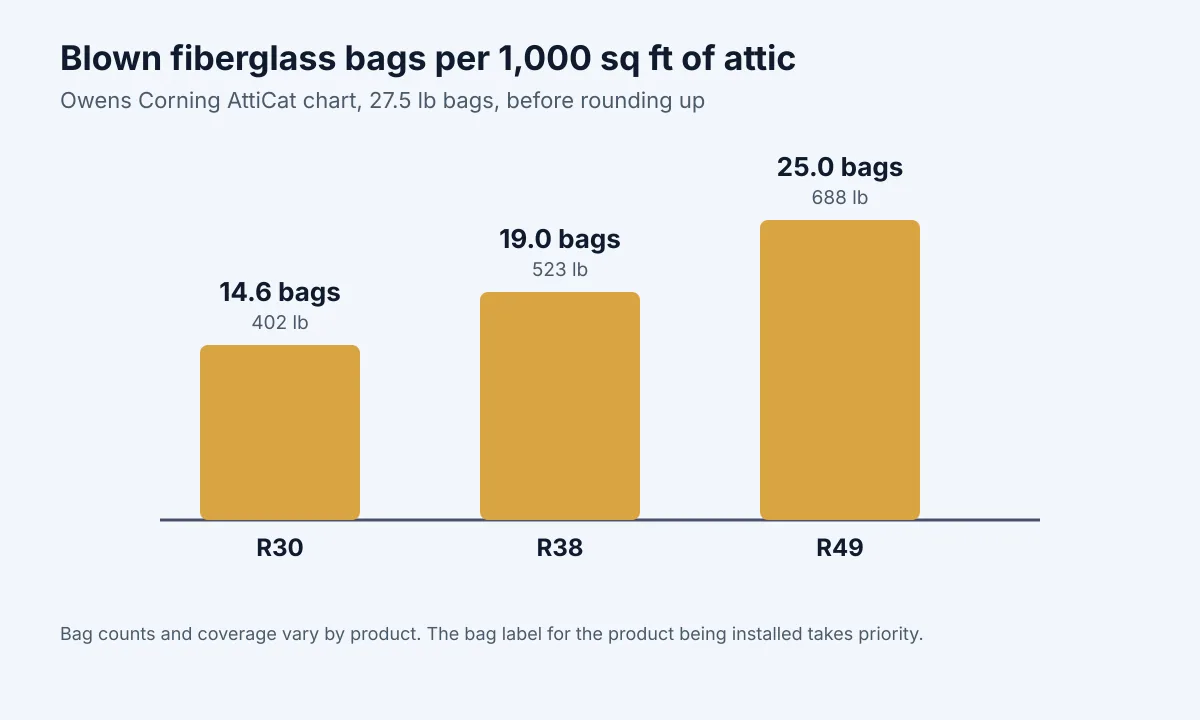
The blown chart follows Owens Corning AttiCat data, and each brand of loose fill publishes its own chart. A different product can need more or fewer bags for the same R value, so the label on the bag being blown governs the final count. Blown cellulose is not part of this calculator.
Insulating an attic, step by step
- Air sealing comes first. Gaps around plumbing stacks, wiring holes, top plates and the attic hatch leak warm air past any amount of insulation, and they are much harder to reach after insulation goes down.
- Baffles go in at the eaves so insulation does not block the soffit vents and the roof deck keeps its airflow.
- Recessed lights, chimneys and flues get checked. Fixtures not rated for insulation contact and hot flues need the clearances their labels and the code require.
- Depth rulers go up across the attic so the installed thickness can be checked against the chart.
- Insulation goes in from the far corners back toward the hatch, at an even depth, with no gaps or thin spots.
- The hatch or pull down stair gets insulated and weatherstripped so it does not become the weak spot in the ceiling.
Worked example: an R49 attic over a 28 by 36 foot house
A ranch house in a cold climate has an attic floor of 28 by 36 feet with a few inches of old insulation. Following the climate zone guidance below, the target is R49 in blown fiberglass at national prices.
| Line | Result |
|---|---|
| Area to insulate | 1,008 sq ft |
| Chart rate at R49 | 25.0 bags per 1,000 sq ft |
| Blown fiberglass bags | 26 |
| Total bag weight | 715 lb |
| Installed cost | $1,210 to $3,830 (typical $2,220) |
Stopping at R38 would take 20 bags instead of 26. The installed range stays the same in this tool because it is priced per square foot, but a contractor topping up to R49 usually prices toward the upper half of the range. Old insulation counts toward the total only if it is dry, clean and evenly spread, and many installers measure what is there before quoting.
What moves insulation cost
The target R value decides the material. Moving up the AttiCat chart to R49 instead of R30 raises the bag count by more than two thirds: 25.0 bags per 1,000 square feet against 14.6.
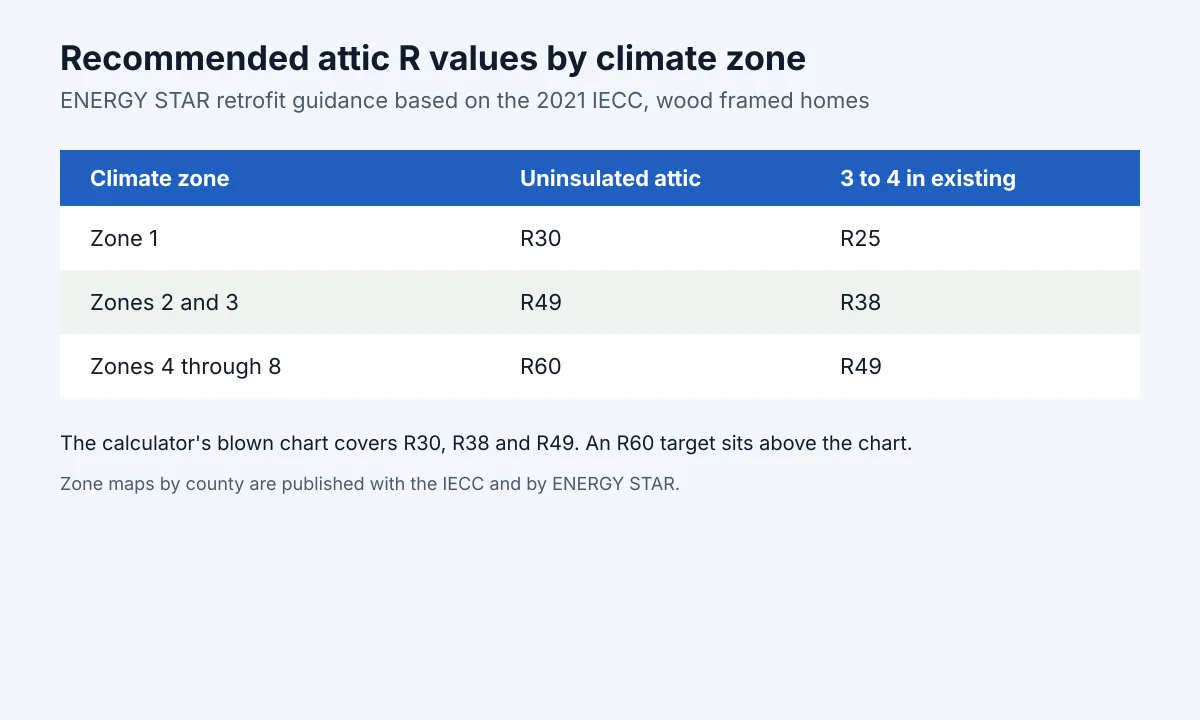
Climate sets that target. ENERGY STAR guidance based on the 2021 IECC calls for R30 in an uninsulated zone 1 attic, R49 in zones 2 and 3, and R60 in zones 4 through 8, with lower add-on targets where 3 to 4 inches already exist.
Attic conditions add labor. Low roof pitches with little headroom, old insulation that has to be removed, rodent damage and a lot of air sealing all push a price toward the High column. Walls insulated from outside, by drilling and filling cavities, cost far more per square foot than an open attic.
Region applies on top, and the default attic’s installed range moves to $1,800 to $5,700 where the high cost factor applies.
Planning scenarios: Basic, Standard and Premium
| Tier | Space | Material | Quantity | Installed, typical |
|---|---|---|---|---|
| Basic | Garage wall 20 × 8 ft | R13 batts | 4 packages | $352 |
| Standard | Attic 40 × 30 ft | Blown fiberglass, R38 | 23 bags | $2,640 |
| Premium | Attic 40 × 40 ft | Blown fiberglass, R49 | 40 bags (1,100 lb) | $1,920 to $6,080 |
The Basic garage wall is a half day job with a utility knife and a staple gun. The Standard attic at R38 suits zones 2 and 3 with some existing insulation. The Premium attic needs 40 bags, more than half a ton of fiberglass, which is why most blown jobs use a rented or truck mounted blowing machine.
Insulation quote checklist
- Target R value and the installed depth, with the brand and product named for blown jobs
- Air sealing scope: top plates, penetrations, attic hatch and any can lights, listed item by item
- Baffles at every rafter bay with a soffit vent, and how ventilation stays open
- Removal and disposal of old, wet or rodent damaged insulation, priced separately
- Vermiculite or suspect material testing before anything old is disturbed
- Clearances around chimneys, flues and recessed lights not rated for contact
- A receipt meeting the FTC R-value Rule, which for loose fill lists coverage area, installed and settled thickness, R-value and bags used
- Cleanup of the living space below the hatch and of the attic access path
- Payment schedule and whether any utility rebate paperwork is handled by the contractor
- Warranty on settling and on the air sealing work
Outside the insulation estimate
- Air sealing materials and labor
- Removal of old insulation and debris
- Baffles, hatch covers and depth rulers
- Blowing machine rental
- Wall cavity drilling and patching
- Ventilation upgrades and roof deck repairs
When an insulation contractor should do the work
Attics are hot, cramped and easy to damage. A step off a joist puts a foot through the ceiling below, and summer attic temperatures make long sessions risky. Contractors with truck mounted machines finish most attics in a day.
Some attics need assessment first. Vermiculite insulation, which looks like gray brown pebbles, can contain asbestos and should not be disturbed before testing. Knob and tube wiring, signs of roof leaks and bathroom fans vented into the attic all need fixing before new insulation covers them. The guide to signs of roof damage lists what to look for overhead.
Fiberglass irritates skin, eyes and lungs, so long sleeves, gloves, goggles and a fitted dust mask or respirator are standard for both batts and blown fill.
Cost data note
Installed insulation is priced at $1.20 to $3.80 per square foot, $2.20 typical, as a national planning range for October 2026 with a review every three months. The blown chart follows the Owens Corning AttiCat product data sheet, Pub. No. 10011273-L, May 2026, batt coverage follows the listed product for each R value, climate zone targets follow ENERGY STAR, and the receipt requirement follows the FTC R-value Rule, 16 CFR 460.17.
Frequently asked questions
How many bags of blown insulation for 1,000 square feet?
19 bags at R38, per the Owens Corning AttiCat chart. R30 takes 14.6 bags and R49 takes 25.0 bags per 1,000 square feet, rounded up to whole bags.
How much does attic insulation cost per square foot?
$1.20 to $3.80 per square foot installed as a national planning range, $2.20 typical, before air sealing, removal of old material or high cost region pricing.
What R value should attic insulation be?
R30 to R60 depending on climate zone. ENERGY STAR calls for R49 in an uninsulated attic in zones 2 and 3 and R60 in zones 4 through 8.
How many packages of R13 insulation for 1,000 square feet?
25 packages at 40.00 square feet each, the coverage of one common R13 roll. Packages from other makers can cover more or less.
Is blown insulation or batts better for an attic?
Blown fill usually suits an open attic floor, since it fills around joists, wires and odd shapes without gaps. Batts suit open walls and floors where they can be fitted snugly into each cavity.
Related calculators
- Drywall calculator for the board that covers insulated walls and ceilings
- Roof slope calculator for an attic’s pitch and headroom at the eaves
- Block wall calculator for a basement wall that gets insulated on the inside
Every indoor tool is collected on the interior calculators hub.