A paver sand calculator covers the two sand layers that every interlocking paver job uses. Bedding sand forms a thin, screeded bed under the pavers, and joint sand fills the narrow gaps between them so the units lock together. The two are bought differently. Bedding sand comes loose by the ton or in 50 lb bags, while polymeric joint sand comes in bags with a binder that hardens after watering. Results give tons, cubic yards and bag counts for the bedding layer, or the number of 50 lb polymeric bags for the joints, each with a Low, Typical and High material price.
Bedding sand to order
0.49 tons
Volume: 0.37 cu yd
| Paved area | 120.0 sq ft |
|---|---|
| Sand volume | 10.0 cu ft |
| Same sand in 50 lb bags | 20 bags |
| Item | Low | Typical | High |
|---|---|---|---|
| Bedding sand | $12 | $20 | $27 |
Planning estimate only, not a contractor quote. Prices are United States national ranges, updated October 2026. How these estimates are built
What each sand result means
In bedding mode the main figure is the weight of sand for the area at the chosen depth, using a planning density of 1.33 tons per cubic yard. The volume beneath it suits a supplier that sells by the yard. The bag line converts the same weight into 50 lb bags, at 40 bags per ton, for small jobs bought at a home center. Bedding sand prices run $25 to $55 per ton, with $40 typical.
In polymeric mode the result is a bag count. The tool divides the area by a planning coverage of 30 square feet per 50 lb bag and rounds up. Bags are priced at $24 to $60 each. The note under the result is a reminder that joint width and paver size move this figure a lot, a point the chart further down shows in numbers. The notes on how site estimates are built cover the region factor and rounding rules.
Sand formulas, one line at a time
- Bedding volume (cu ft) = area × (bedding depth in inches ÷ 12)
- Cubic yards = cubic feet ÷ 27
- Tons = cubic yards × 1.33
- 50 lb bags = tons × 2,000 ÷ 50, rounded up
- Polymeric bags = area ÷ 30, rounded up
The default 12 by 10 foot patio has 120 square feet. A 1 inch bed holds 10.0 cubic feet, which is 0.37 cubic yards and 0.49 tons, or 20 bags. Material runs $12 to $27. The joints on that patio take 4 bags of polymeric sand, a range of $96 to $240 with $144 typical, so the joint sand often costs more than the bedding layer it sits above.
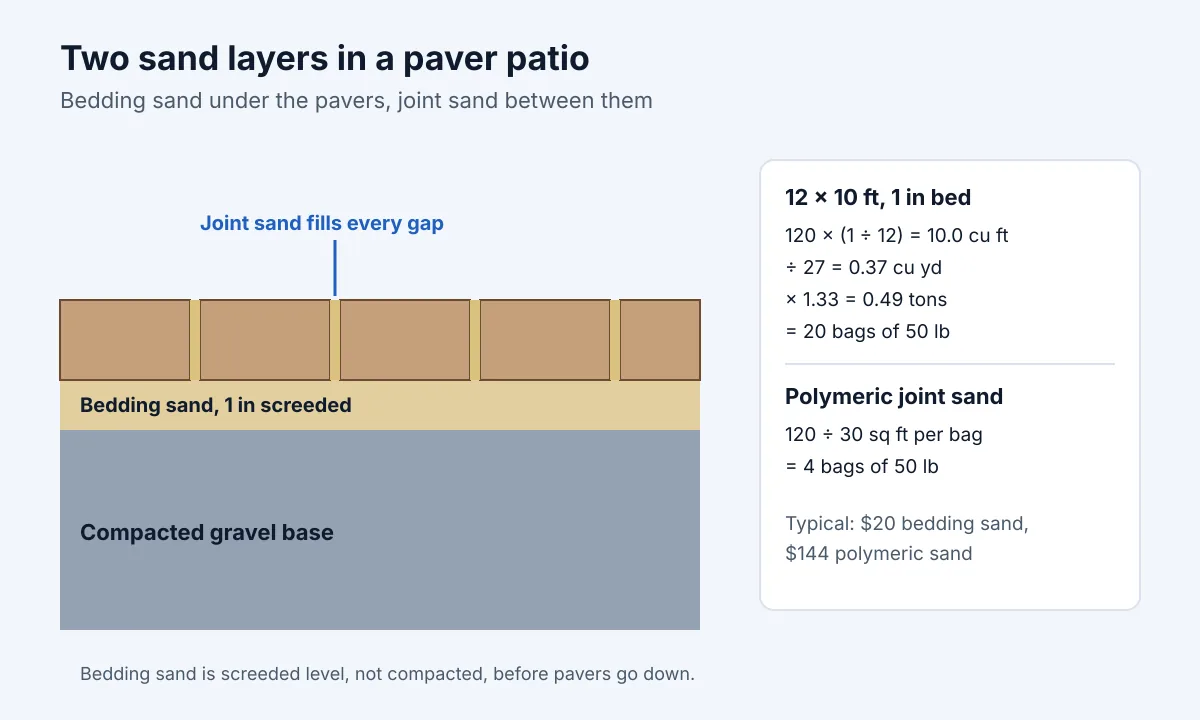
Bedding depth matters more than it looks. Going to 1 1/2 inches on the same patio lifts the order to 0.74 tons, half again as much. A thicker bed is not stronger, though, since loose sand under pavers can shift, and the right fix for a low spot is more base, not more sand.
Sand placement, in order
- The compacted base gets checked for level and slope first. Sand cannot correct a dip in the base without leaving a soft spot.
- Two screed rails, often 1 inch pipe or electrical conduit, get set on the base, and the sand gets spread between them.
- A straight board pulled along the rails screeds the sand to an even thickness. ICPI calls for 1 to 1 1/2 inches, screeded and left loose, not compacted.
- The rails come out and the grooves get filled by hand. Nobody walks on screeded sand.
- Pavers go down on the sand, then a plate compactor with a protective pad settles them into the bed.
- Joint sand gets swept in and the pavers get compacted again. With polymeric sand, the surface is blown clean of every grain before a light misting activates the binder.
Worked example: sand for a 16 by 14 foot patio
The 16 by 14 foot patio priced on the paver count page needs both layers. Bedding goes in at 1 inch, and the joints get polymeric sand at national prices.
| Item | Amount |
|---|---|
| Area covered | 224 sq ft |
| Bedding sand volume | 18.7 cu ft (0.69 cu yd) |
| Bedding sand to order | 0.92 tons, or 37 bags of 50 lb |
| Bedding sand cost | $23 to $51 (typical $37) |
| Polymeric sand | 8 bags of 50 lb |
| Polymeric sand cost | $192 to $480 (typical $288) |
At just under a ton, the bedding sand fits in a pickup bed or a small bulk delivery, and 37 bags is a lot of lifting for so little money. The polymeric count of 8 bags assumes the default coverage. The herringbone layout chosen for that patio has short, tight joints, so at the narrow joint rating of that one product the count drops to 3 to 4 bags.
What drives sand quantity and price
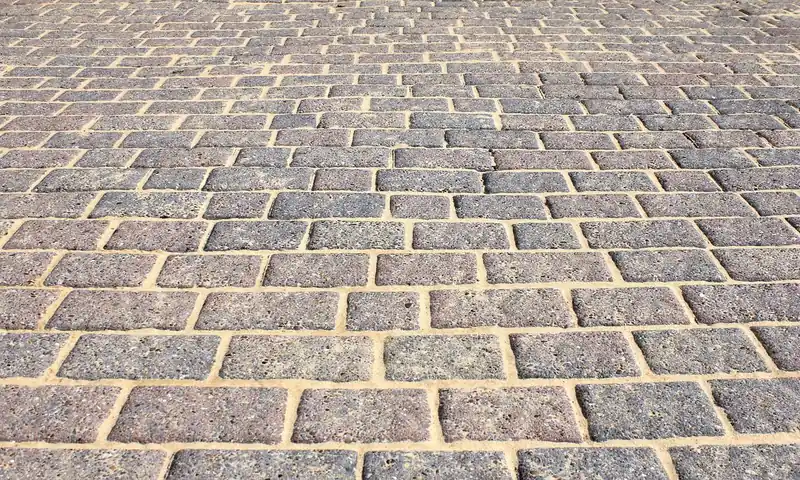
Joint width is the biggest variable for polymeric sand. One paver maker lists Alliance Gator Super Sand Bond at 65 to 85 square feet per 50 lb bag for narrow joints and 22 to 42 for wide joints. Tumbled pavers and natural stone with irregular gaps sit at the wide end.

Paver size changes the joint length. Small 4 by 8 inch units create far more linear feet of joint per square foot than 12 by 12 slabs, so they eat more joint sand for the same area.
Product choice moves the price. Plain joint sand costs a fraction of polymeric sand but washes out and lets weeds and ants in. Polymeric sand resists that once cured. Region applies on top: in a high cost state the default bedding sand becomes $15 to $34.
Loose delivery versus bags is the last lever. Bulk sand by the ton costs far less per pound than bagged sand, but small orders can carry a delivery fee larger than the sand.
Planning scenarios: Basic, Standard and Premium
| Level | Job | Bedding sand | Polymeric bags | Sand, typical total |
|---|---|---|---|---|
| Basic | Walkway 4 × 36 ft (144 sq ft) | 0.59 t (24 bags) | 5 | $24 + $180 |
| Standard | Patio 12 × 16 ft (192 sq ft) | 0.79 t (32 bags) | 7 | $32 + $252 |
| Premium | Driveway 20 × 40 ft (800 sq ft) | 3.28 t (132 bags) | 27 | $131 + $972 |
The walkway and patio sit in bag territory for bedding sand. The driveway needs 3.28 tons of bedding sand, a bulk delivery for sure, and 27 bags of polymeric sand at a typical $972, with a range of $648 to $1,620. All three use a 1 inch bed, since bedding depth does not grow with traffic the way base depth does.
Buying notes for paver sand
- Bedding sand is a coarse, washed concrete sand. Fine play sand and mason sand hold water and shift under load.
- Polymeric sand needs dry weather before and after application. The bag label lists the cure window and the rain-free hours required.
- Bags must stay dry until use. Polymeric sand that gets damp in storage can set in the bag.
- Gray, tan and charcoal colors are common. A test patch on a spare paver shows the cured color.
- A leaf blower and a fine mist nozzle are part of the polymeric kit. Haze left on the paver surface is hard to remove later.
- One extra bag of joint sand covers touch ups after the first heavy rain settles the joints.
Sand and joint quote checklist
- Bedding sand type, such as washed concrete sand, and its screeded thickness
- Joint sand product named, including polymeric brand and color
- Weather window for polymeric sand and who reapplies it after an early rain
- Blowing the surface clean before activation, so no haze is left on the pavers
- Compaction of pavers after sweeping joint sand in
- Touch up after the first heavy rains settle the joints
- Sealer type and timing if sealing follows the sand
- Warranty on joint washout and weed growth for the first season
Not included in the sand estimate
- Delivery fees for bulk sand
- Screed rails, screed board and hand tools
- Plate compactor rental and protective pad
- Gravel base, pavers and edge restraint
- Labor for screeding, sweeping and activation
- Sealer applied over the finished joints
Where sand work goes wrong and a pro helps
Polymeric sand is unforgiving. Too much water washes the binder out of the joints, too little leaves a crust over loose sand, and dust left on the paver faces cures into a hard haze. Installers who do it weekly get it right the first time, which costs less than stripping a hazed patio.
Sand problems often trace back to the base. Pavers that sink in one area, joints that keep opening or sand that washes out at one edge point to drainage or base failure, a repair that means lifting pavers. The paver sealing cost guide covers the sealers often applied over cured joints.
Dry sand and cutting both make dust. Polymeric sand contains fine silica, so a dust mask suits the sweeping stage, and eye protection suits blower work.
Cost data note
Sand figures use national bands set for October 2026: bedding sand at $25 to $55 per ton and polymeric sand at $24 to $60 per 50 lb bag. Prices get a fresh review every three months. Polymeric coverage of 30 square feet per bag is a planning estimate, the bedding depth guidance follows ICPI Tech Spec 10, and the narrow and wide joint coverage comes from a paver maker’s listing for one polymeric product.
Frequently asked questions
How much sand for a 10 by 10 paver patio?
0.41 tons of bedding sand at 1 inch, or 17 bags of 50 lb. The joints need about 4 bags of polymeric sand at the default coverage.
How thick should sand be under pavers?
1 to 1 1/2 inches, screeded and left uncompacted, per ICPI. A thicker sand bed lets pavers rock and settle.
How many square feet does a 50 lb bag of polymeric sand cover?
30 square feet as the calculator’s planning figure. One product listing gives 65 to 85 square feet for narrow joints and 22 to 42 for wide joints, so the bag label for the chosen product decides the final count.
How many bags of sand are in a ton?
40 bags of 50 lb. A ton of bedding sand covers about 244 square feet at 1 inch deep with the 1.33 density used here.
Can bedding sand be used in the joints?
Yes, plain sand works as joint sand, but it washes out over time. Polymeric sand costs more and holds longer, and many installers sweep it in after the pavers are compacted.
Related calculators
- Paver quantity calculator for the number of pavers that sit on the sand
- Paver base gravel calculator for the compacted layer under the bedding sand
- Bagged concrete calculator for a concrete edge restraint or a set of bagged footings
- Mortar calculator for a mortared border course or a seat wall beside the patio
The paver tools hub groups every calculator for paved surfaces in one place, and the guide to paver installation cost shows how sand fits into the price of a finished patio.