By Muhammad Awais. Prices reviewed October 2026.
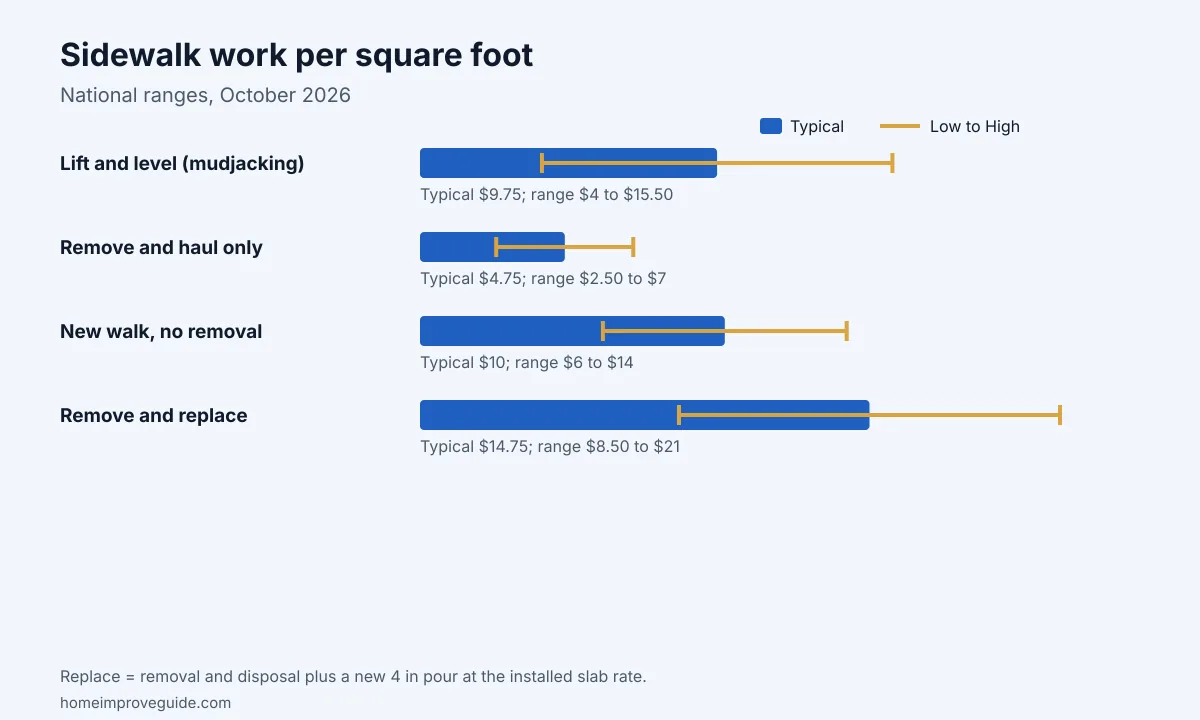
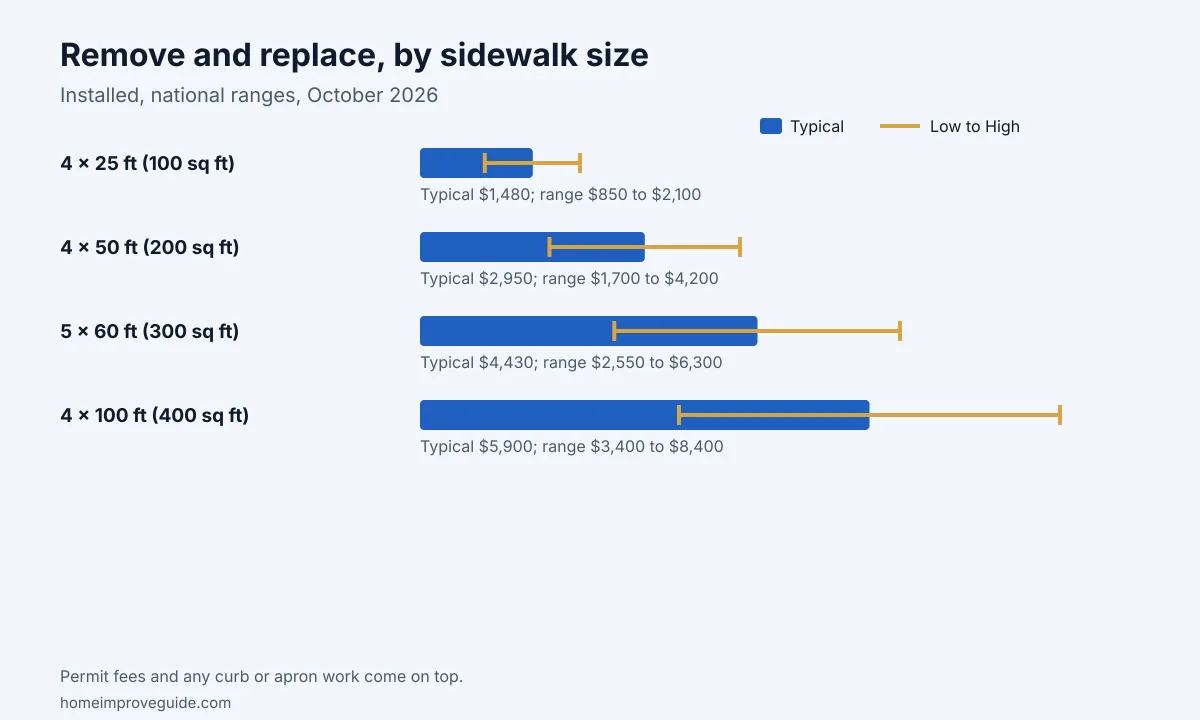
Replacing a concrete sidewalk costs $8.50 to $21 per square foot, with $14.75 typical in October 2026. That sidewalk replacement cost combines two parts: breaking out and hauling away the old concrete at $2.50 to $7.00 per square foot, and pouring a new 4 inch walk at $6 to $14. A 4 by 50 foot front walk therefore runs $1,700 to $4,200, with $2,950 typical. Panels that are sound but sunken can often be lifted instead, at $4.00 to $15.50 per square foot.
| Sidewalk job | Sq ft | Replace, Low | Typical | High | New walk only, typical |
|---|---|---|---|---|---|
| One 5 by 5 ft panel | 25 | $213 | $369 | $525 | $250 |
| Front walk, 4 by 25 ft | 100 | $850 | $1,480 | $2,100 | $1,000 |
| Front walk, 4 by 50 ft | 200 | $1,700 | $2,950 | $4,200 | $2,000 |
| Street frontage, 5 by 60 ft | 300 | $2,550 | $4,430 | $6,300 | $3,000 |
| Long walk, 4 by 100 ft | 400 | $3,400 | $5,900 | $8,400 | $4,000 |
The last column prices a new walk where nothing has to be removed, at the installed concrete rate alone.
Repair, lift or replace
Not every damaged walk needs new concrete. The right fix depends on what failed.
- Hairline cracks. Fine cracks in a level slab are mostly cosmetic and can be sealed to keep water and weeds out.
- Small trip edges. A lip where one panel sits slightly higher than the next can be ground down, a common fix for cities working through hazard lists.
- Sunken panels in one piece. Mudjacking or foam lifting pumps material under the slab to raise it back to level, at $4.00 to $15.50 per square foot.
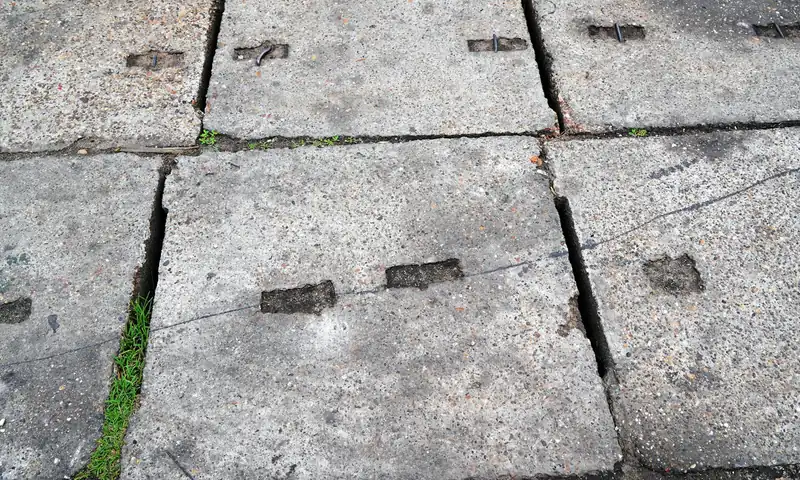
- Broken, heaved or crumbling panels. Concrete split into pieces, pushed up by roots or scaling from salt has reached the end of its life, and replacement is the lasting fix.
On 200 square feet of walk, lifting at the typical rate costs about $1,950, while full replacement costs about $2,950. Lifting saves money only while the slabs themselves stay intact.
Who pays for the public sidewalk
Rules for the public walk in front of a property are set city by city. Many municipalities make the adjacent owner responsible for repairs, some share the cost or run a citywide replacement program, and some handle all public walks themselves. Damage from a city street tree is often treated differently from ordinary wear. The local public works or street department publishes the rules, the required thickness and joint pattern, and the permit process for work in the public right of way.
Sizing the concrete for a new walk
The concrete calculator below includes a sidewalk setting. Length, width and thickness give the cubic yards and the bag count, and the result prices ready mix against bagged mix.
Concrete to order, with waste
1.36 cu yd
Before waste: 1.23 cu yd (33.33 cu ft)
| Volume before waste | 33.33 cu ft |
|---|---|
| Volume with waste | 36.67 cu ft |
| 80 lb bags | 62 bags |
| 60 lb bags | 82 bags |
| 40 lb bags | 123 bags |
| Item | Low | Typical | High |
|---|---|---|---|
| Ready mix concrete with delivery | $250 | $324 | $408 |
| 80 lb bags | $310 | $403 | $496 |
| 60 lb bags | $369 | $451 | $574 |
| 40 lb bags | $492 | $554 | $738 |
Planning estimate only, not a contractor quote. Prices are United States national ranges, updated October 2026. How these estimates are built
A 4 by 50 foot walk poured 4 inches thick needs 2.72 cubic yards with a 10 percent allowance. Delivered ready mix for that volume costs about $548 typical, while 123 bags of 80 lb mix would cost about $800. The installed price in the table above includes forms, base, finishing and labor on top of the concrete itself.
Cost factors on a sidewalk job
- Removal. Breaking out and hauling old concrete adds $2.50 to $7.00 per square foot, more when the slab is thick or reinforced.
- Tree roots. Roots that lifted the old walk have to be cut or rerouted, often with an arborist’s advice, or the new walk will heave again.
- Thickness and reinforcement. Walks that cross a driveway apron are often required to be thicker, and that section prices closer to driveway rates.
- Permit and inspection. A public sidewalk permit costs $50 to $100 in many towns, plus any inspection fees.
- Small jobs. A single panel carries a crew’s full setup cost, so one 5 by 5 foot panel at $369 typical costs more per square foot than a long run.
- Region. State price levels apply as well, about 15 percent lower in cheap markets and 25 percent higher in costly ones.
Doing it without a contractor
A homeowner can replace a few private walkway panels with rented breaking tools, a wheelbarrow and bagged or delivered concrete. The labor is heavy: broken concrete weighs a great deal, and hauling it away takes a truck or a dumpster. Forming straight edges, setting a slight cross slope for drainage, floating, edging and cutting joints all take practice.
Public sidewalks are different. Most cities require a licensed and insured contractor, a right of way permit and an inspection, and they set the slope, thickness, finish and joint spacing. Work done without the permit can be ordered torn out at the owner’s expense.
Mistakes that make a sidewalk fail early
- No compacted base. A walk poured straight onto soft or organic soil settles unevenly and cracks within a few seasons.
- Ignoring the roots. A new walk over the same roots heaves again, sometimes within a couple of years.
- No cross slope. A flat walk holds water that freezes on the surface and pools against the house or the curb.
- Salt on new concrete. De icing salt on a walk in its first winter causes surface scaling and flaking.
- Joints too far apart. Control joints spaced too widely let the slab crack wherever it shrinks.
Sidewalk replacement quote checklist
A sidewalk bid should spell out the following so two contractors can be compared fairly.
- Square footage removed and replaced, and the number of panels
- Haul away and disposal of the old concrete, with any dumpster cost
- Thickness, with thicker sections at driveway crossings noted
- Base material and compaction under the new walk
- Root cutting or root barrier, and who decides on the cuts
- Joint spacing, edge finish and surface texture required by the city
- Right of way permit, inspection and traffic or pedestrian protection
- Restoration of grass or landscaping along the edges and a workmanship warranty
When a licensed contractor is needed
Work on a public sidewalk, curb ramps and driveway aprons in the street right of way usually requires a licensed contractor and a city permit. Ramps must meet accessibility rules for slope and detectable warnings. Before breaking ground near the street, a utility locate through 811 marks gas, water and power lines.
Cost data note
The replacement rate is a sum: a sourced removal range, averaged across two published national sources, plus the site’s installed concrete rate, as the methodology page describes. Lifting and permit figures come from published data as well. Ranges reflect October 2026; a fresh check follows every 3 months.
Frequently asked questions
What is the sidewalk replacement cost per square foot?
Removal plus a new 4 inch walk costs $8.50 to $21 per square foot, with $14.75 typical. A new walk where nothing has to come out costs $6 to $14.
What does a single sidewalk panel cost to replace?
A single 5 by 5 foot panel costs $213 to $525 to replace, with $369 typical. Contractors often have a minimum charge, so several panels done together cost less each.
Is mudjacking cheaper than replacing a sidewalk?
Lifting runs $4.00 to $15.50 per square foot against $8.50 to $21 for replacement. It only works on panels that are sunken but still in one piece.
Who is responsible for repairing the sidewalk in front of a house?
It depends on the city. Many make the adjacent property owner responsible, some share the cost, and some repair public walks themselves. The local public works department sets the rule.
How long does a new concrete sidewalk last?
A well built walk on a good base lasts for decades. Roots, poor drainage, salt and heavy vehicles crossing it shorten that life the most.
More on concrete projects
The concrete calculators page groups every concrete tool. Related guides cover slab installation prices, the price of ready mix and house foundations, and the guide listing has the rest.