A mortar calculator answers a narrow question that trips up a lot of masonry orders: how many bags to buy for a known number of blocks or bricks. The answer depends on what goes in the bag. Premixed mortar mix already holds cement and sand, so one 80 lb bag lays only about 12 standard blocks or 37 bricks. A site mix starts with a 70 lb bag of masonry cement and adds 240 lb of sand, which stretches one bag to about 46 blocks or 144 bricks. The tool counts bags for both routes, lists the sand for a site mix and prices each with Low, Typical and High ranges.
Premixed mortar bags
15 bags
Coverage per bag: 12 units
| Units laid | 180 units |
|---|---|
| Total bag weight | 1,200 lb |
| Item | Low | Typical | High |
|---|---|---|---|
| Mortar mix, 80 lb bags | $165 | $210 | $255 |
Planning estimate only, not a contractor quote. Prices are United States national ranges, updated October 2026. How these estimates are built
How to read the mortar result
In premixed mode the main figure is the number of bags, with the coverage per bag beneath it. The table adds the total bag weight, which matters for a pickup truck or a trip up a ladder: the default 180 blocks need 15 bags of 80 lb mix, 1,200 lb in all. Bags cost $11 to $17 for the 80 lb size and $9 to $15 for the 60 lb size.
In site mix mode the main figure is masonry cement bags. The sand gets its own lines in pounds and tons, since sand usually comes loose by the ton from a supply yard. The cost table splits cement at $11 to $18 a bag and sand at $30 to $65 a ton. Mortar volume appears too, at about 2.75 cubic feet per cement bag. The notes on estimating methods list both data sources.
Mortar formulas behind the counts
- Premixed bags = units laid ÷ coverage per bag, rounded up
- 80 lb premixed coverage: 12 blocks or 37 bricks; 60 lb coverage: 9 blocks or 28 bricks
- Masonry cement bags = units laid ÷ 46 for blocks or ÷ 144 for bricks, rounded up
- Mason sand (lb) = cement bags × 240; tons = pounds ÷ 2,000
QUIKRETE data sheets supply every coverage figure, which assumes 8 × 8 × 16 inch block and standard brick laid with ordinary joints. For the default of 180 blocks, 180 ÷ 12 = 15 bags of premixed mix. The same blocks laid with site mixed mortar need 180 ÷ 46, rounded up to 4 cement bags, and 960 lb of sand.

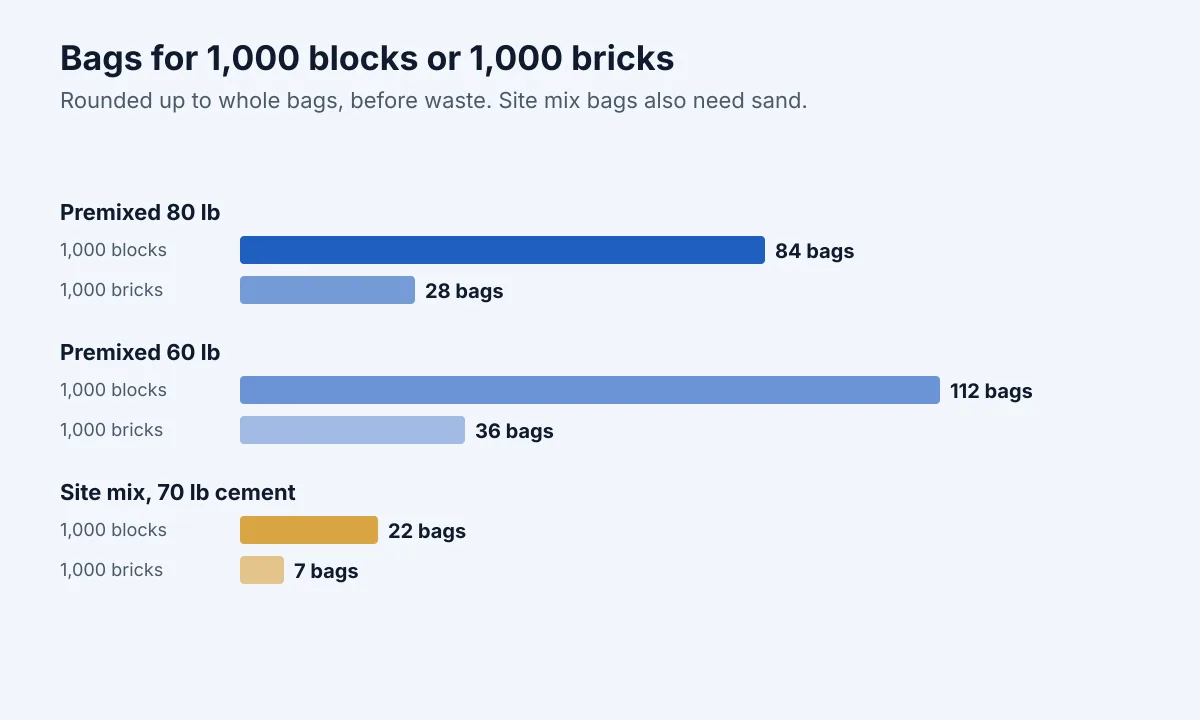
Blocks use far more mortar per unit than bricks. A block’s bed joint runs the full length of two face shells and its head joints are tall, so one premixed bag lays about a third as many blocks as bricks. The chart shows bags for 1,000 units of each.
Mixing and using the order
- The unit count comes first, before waste. The block and brick calculators on the site show it as the count before waste.
- The mix route depends on job size. Premixed bags need only water and suit small jobs and repairs, while site mixing saves money once a wall runs to hundreds of units.
- For a site mix, the cement and sand get measured by the same method every batch, often in shovels or buckets, so the color and strength stay even.
- Batches stay small enough to use within a couple of hours. Mortar that starts to stiffen can be retempered with a little water early on, but old mortar gets thrown out.
- Hot, dry or windy weather pulls water out of joints quickly. Damp burlap or misting keeps fresh work from drying too fast.
- A spare bag on site covers droppings and fuller joints than planned, since data sheet coverage counts only the mortar that ends up in the wall.
Worked example: mortar for 2,160 bricks
A 40 by 8 foot garden wall in modular brick takes 2,160 bricks before waste. The comparison below runs both mixes at national prices.
| Mix | Bags | Sand | Material cost |
|---|---|---|---|
| Premixed, 80 lb bags | 59 (4,720 lb) | Included | $649 to $1,000 (typical $826) |
| Site mix, 70 lb masonry cement | 15 | 3,600 lb (1.80 tons) | $219 to $387 (typical $291) |
The site mix route costs about a third as much in material and makes about 41.3 cubic feet of mortar. It also needs a mixer or a mortar box, a pile of sand and steady batching, while 59 premixed bags weigh over two tons and fill several pickup loads. Most masons laying a wall of this size mix on site.
What changes mortar quantity and cost
Joint size has a large effect. Data sheet coverage assumes standard joints, and a joint that runs thicker than planned, or a fully grouted head joint where a lighter one was assumed, uses more mortar per unit.
Unit type matters next. Hollow block needs mortar only on the face shells in most walls, while bricks are fully bedded. Oversized bricks and textured block both pull more mortar.
Mix route drives price. At typical prices an 80 lb premixed bag and a 70 lb masonry cement bag cost about the same, $14 and $14, yet the cement bag with sand lays several times as many units. Sand at $45 a ton typical adds little.
Region sits on top. The default 180 block order costs $206 to $319 in a high cost state.
Planning scenarios: Basic, Standard and Premium
| Size | Units | Premixed 80 lb bags | Premixed, typical | Site mix cement + sand | Site mix, typical |
|---|---|---|---|---|---|
| Basic | 60 blocks | 5 | $70 | 2 bags + 480 lb | $39 |
| Standard | 1,000 bricks | 28 | $392 | 7 bags + 1,680 lb | $136 |
| Premium | 600 blocks | 50 | $700 | 14 bags + 3,360 lb | $272 |
For a small raised bed, premixed bags make sense despite the higher unit cost, since buying and storing sand for two batches is a nuisance. At 1,000 bricks the site mix saves real money. At 600 blocks the gap reaches $700 against $272, and the 50 premixed bags would weigh two tons.
Buying notes for mortar
- Type N mortar suits most above grade walls, veneer and garden walls. Type S suits walls below grade, retaining walls and work that needs higher strength.
- Mortar mix is not concrete mix. Concrete mix contains gravel and cannot form a thin, smooth joint.
- Mason sand is finer and more uniform than concrete sand. QUIKRETE specifies sand meeting ASTM C144 for its masonry cement.
- Colored mortar comes premixed or as a pigment added to site mixes, and a test panel shows the cured color.
- Bags must stay dry. Cement that absorbs moisture in the bag forms lumps and loses strength.
- Buying all masonry cement from one lot keeps the joint color consistent along the wall.
Masonry quote checklist for mortar
- Mortar type for each wall, Type N or Type S, written on the bid
- Premixed bags or a site mix of masonry cement and sand
- Mortar color and a test panel when the joints will be seen
- Joint width and tooling profile for brick and block
- Cold or hot weather procedures, such as covering fresh work
- Repointing work on older walls, with a mortar matched to the original
- Cleanup of mortar smears and droppings around the wall
- Workmanship warranty on cracked or loose joints
What the mortar estimate does not cover
- Grout or concrete for filled block cores
- Mixer rental, mortar box, hoe and wheelbarrow
- Water and any admixtures or color
- Labor, delivery and sand delivery fees
- Blocks, bricks, ties and reinforcement
- Waste beyond the units laid; a spare bag is cheap insurance
When a mason is worth hiring
Mixing mortar is simple, but laying a straight, plumb wall with full, tooled joints takes practice. Structural walls, chimneys, veneer on a house and retaining walls all carry code requirements for mortar type, reinforcement and ties, and a mason or engineer should set those.
Repointing old brick is a special case. Older walls laid with soft lime mortar can crack or spall if repointed with a hard modern mix, so historic masonry calls for a mortar matched to the original.
Wet cement is caustic. Gloves, long sleeves and eye protection prevent cement burns, and mixing dry bags indoors or in wind raises dust that calls for a mask.
Cost data note
Mortar figures reflect national planning prices for October 2026 and get reviewed every three months: premixed bags at $11 to $17 for 80 lb and $9 to $15 for 60 lb, masonry cement at $11 to $18 per 70 lb bag and mason sand at $30 to $65 per ton. Coverage figures come from the QUIKRETE Mortar Mix and Masonry Cement data sheets and are approximate. A local supply yard price takes priority.
Frequently asked questions
How many bags of mortar for 100 blocks?
9 bags of 80 lb premixed mortar mix, at about 12 blocks per bag. With site mixed mortar, 100 blocks need 3 bags of 70 lb masonry cement plus sand.
How many bricks does an 80 lb bag of mortar lay?
About 37 standard bricks, according to QUIKRETE’s coverage table for Mortar Mix. The smaller 60 lb bag covers roughly 28.
What type of mortar is used for a garden wall?
Type N in most cases. It is the general purpose mortar for above grade walls, while Type S is the choice for walls that retain soil or sit below grade.
How much sand goes with a bag of masonry cement?
240 lb of mason sand per 70 lb bag in the QUIKRETE mix design, which yields about 2.75 cubic feet of mortar.
Is premixed mortar or site mix cheaper?
Site mix, by a wide margin on large jobs. On 1,000 bricks the typical material cost is $136 for site mix against $392 for premixed bags.
Related calculators
- Brick count calculator for the bricks the mortar binds
- Block wall calculator for CMU walls sized by area
- Cinder block calculator for raised beds and garden walls counted by courses
- Concrete bag calculator for footings and core fill, where concrete mix replaces mortar
- Paver sand calculator for a patio laid next to a new block or brick wall
The masonry calculators hub gathers every block, brick and mortar tool.