A cinder block calculator counts blocks the way most backyard builders think about them: so many feet of run, so many rows high. Raised garden beds, fire pit rings, garden walls and shed skirting usually go up a course at a time, and each course of standard block adds 8 inches of height. The tool takes the run length and the number of courses, rounds every course up to whole blocks, then adds waste and mortar. A second mode works from wall height and subtracts any door or window openings. Results include blocks to buy, mortar bags and a material cost range by block width.
Blocks to buy, with waste
60 blocks
Before waste: 54 blocks
| Blocks per course | 18 blocks |
|---|---|
| Finished height | 2.00 ft |
| Wall face area | 48.0 sq ft |
| Mortar, 80 lb bags | 5 bags |
| Item | Low | Typical | High |
|---|---|---|---|
| Blocks | $120 | $165 | $210 |
| Mortar, 80 lb bags | $55 | $70 | $85 |
| Material total | $175 | $235 | $295 |
Planning estimate only, not a contractor quote. Prices are United States national ranges, updated October 2026. How these estimates are built
What the cinder block result shows
The figure in large type is the number of blocks to bring home, waste included. In course mode the table also lists blocks per course and the finished height, which answers the most common planning question for a bed or a seat wall: how tall will this be with three rows, or four. The default run of 24 feet at 3 courses stands 2.00 feet tall and needs 54 blocks before waste.
Mortar counts use the coverage QUIKRETE prints for its Mortar Mix, roughly 12 blocks per 80 lb bag, applied to laid blocks before waste. Dry stacked raised beds skip mortar entirely, so that line and its cost can be ignored for a mortarless bed. Prices follow block width, with 8 inch block at $2.00 to $3.50 each. The page on how the estimates work covers rounding and the region factor.
Course math for cinder block
- Blocks per course = run length × 12 ÷ 16, rounded up
- Blocks = blocks per course × courses
- Height = courses × 8 inches
- Wall mode: blocks = (length × height − openings) × 1.125, rounded up
- Premixed mortar, 80 lb bags = laid blocks ÷ 12, round up to whole bags
A standard block has a nominal face of 8 by 16 inches, mortar joint included, so one linear foot of a single course holds 0.75 blocks and a square foot of wall holds 1.125. For the default 24 foot run, 24 × 12 ÷ 16 gives exactly 18 blocks per course and 54 for three courses. With 10 percent waste the order is 60 blocks and 5 bags of mortar, a typical $235 in material.
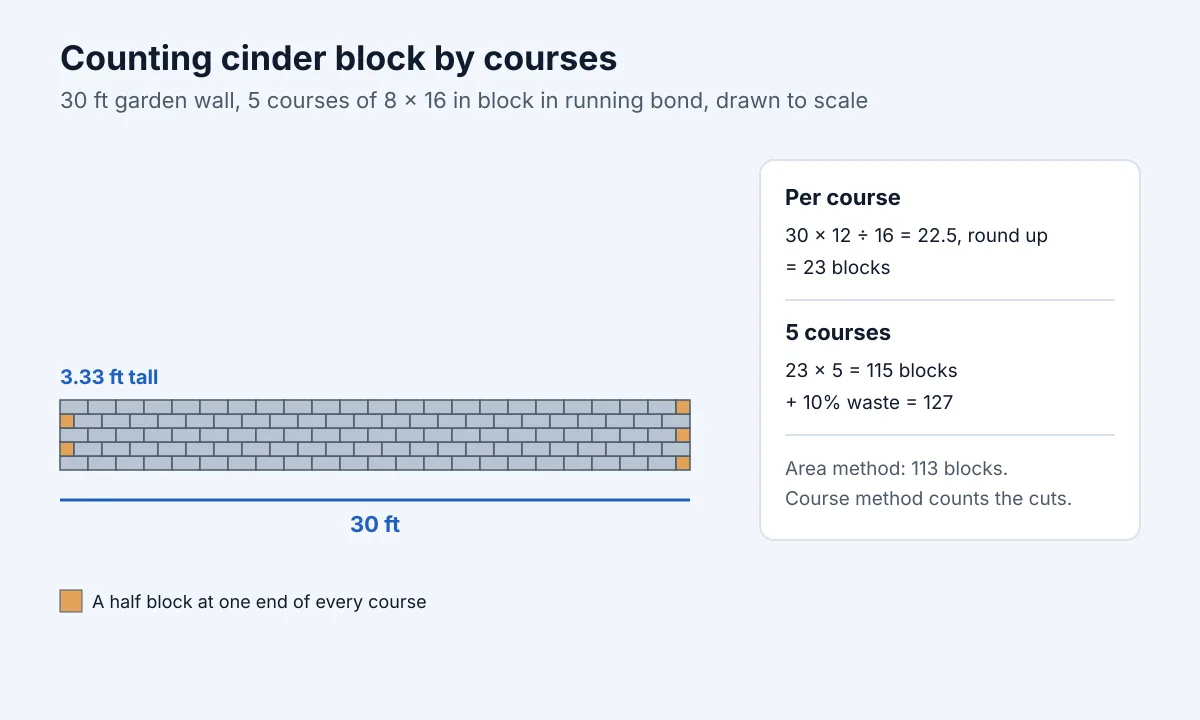
Rounding each course up matters on short runs. A 30 foot wall needs 22.5 blocks per course by pure arithmetic, but a course cannot hold half a block without cutting one, so the tool counts 23. The area method gives 113 for the same wall, two fewer than the course method’s 115.

Laying out a cinder block project
- The run gets measured along the centerline of the blocks. For a rectangle such as a raised bed, that means all four sides added together, measured to the middle of the block width.
- The height target turns into courses. A 4 foot wall is 6 courses of 8 inch block, and a waist high seat wall is usually 3 courses plus a cap.
- A level, compacted footing or gravel pad goes down first. Mortared walls need a concrete footing, while low dry stacked beds often sit on compacted gravel.
- The first course sets the line for everything above it, so it goes down on a full mortar bed and gets checked for level in both directions.
- Running bond offsets each course by half a block. Every other course starts with a half block or a cut, which the course method already covers by rounding up.
- Cap blocks or solid top units finish the wall and keep water out of the cores.

Worked example: a 30 foot garden wall, five courses
A garden wall along a property line runs 30 feet and stands five courses high, a little over 3 feet. It uses 8 inch block, 10 percent waste and national prices.
| Result line | Number |
|---|---|
| Blocks per course | 23 |
| Finished height | 3.33 ft |
| Wall face area | 100.0 sq ft |
| Blocks before waste | 115 |
| Blocks to buy, with waste | 127 |
| Mortar, 80 lb bags | 10 |
| Material total | $364 to $615 (typical $489) |
The blocks make up $349 of the typical total and the mortar $140. A footing, cap blocks and any rebar or core fill add to that. At about 127 blocks, the order fits on a single pallet delivery from most yards.
Things that change a cinder block budget
Block width sets the price per unit while leaving the count alone, since every width in the menu shares the same face. Four inch block runs $1.60 to $2.70 each against $3.20 to $5.20 for the 12 inch unit, so a wall built from the widest unit costs roughly twice as much in block alone.
Specialty units cost more than standard stretchers. Split face and colored blocks, bond beam blocks for reinforced courses and solid cap blocks all carry a premium, and a decorative wall can use several types.
Mortared and dry stacked work differ in cost. Dry stacked beds save the mortar and much of the labor but suit only low, unloaded walls.
Region moves the material figure, and the default 24 foot, three course run in a high cost state comes to $219 to $369.
Planning scenarios: Basic, Standard and Premium
| Option | Project | Block | To buy | Mortar bags | Material, typical |
|---|---|---|---|---|---|
| Basic | Raised bed ring, 24 ft run, 2 courses | 8 in | 40 | 3 | $152 |
| Standard | Privacy wall, 40 ft long, 6 ft tall | 8 in | 297 | 23 | $1,140 |
| Premium | Shop wall 30 × 8 ft with a 3 × 7 ft door | 12 in | 272 | 21 | $1,410 |
The Basic raised bed is a weekend job that can go dry stacked, which would drop the mortar line. The Standard privacy wall at 6 feet needs a proper footing and reinforcement under most codes. The Premium shop wall in 12 inch block subtracts its door and still needs 272 blocks, and its material runs $1,100 to $1,770.
Notes for buying cinder block
- Most blocks sold as cinder block today are concrete masonry units made with sand and gravel or lightweight aggregate rather than coal cinders.
- Stretcher blocks have hollow cores and recessed ends. Corner and end blocks have a flat end for the exposed face of a wall.
- Half blocks save cutting at the ends of running bond courses.
- Cap blocks are thinner solid units that close the top of a wall or bed.
- Pallet counts differ by width and plant, and the yard can quote blocks per pallet for the chosen size.
- Blocks for a mortared wall should stay dry before laying, since wet units can shrink and crack joints as they dry.
Quote checklist for a cinder block project
- Mortared or dry stacked construction, stated clearly
- Base under the first course: concrete footing or compacted gravel pad, with depth
- Block type for ends, corners and the top, including caps
- Core fill, rebar or adhesive where the design calls for it
- Height limit before a permit or engineered design is required
- Drainage behind any wall that holds soil
- Delivery, staging and removal of broken or leftover block
- Price per course or per wall, and the final payment terms
Outside the cinder block estimate
- Concrete footing or gravel pad
- Rebar, bond beam units and grout or concrete for core fill
- Cap blocks, corner and half blocks priced separately
- Labor, mixer rental and saw rental
- Drainage behind any wall that holds soil
- Delivery fees and permits
When block work needs a mason or engineer
Height and load change the job. A garden bed or a knee high wall is ordinary DIY work, while a wall over a few feet tall, a wall that retains soil or a wall that carries a roof needs a footing below frost, steel in the cores and often an engineered design. Many towns require a permit for fences and walls over a set height.
Retaining walls are the most common failure. Soil and water push hard on the back of a wall, and a hollow block wall without reinforcement and drainage can lean or topple. The footing calculator sizes the concrete under a freestanding wall, but retaining walls deserve a professional design.
Blocks are heavy and cutting them throws silica dust. Gloves, eye protection, a dust mask or wet cutting, and careful lifting from the knees keep the work safe.
Cost data note
The block bands below reflect national planning prices for October 2026, with a fresh review on a three month cycle. Per unit, 4 inch block runs $1.60 to $2.70, 6 inch $1.90 to $3.10, 8 inch $2.00 to $3.50 and the 12 inch size $3.20 to $5.20. An 80 lb bag of mortar is priced between $11 and $17. The 1.125 blocks per square foot rate comes from the site configuration, and the yield of 12 blocks per mortar bag from the manufacturer’s coverage table.
Frequently asked questions
How many cinder blocks for a 4 foot wall?
48 blocks for every 10 feet of run before waste. A 4 foot wall is 6 courses of 8 inch block, and each course of a 10 foot run takes 8 blocks.
How many cinder blocks per square foot?
1.125. The nominal face of a standard block is 8 by 16 inches including the mortar joint, which is 128 square inches.
How many cinder blocks for a raised garden bed?
54 blocks for a bed with a 24 foot centerline run, three courses high. A two course bed of the same size needs 36.
How much does a cinder block cost?
$2.00 to $3.50 for a standard 8 inch block as a national planning range, $2.75 typical. Narrow 4 inch block starts lower and 12 inch block runs higher.
How many courses tall is an 8 foot block wall?
12 courses. Each course of standard block rises 8 inches, mortar joint included.
Related calculators
- Concrete block wall estimator for CMU walls sized by area
- Mortar bag estimator for a mortar order from a block count
- Strip footing calculator for the concrete under a mortared block wall
- Brick veneer calculator for a brick face over a block wall
- Concrete bag counter for filling block cores or setting posts
The masonry tools hub lists every block, brick and mortar calculator.