By Muhammad Awais. Prices reviewed October 2026.
Every plumber cost estimate starts with two numbers: the hourly rate and the service call. Nationally, licensed plumbers charge $60 to $175 an hour, with $90 as the typical figure, and most open a visit with a service call of $75 to $225 that usually covers the first hour on site. A typical repair visit lands between $180 and $500, with $340 as the planning figure. Nights, weekends and holidays move the labor to $125 to $170 an hour.
| Plumber charge | Low | Typical | High |
|---|---|---|---|
| Plumber, per hour | $60 | $90 | $175 |
| Service call, usually covers the first hour | $75 | $150 | $225 |
| Emergency or after hours, per hour | $125 | $150 | $170 |
| Typical plumbing visit, per job | $180 | $340 | $500 |
Prices for common plumbing jobs
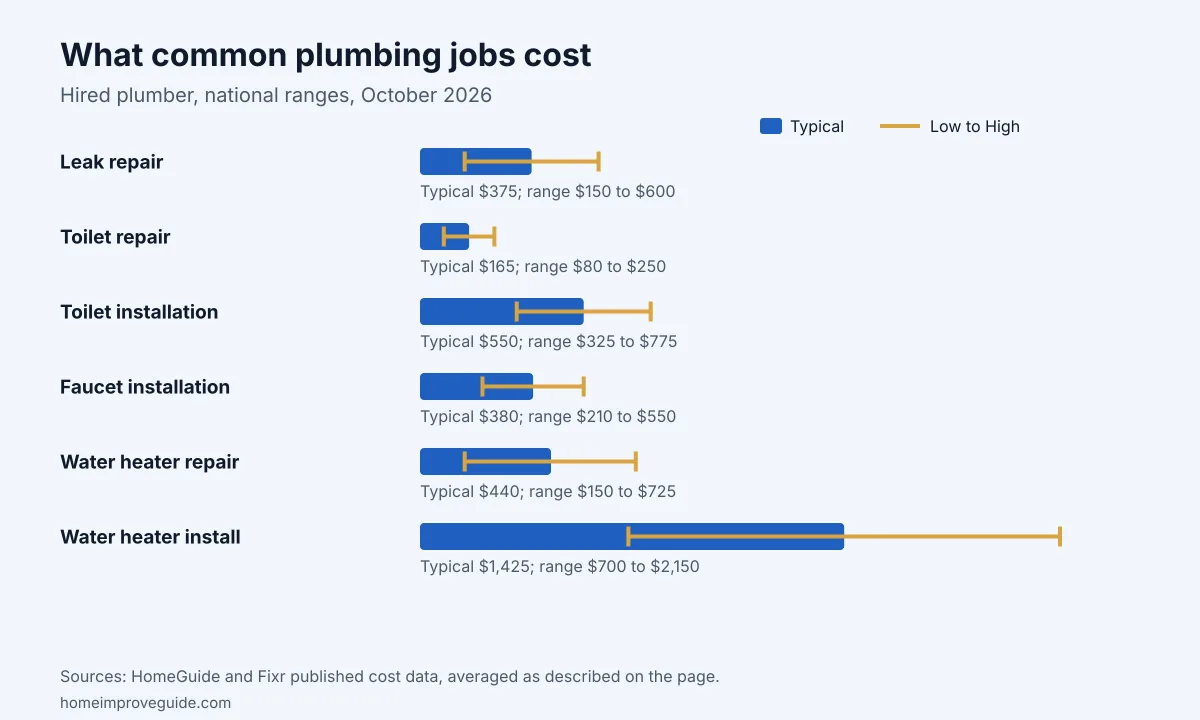
Most residential calls fall into a short list of repairs and replacements. The installed prices below include the plumber’s labor and standard parts, and the fixture itself for installations unless the owner supplies it. Clearing a clogged drain is priced separately in the drain guide, where a single drain visit runs $111 to $451.
| Job | Low | Typical | High |
|---|---|---|---|
| Leak repair, per job | $150 | $375 | $600 |
| Toilet repair | $80 | $165 | $250 |
| Toilet installation | $325 | $550 | $775 |
| Faucet installation | $210 | $380 | $550 |
| Water heater repair | $150 | $440 | $725 |
| Water heater installation | $700 | $1,425 | $2,150 |
The spread inside each row reflects access more than skill. A leak at an exposed trap under a sink is a short visit, while a leak inside a finished wall needs the drywall opened, the pipe repaired and the opening left for another trade to close. Water heater installation spans the widest band because tank size, fuel type, venting and code upgrades such as expansion tanks and seismic straps all vary by house.
How plumbers bill a visit
Three billing methods cover nearly every residential plumber, and a single company may use more than one:
- Service call plus hourly. The visit fee covers travel and the first hour, and each later hour bills at the hourly rate. Parts are added at the plumber’s price.
- Flat rate by task. Many larger firms work out of a price book that sets one fixed charge for each task, such as a new fill valve or a wax ring, however long it takes. The quote arrives before work starts, which removes the risk of a slow job but often costs more on easy ones.
- Trip charge plus labor. Some plumbers bill a smaller travel fee that does not include any work time, then charge from the first minute of labor.
Minimum charges matter on small jobs. A five minute fix still costs the full service call, so owners with several small problems save by listing every one of them for the same visit.
Worked example: a two hour leak repair
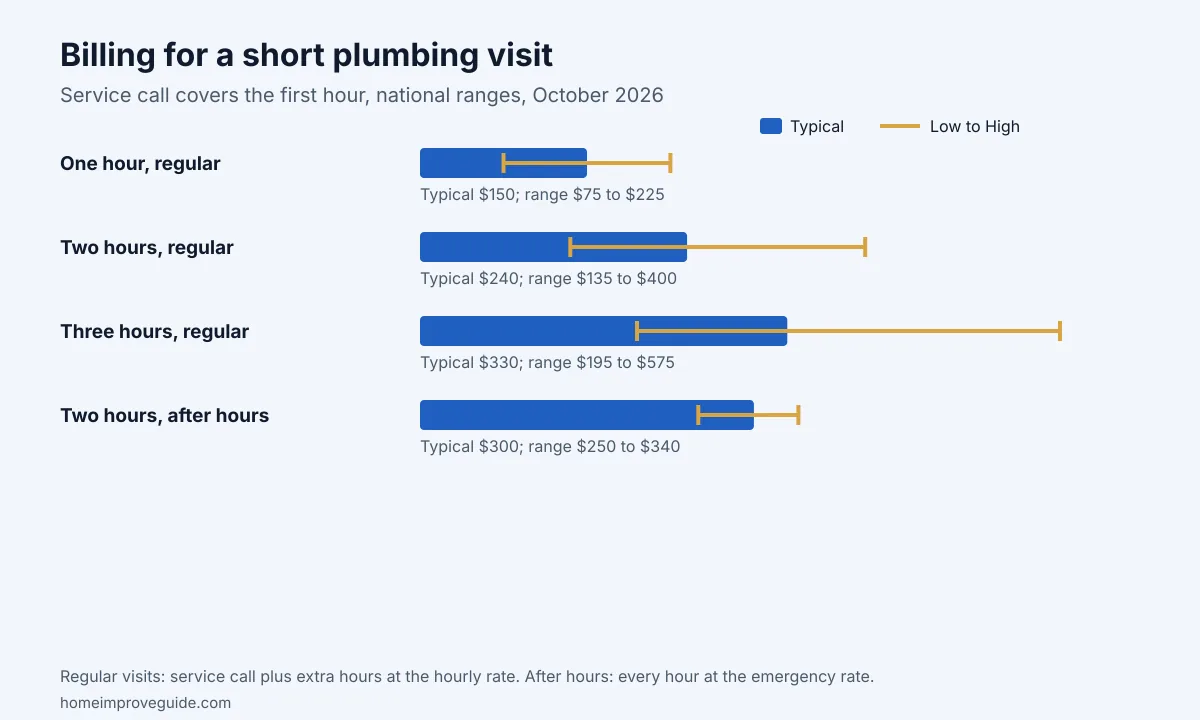
A leaking supply line under a bathroom vanity takes two hours to diagnose and replace on a weekday morning. The plumber bills a service call for the first hour and the hourly rate for the second.
- Service call, first hour included: $75 to $225.
- Second hour at the hourly rate: $60 to $175.
- Labor total: $135 to $400, with $240 typical, before the cost of the new supply line and valve.
A third hour brings the typical labor to about $330. The same two hours on a Saturday night at the emergency rate run $250 to $340, or $300 typical, about $60 more than the weekday visit.
After hours and emergency calls
Burst pipes, a failed water heater flooding a basement and sewage backing into a tub cannot wait for Monday. Plumbers who answer at night price that availability into the hourly rate, often at one and a half to three times the daytime figure, and some add a flat call out fee on top. The first step in any water emergency is closing the main shutoff valve, usually found where the water line enters the house or at the meter. Once the water is off, many leaks can wait for the morning rate, and the after hours visit can be limited to making the house safe.
What pushes a plumbing bill up
- Access. Pipes inside finished walls, under slabs or in tight crawl spaces add hours and may need other trades to repair the openings.
- Age of the system. Galvanized steel, polybutylene and old cast iron break easily when touched, so one repair often turns into two.
- Code upgrades. Replacing a water heater or a fixture can trigger requirements for expansion tanks, vacuum breakers or new venting.
- Parts. Fixture grade, valve brands and pipe material change the parts bill, and some plumbers mark up parts they supply.
- Licensing level. Master plumbers charge more than journeymen, and a crew with an apprentice may bill two hourly rates.
- Region. Labor follows local wages, so the typical visit of $340 becomes about $425 in the higher cost states and about $289 in the lower cost ones, which sit 25 percent above and 15 percent below the national level.
Licensed plumber, handyman or DIY
Swapping a faucet cartridge, replacing a toilet flapper and clearing a sink trap are common owner repairs that need basic tools and a little patience. A handyman may take on similar small tasks, but most states restrict work on supply lines, drains, gas piping and water heaters to licensed plumbers, and many require a permit and inspection for water heater replacement and new fixtures. A licensed plumber carries insurance, pulls the permit and stands behind the work, which matters when a mistake means water damage inside a wall. Any job that touches the main water line, the sewer line or a gas connection belongs with a licensed professional.
Costs the plumber’s price leaves out
- Drywall, tile and flooring repair after pipes are reached through a finished surface.
- Fixtures and appliances the owner chooses above the standard grade in the quote.
- Permit and inspection fees, which vary with the city or county.
- Water damage cleanup, drying and mold treatment after a leak.
- Camera inspection and excavation for sewer line problems.
- Haul away of an old water heater, which some plumbers charge separately.
Plumber quote checklist
Comparing two quotes only works when both describe the same job, so each should spell out:
- The billing method: service call and hourly, flat rate or trip charge.
- What the service call includes, and the charge for each extra hour.
- The parts list with brands and prices, and any markup.
- Permit responsibility and the inspection date where one is needed.
- The after hours rate and when it starts.
- Who repairs walls or floors opened to reach the pipes.
- The warranty on labor and on parts, and its length.
Cost data note
Plumber rates average published national figures from HomeAdvisor, Fixr and HomeGuide, combined with the method described on the methodology page. The typical visit range rests on one source, HomeAdvisor, and the emergency hourly range draws its spread from HomeGuide alone. The HomeGuide plumber page was written in 2023, so it is paired with newer pages wherever possible and is first in line at the next review. The ranges carry the date October 2026 and come up for a fresh check on a 3 month cycle.
Frequently asked questions
How much does a plumber charge per hour?
Licensed plumbers charge $60 to $175 an hour nationally, with $90 as the typical rate. Emergency and after hours work runs $125 to $170 an hour.
What is a plumber’s service call fee?
A service call runs $75 to $225, with $150 as the typical figure, and it usually covers travel and the first hour of work.
How much does a typical plumbing repair cost?
A typical repair visit costs $180 to $500, with $340 typical. Leak repairs run $150 to $600, depending on where the pipe sits.
What does it cost to install a water heater?
A plumber installs a water heater for $700 to $2,150, with $1,425 as the midpoint, depending on tank size, fuel type and code upgrades.
Is a flat rate plumber cheaper than an hourly one?
Not always. A flat rate removes the risk of a slow job and fixes the price up front, but on quick tasks an hourly plumber often costs less, so comparing both quotes is worthwhile.
Related plumbing guides
The drain clearing guide covers clogs an owner can clear and the price of a plumber’s visit when the clog will not move. Whole house pipe replacement is priced in the repiping guide, and the gas line guide covers appliance hookups that many plumbers also handle. Electrical repairs are priced in the electrician cost guide, and the full list of guides groups every topic by trade.