By Muhammad Awais. Prices reviewed October 2026.
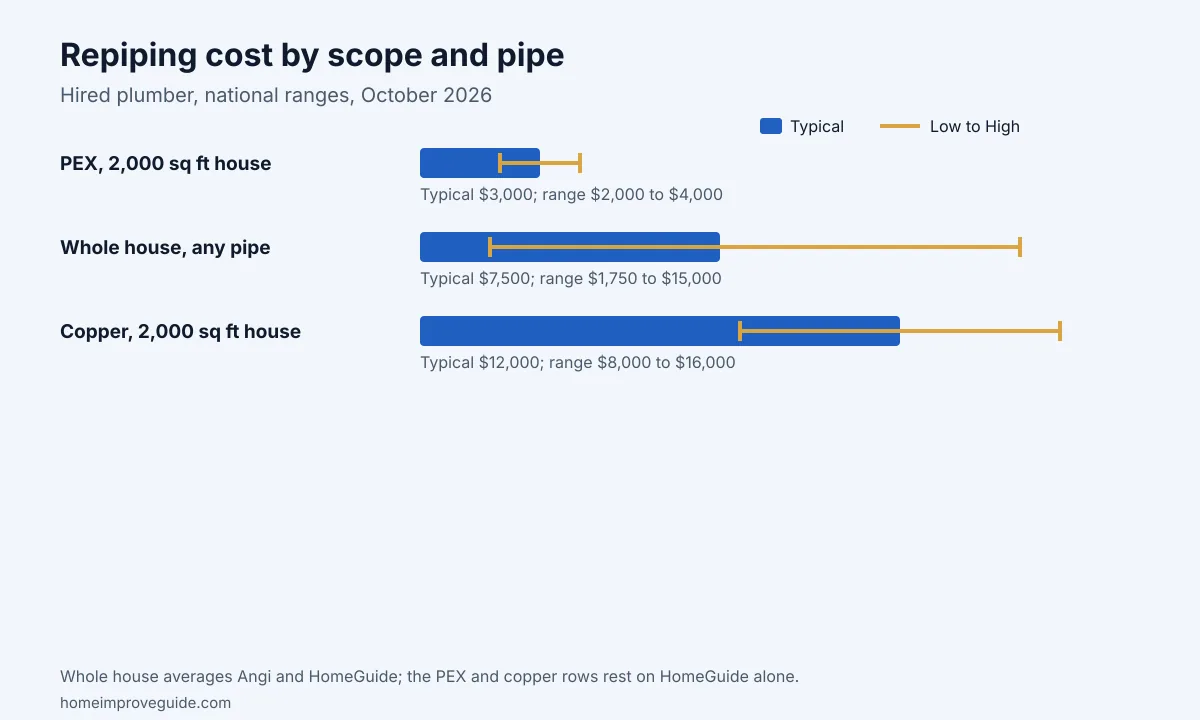
Repiping a house cost runs $1,750 to $15,000 nationally for replacing the water supply pipes throughout a home, and Angi puts the typical job at $7,500. Pipe material and house size decide where a job lands. HomeGuide prices a 2,000 square foot house at $2,000 to $4,000 with PEX tubing and $8,000 to $16,000 with copper, before the walls are patched.
| Repiping item | Low | Typical | High |
|---|---|---|---|
| Whole house repipe | $1,750 | $7,500 | $15,000 |
| PEX repipe, 2,000 sq ft house | $2,000 | $3,000 | $4,000 |
| Copper repipe, 2,000 sq ft house | $8,000 | $12,000 | $16,000 |
| Per fixture | $450 | $1,200 | $1,800 |
| Drywall repair afterward | $300 | $750 | $1,200 |
| Permit | $50 | $275 | $500 |
Signs a house needs new pipes
Repiping is usually a response to an aging system rather than a single leak. Galvanized steel pipes, common in houses built before the 1960s, corrode from the inside, which narrows the bore and leaves rusty or brown water. Polybutylene, a gray plastic used from the late 1970s into the 1990s, can fail without warning at fittings. Other signs include repeated pinhole leaks in copper, low pressure at several fixtures at once, and water that tastes metallic. When a plumber has repaired several leaks in a year, at $150 to $600 each, the repairs start to add up toward the cost of new pipe.
PEX, copper or CPVC
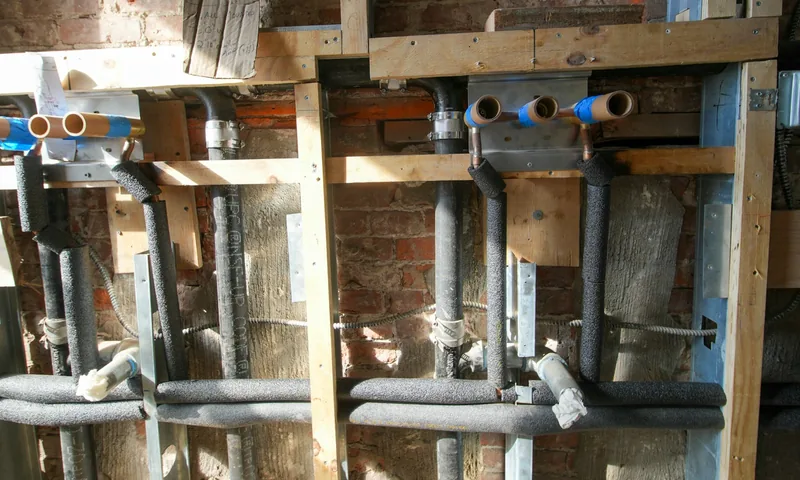
PEX is flexible plastic tubing that snakes through walls and floors with few fittings, which is why it costs the least to install and dominates whole house repipes. It resists freeze cracking better than rigid pipe but must be kept out of direct sunlight. Copper has a long service record, tolerates heat and looks familiar to buyers and inspectors, but it costs more in material and in labor, since every joint is soldered or pressed. CPVC, a rigid plastic, sits between the two on price and is common in warm climates. Local codes and the water’s chemistry can favor one material, and a plumber familiar with the area’s water knows which pipe has held up.
How a repipe is done
- The plumber maps the existing lines and plans new runs, often through attics, crawl spaces and closets to limit wall openings.
- Small openings are cut in drywall at fixtures and along the routes.
- New lines connect the main shutoff with each fixture, often through a manifold on PEX systems.
- Fixtures are reconnected, the system is pressure tested and the old pipes are capped or removed.
- The inspector checks the work, and the openings are patched.
Many houses keep running water each evening during the work, and most single family repipes finish within a few days, with drywall patching after.

Worked example: a 2,000 square foot house with PEX
A two bath house with galvanized lines gets a full PEX repipe:
- PEX repipe: $2,000 to $4,000, typical $3,000.
- Drywall repair: $300 to $1,200, typical $750.
- Permit: $50 to $500, typical $275.
- Total: $2,350 to $5,700, with $4,030 typical.
The same house with copper comes to $8,350 to $17,700, with $13,030 typical, using the same drywall and permit lines.
Partial repipes and staged work
Not every house needs every pipe replaced at once. When only one branch has failed, such as the lines serving a kitchen or a single bathroom, a plumber can replace that section and leave sound pipe in place. Partial work makes sense when the rest of the system is copper or PEX in good condition, or when a remodel already has the walls open in one area. It makes less sense with galvanized or polybutylene systems, where the remaining pipe shares the same age and the same weakness, and where joining old and new materials adds fittings that can leak. Some owners stage a full repipe over two visits, starting with the worst area, though each visit carries its own setup, permit and patching. A plumber who explains the condition of each branch, ideally with photos taken through an access panel, gives an owner the facts needed to choose between a staged and a single job.
What raises a repipe estimate
- Fixture count. Each sink, toilet, tub, shower and appliance connection adds runs and fittings; HomeGuide puts each at $450 to $1,800, and Angi averages about $1,200.
- Stories and layout. Two story houses and slab foundations need more wall and ceiling openings than single story houses over a crawl space.
- Finishes. Tile walls, plaster and finished ceilings are slower to open and close than drywall.
- Main line. The service line between the street and the house is a separate job.
- Water heater. An old heater is often replaced at the same time.
- Region. The typical whole house job of $7,500 becomes about $9,380 in the higher cost band (25 percent above national) and about $6,380 in the lower cost band (15 percent below).
Who should do the work
Whole house repiping is licensed plumbing work in every state, with a permit and inspection. Owners can lower the bill by clearing access to the attic, crawl space and cabinets, by choosing fixtures early if they will be replaced at the same time, and by hiring their own drywall finisher when the plumber’s quote leaves patching out. A plumber who specializes in repipes often finishes faster and opens fewer walls than a general service plumber.
Left out of repipe quotes
- Drywall, tile and paint repair, when not listed.
- New fixtures, faucets and valves chosen by the owner.
- The main water line between the meter and the house.
- Drain and sewer lines, which are a separate system.
- Water heater replacement.
- Water treatment equipment such as softeners or filters.
Repiping quote checklist
- Pipe material, brand and sizes for mains and branches.
- Every fixture and appliance that gets new supply lines.
- The routes planned and the number of wall openings.
- Shutoff valves at each fixture and a manifold, if used.
- Permit, inspection and pressure test.
- Drywall patching and painting, or a clear note that they are excluded.
- Water service hours during the job.
- Warranty on pipe and labor.
Cost data note
The whole house range averages Angi and HomeGuide, and its Typical is the average Angi states. The PEX and copper lines rest on HomeGuide alone, and the per fixture range comes from HomeGuide with Angi’s average as the Typical. Drywall repair averages both publishers, and the permit rests on Angi. The methodology page sets out each step. Prices are as of October 2026; the next review comes 3 months later.
Frequently asked questions
What is the price range for a whole house repipe?
Replacing all supply lines costs $1,750 to $15,000, and Angi puts the typical job at $7,500.
Is PEX cheaper than copper for repiping?
Yes. In a 2,000 square foot house, PEX runs $2,000 to $4,000 against $8,000 to $16,000 for copper.
How long does repiping take?
Most single family houses take a few days, with water restored at the end of most work days. Drywall repair follows.
Does repiping add value to a house?
New supply lines remove a common inspection concern, especially with galvanized or polybutylene pipe, which can help a sale go smoothly.
Do the walls have to be opened?
Some openings are needed at fixtures and along routes. Drywall repair after a repipe runs $300 to $1,200.
Related plumbing guides
Smaller plumbing jobs and hourly rates are priced in the plumber cost guide. Fuel piping is covered in the gas line installation guide, and clogged drains in the drain unclogging guide. The guides menu lists every trade.