By Muhammad Awais. Prices reviewed October 2026.
For an old slab or walk, concrete removal cost averages $2 to $6 per square foot with disposal included, and Fixr puts the typical figure at $4. A whole removal job usually lands between $520 and $3,310, with $1,470 as the typical total. Rebar is the biggest swing factor: unreinforced concrete comes out for $2 to $4 a square foot, while reinforced slabs run $4 to $6.
| Removal charge | Low | Typical | High |
|---|---|---|---|
| Removal, per sq ft, disposal included | $2 | $4 | $6 |
| Unreinforced concrete, per sq ft | $2 | $3 | $4 |
| Reinforced concrete, per sq ft | $4 | $5 | $6 |
| Typical removal job | $520 | $1,470 | $3,310 |
| Permit | $25 | $115 | $200 |
Removal prices by project
| Project | Low | Typical | High |
|---|---|---|---|
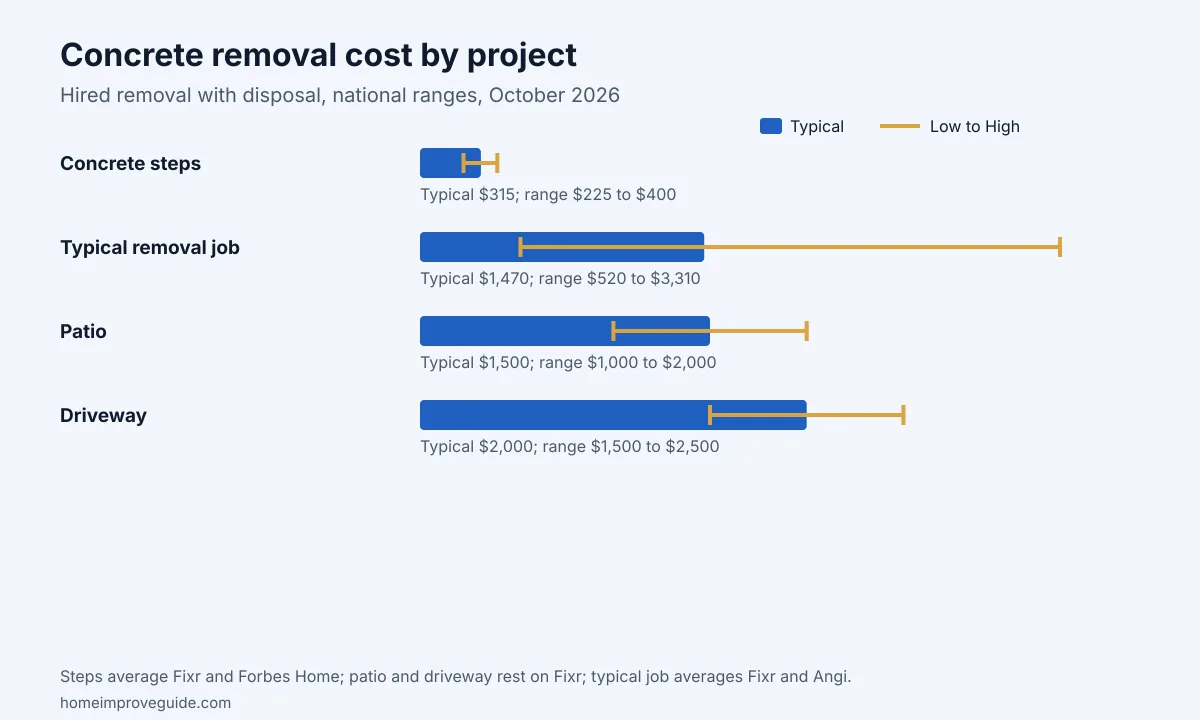
| Concrete steps | $225 | $315 | $400 |
| Patio | $1,000 | $1,500 | $2,000 |
| Driveway | $1,500 | $2,000 | $2,500 |
Steps cost the least to remove because the volume is small, even though they are often thick. Patios and driveways scale with area. Public sidewalks follow their own rate, $2.50 to $7 per square foot, set out in the sidewalk replacement guide.
Cost by area removed
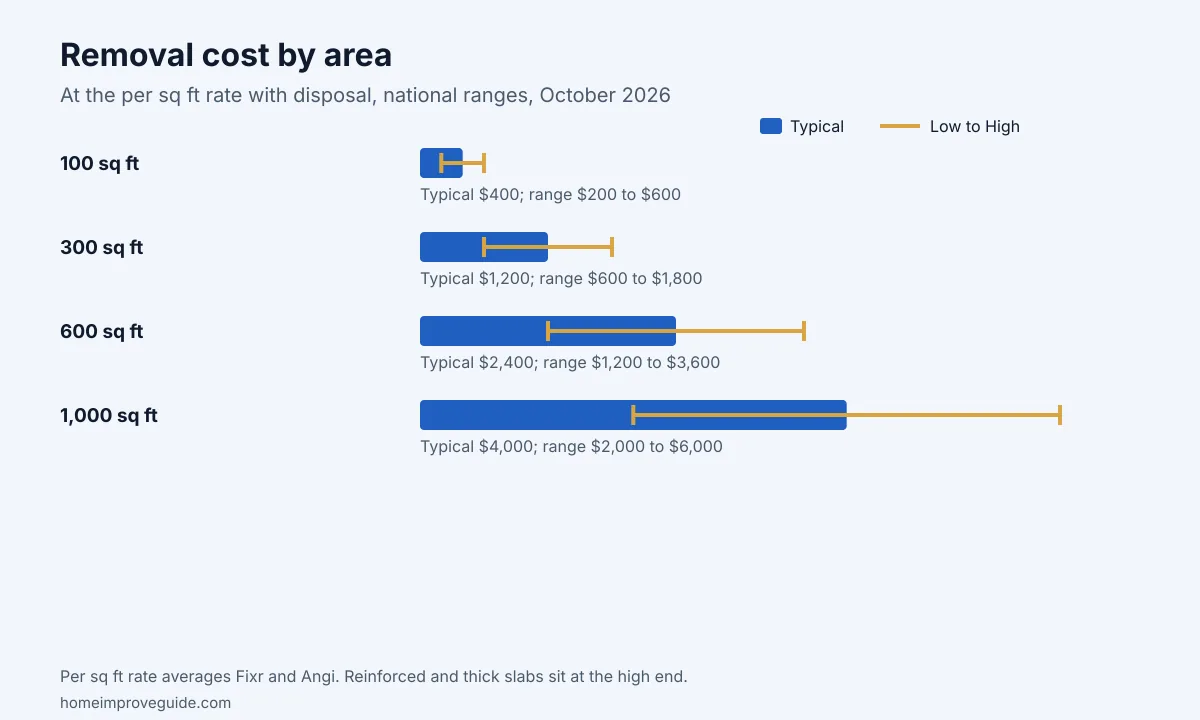
At the per square foot rate, typical areas come to:
| Area | Low | Typical | High |
|---|---|---|---|
| 100 sq ft | $200 | $400 | $600 |
| 300 sq ft | $600 | $1,200 | $1,800 |
| 600 sq ft | $1,200 | $2,400 | $3,600 |
| 1,000 sq ft | $2,000 | $4,000 | $6,000 |
Small jobs carry a minimum, since the crew still brings a breaker, a truck or a trailer and pays a dump fee. Large jobs bring the rate down, especially when a skid steer or a small excavator can break and load in one pass.
How concrete comes out
- The crew checks for buried lines and marks any utilities near the slab.
- A saw cuts clean edges where the slab meets concrete that stays.
- A jackhammer, a walk behind breaker or an excavator mounted hammer breaks the slab into pieces a person or a machine can lift.
- Rebar and mesh are cut free, which slows the work on reinforced slabs.
- Pieces are loaded into a dumpster or truck and taken to a recycler or landfill.
- The base is graded for whatever replaces the concrete.
Disposal is built into the per square foot rate, and concrete that a recycler accepts as clean fill usually costs less to dump than mixed debris.
Worked example: a reinforced two car driveway
A cracked 20 by 24 foot driveway, 480 square feet with wire mesh and rebar, is coming out before new pavers go in.
- Removal at the reinforced rate: $1,920 to $2,880, typical $2,400.
- The same driveway without reinforcement would come to about $1,440 typical.
- A city permit, where required: $25 to $200.
Many installers fold removal into the price of the new surface. Getting it listed as its own line helps compare quotes and shows whether the new base gets dug deeper than the old one.
What changes the price
- Thickness. Slabs thicker than the usual 4 inches take longer to break and weigh more at the dump.
- Reinforcement. Rebar and mesh must be cut and separated.
- Access. Machines need a wide gate or open driveway; backyard jobs reached only by wheelbarrow cost more.
- Disposal distance. Recyclers and landfills far from the site add hauling time.
- What lies under it. Old footings, buried slabs or poor soil found after removal add digging.
- Region. A typical job of $1,470 comes to about $1,840 in the higher cost band and about $1,250 in the lower cost band, 25 percent over and 15 percent under national prices.
Removal as part of a bigger project
Most concrete comes out because something new is going in, and the order of work matters. A paver patio or driveway needs the old slab gone and the subgrade dug deeper than the slab was thick, so the new gravel base has room. A new poured slab often reuses part of the old base once it is checked and recompacted. When a contractor handles both the removal and the replacement, the crew can break, haul and grade in one visit, and the price usually comes in lower than two separate jobs. When the work is split, the removal crew should leave the base at a stated depth and grade, written into its quote, so the next crew does not bill again for digging. Removal also exposes problems that were hidden under the slab, such as soft soil, old drain lines or roots from nearby trees, and a short allowance for those surprises keeps the budget honest.
Breaking it up yourself
Thin, unreinforced slabs such as a small pad or a garden path can be broken by an owner with a rented electric breaker hammer, safety glasses, hearing protection and gloves. The labor is heavy, concrete is far heavier than it looks, and disposal is the hard part: rental trucks and dumpsters have weight limits, and landfills charge by the ton. Reinforced slabs, driveways and anything near buried utilities are better left to a demolition or concrete crew. Sawing concrete throws off fine silica dust; a water fed saw and a properly fitted mask protect anyone working close by.
Excluded from removal prices
- The new patio, driveway or walk that replaces the old one.
- Grading and new gravel base.
- Repair of lawns, irrigation and fences damaged by equipment.
- Removal of footings or foundations below the slab.
- Hazardous material testing for old coatings or adhesives.
- Tree root removal under the slab.
Concrete removal quote checklist
- Area, thickness and whether the slab is reinforced.
- Saw cuts where old concrete meets concrete that stays.
- Equipment used, and protection for driveways and lawns it crosses.
- Disposal method and the destination for the debris.
- Permit responsibility and utility locating.
- Grading of the exposed base.
- Price changes if hidden footings or extra thickness turn up.
- Cleanup and final site condition.
Cost data note
Removal rates average Fixr and Angi for the per square foot rate and the typical job, and Fixr and Forbes Home for steps. The reinforced, unreinforced, patio and driveway lines rest on Fixr alone, and the permit on Angi alone. The Angi removal page dates from 2022 and is first in line for a refresh at the next review. Methods are on the methodology page, and all prices are October 2026 figures, rechecked as part of the site’s regular 3 month schedule.
Frequently asked questions
What is the removal rate per square foot of concrete?
Removal costs $2 to $6 per square foot with disposal, and Fixr puts the typical figure at $4.
What does it cost to remove a concrete patio?
Fixr puts patio removal at $1,000 to $2,000. A 300 square foot patio at the per square foot rate comes to $600 to $1,800.
Does reinforced concrete cost more to remove?
Yes. Reinforced slabs run $4 to $6 per square foot, against $2 to $4 for plain concrete.
Can old concrete be recycled?
Often. Many recyclers crush clean concrete into base gravel, and dumping there usually costs less than a landfill.
Is a permit needed to remove concrete?
Some cities require one, especially for driveways and work near the street. Permits run $25 to $200 where required.
Related concrete guides
The concrete calculators size the replacement pour, and the concrete cost calculator prices it. The concrete patio guide, the sidewalk replacement guide and the pavers versus concrete guide cover what usually replaces old concrete, while the concrete cost per square foot guide prices a new slab. Every guide is gathered on the guides page.