By Muhammad Awais. Prices reviewed October 2026.
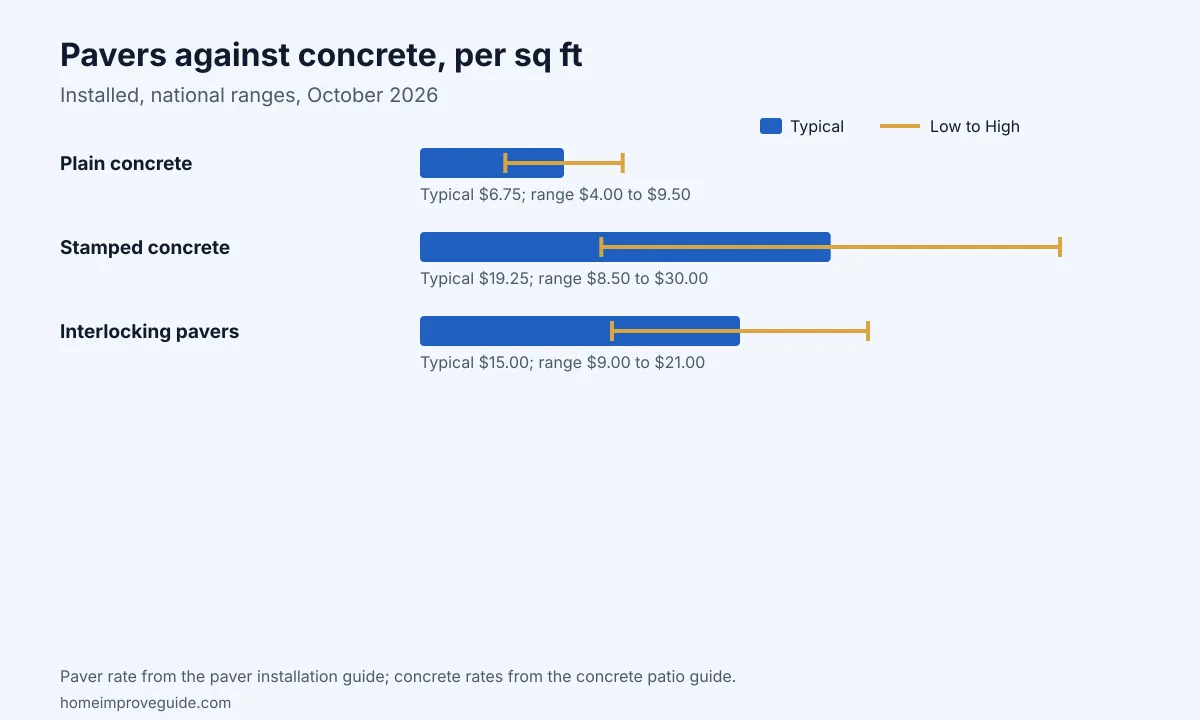
Pavers vs concrete comes down to price now against repair later. Plain poured concrete is the cheaper patio to build at $4 to $9.50 a square foot installed, while interlocking pavers cost $9 to $21, and stamped concrete, at $8.50 to $30, can cost more than either. Pavers win on repairs, since a damaged section lifts out and goes back down, while a cracked slab is patched or cut out. The figures below come from the site’s paver installation and concrete patio guides, both dated October 2026.
| 300 sq ft patio | Per sq ft installed | Low | Typical | High |
|---|---|---|---|---|
| Plain concrete | $4 to $9.50 | $1,200 | $2,030 | $2,850 |
| Stamped concrete | $8.50 to $30 | $2,550 | $5,780 | $9,000 |
| Interlocking pavers | $9 to $21 | $2,700 | $4,500 | $6,300 |
Upfront cost compared
On a 300 square foot patio, plain concrete comes to $1,200 to $2,850, with $2,030 typical, and pavers come to $2,700 to $6,300, with $4,500 typical, a typical gap of about $2,470. Pavers cost more because every unit is placed by hand on a thick compacted base and a screeded sand bed, and cut to fit at the edges. A concrete crew forms the shape, pours and finishes the whole surface in a day. Stamped concrete closes the look gap with pavers by pressing a pattern into the wet surface, and at $5,780 typical on the same patio it often costs more than the pavers it imitates.
How each surface handles weather and wear
Concrete is one rigid piece. As the ground freezes, thaws, swells and dries, the slab cracks, and control joints only decide where the cracks go. Pavers are many small rigid pieces with flexible joints, so the surface moves with the ground and the joints absorb the motion. In cold climates with deicing salt, both surfaces need care: dense concrete pavers resist salt well, while poured concrete without air entrainment can flake at the surface. In hot, stable climates with little frost, a well built slab can stay crack free for many years and the difference narrows.
Repairs: patching against lifting
A cracked or sunken slab has no clean repair. Small cracks can be filled, and they stay visible. A badly broken section is cut out and replaced, at removal rates of $2 to $6 per square foot plus new concrete at the plain rate, so replacing an 80 square foot section runs about $480 to $1,240, and the new concrete rarely matches the old in color. Pavers work differently. A crew pulls the affected pavers, fixes the base, then relays the same pavers, and the repair disappears once the joint sand settles. Utility work under a patio follows the same pattern, which is one reason paver driveways are common over buried lines.
Upkeep over the years
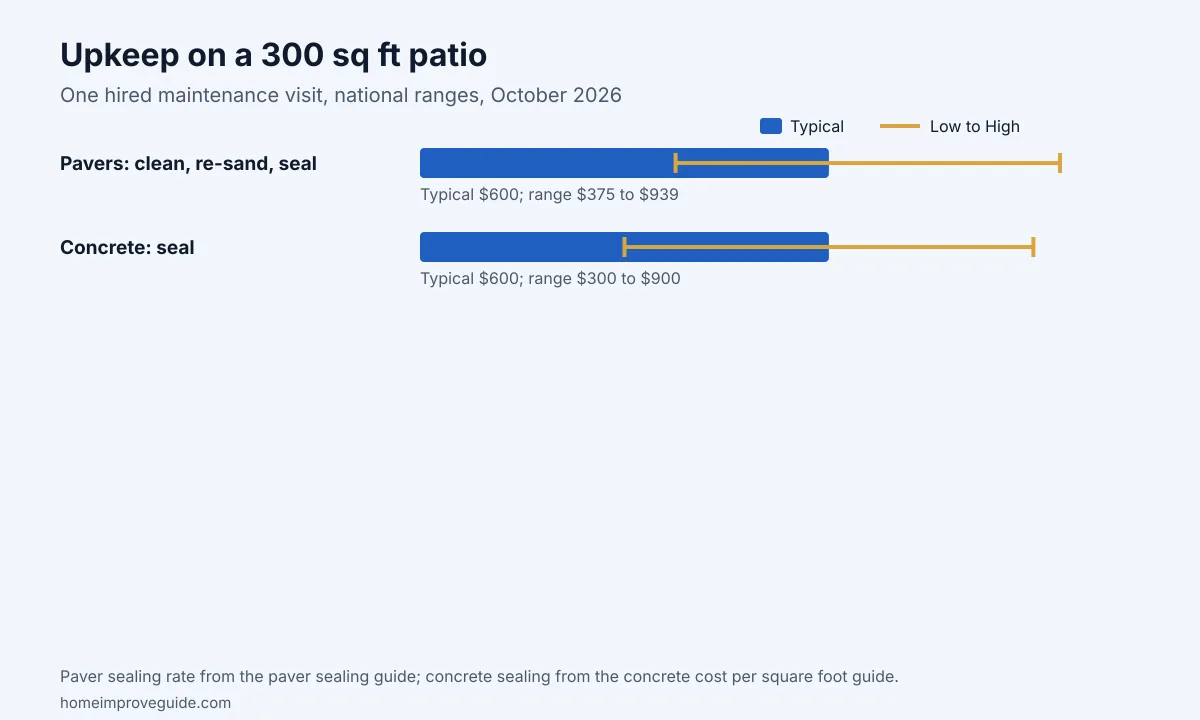
Pavers need their joints kept full and weeds out of them, and many owners have them cleaned, re-sanded and sealed every few years. A hired visit for that runs $1.25 to $3.13 a square foot, or $375 to $939 on a 300 square foot patio. Plain concrete needs less, though sealing every few years, at $1 to $3 per square foot, helps it resist stains and freeze damage, and costs $300 to $900 on the same patio. Stamped concrete needs regular resealing to keep its color and texture, which brings its upkeep closer to that of pavers.
Which fits which project
- Tight budget, simple shape. Plain concrete gives the most patio for the money.
- Cold climate or shifting soil. Pavers tolerate movement without visible cracks.
- Utilities or roots below. Pavers can be lifted and relaid after digging.
- Decorative look on a budget. A plain slab with a stamped border, or a concrete field with a paver edge, splits the difference.
- Owner installation. A small paver patio is a realistic owner project; a large poured slab needs a crew on pour day.
- Resale. Buyers tend to see well kept pavers as an upgrade, while a cracked slab reads as a repair to plan for.
Planning either project
The paver calculator counts pavers with waste for the chosen pattern, and the concrete slab calculator finds the cubic yards for a poured patio. Both need the same site preparation in principle: removing sod and soil, building a compacted gravel base and sloping the surface away from the house. A paver patio needs a deeper base and edge restraint; a slab needs forms and, often, reinforcement.
DIY or hire out
Pavers suit owners who can work steadily over several weekends, since the job can pause at any stage and resume later. Concrete does not pause. Once the truck arrives, the slab must be placed, leveled, floated, edged and jointed within a few hours, which takes several experienced hands. Many owners hire the concrete pour and lay pavers themselves, or hire both and spend their effort on the planning and the plants around the new patio. Either way, the base decides how the patio ages, so the gravel depth and compaction deserve as much attention in a quote as the surface that sits on top of them. A cheap bid that thins the base saves money only until the first hard winter.
What these comparisons leave out
- Removal of an old patio, priced in the concrete removal guide.
- Steps, walls and edging built with the patio.
- Drainage beyond normal slope.
- Permits for driveways and large slabs.
- Regional price differences, about 25 percent above or 15 percent below national figures.
- Furniture, lighting and plantings.
Quote checklist for either surface
- Area, shape and the finished slope.
- Base depth and compaction for both options.
- Paver brand and thickness, or concrete thickness and reinforcement.
- Edge restraint for pavers, control joints for concrete.
- Finish: pattern for pavers, broom, stamp or color for concrete.
- Removal and haul away of old material.
- Sealing, if included, and the product used.
- Warranty on settling, cracking and joint loss.
Cost data note
This guide uses no rates of its own. Paver prices come from the paver installation guide, concrete patio prices from the concrete patio guide, removal from the concrete removal guide, paver sealing from the paver sealing guide and concrete sealing from the concrete per square foot guide. Each source guide names its publishers and follows the rules on the methodology page. All of them carry October 2026 prices on the same 3 month review cycle.
Frequently asked questions
Are pavers more expensive than concrete?
Yes, compared with plain concrete. Pavers cost $9 to $21 a square foot installed against $4 to $9.50 for a plain slab, though stamped concrete at $8.50 to $30 can cost more than pavers.
Which lasts longer, pavers or concrete?
Both last for decades with a good base. Pavers hide wear better because damaged units can be replaced, while concrete cracks are permanent once they form.
Is stamped concrete cheaper than pavers?
Often not. On a 300 square foot patio, stamped concrete runs $5,780 typical against $4,500 for pavers, and it needs regular resealing.
Can pavers be laid over an old concrete slab?
Thin pavers can go over a sound, well drained slab using a mortar or adhesive bed, but a cracked or sinking slab should come out first.
Which is better for a driveway?
Both work. Concrete costs less and suits simple shapes, while pavers handle freeze cycles and repairs better and cost more to install.
Related patio guides
The paver calculators hub lists every paver tool. Full pricing for each option is in the paver installation guide and the concrete patio guide, and the paver sealing guide covers upkeep. Every cost guide sits in the guides catalog.