By Muhammad Awais. Prices reviewed October 2026.
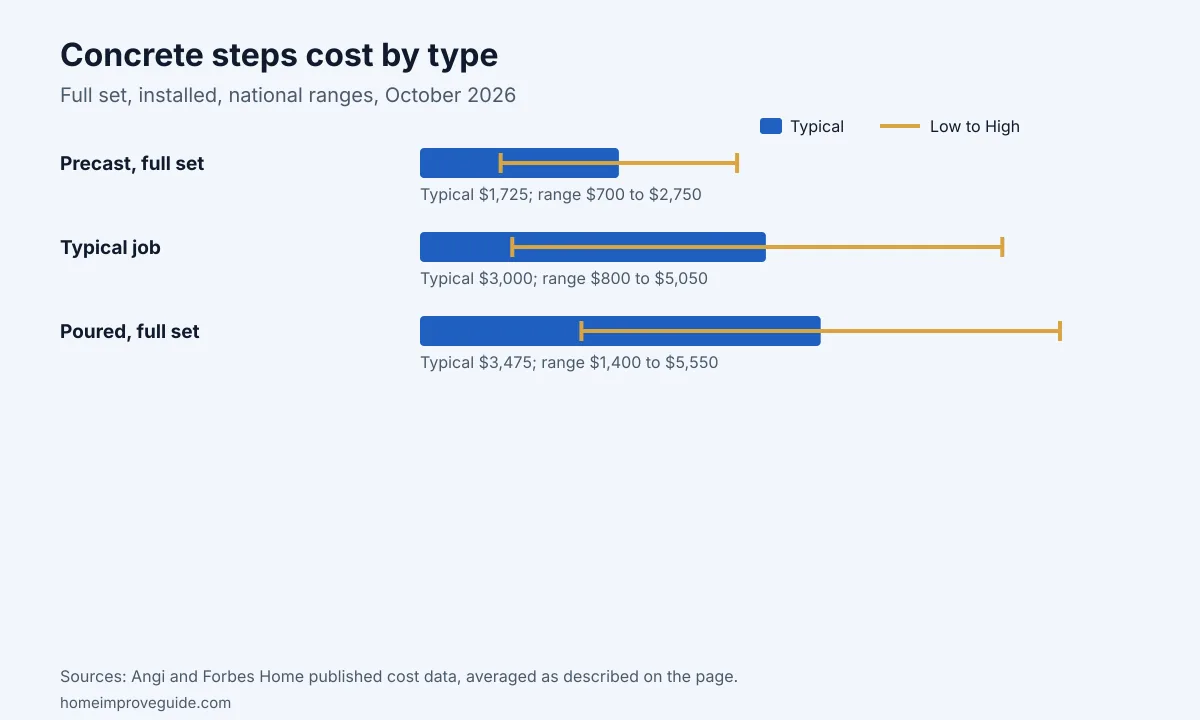
At a front or back door, a typical set of concrete steps costs $800 to $5,050 nationally, with $3,000 as the mean of the averages Angi and Forbes Home publish. The construction method sets the price band. Steps poured in place on site run $1,400 to $5,550 a set, while precast steps delivered in one piece and set by a small crane or loader run $700 to $2,750.
| Concrete steps item | Low | Typical | High |
|---|---|---|---|
| Concrete steps, typical job | $800 | $3,000 | $5,050 |
| Poured steps, full set | $1,400 | $3,475 | $5,550 |
| Precast steps, full set | $700 | $1,725 | $2,750 |
| Poured step, each | $200 | $350 | $500 |
| Precast step, each | $100 | $225 | $350 |
| Removing old steps | $200 | $300 | $400 |
| Railings, full set | $300 | $450 | $600 |
Poured in place or precast
Poured steps are formed on site to fit the door, the landing height and the walk. They can be any width, can wrap around a corner and can carry a landing large enough for a storm door to swing. They take forms, reinforcement, a pour, finishing and a curing period before use. Precast steps are cast at a plant in standard sizes, often hollow, and arrive ready to set on a gravel base. They go in within hours and cost less, but come in fixed widths and rises, and a set that does not suit the door height needs a landing or a different unit. HomeGuide prices single steps at $200 to $500 each poured and $100 to $350 each precast.
How much concrete a set of steps needs
The concrete calculator has a steps mode that works out volume from the width, tread depth, riser height and number of steps. A 4 foot wide set of 3 steps with 11 inch treads and 7 inch risers needs 0.52 cubic yards with waste, or 24 bags of 80 lb concrete. Five steps of the same size need 1.31 cubic yards, or 59 bags. Owners and crews often hand mix small sets with bagged concrete, while a ready mix truck is the cheaper choice for larger sets with a landing.
Worked example: replacing a front stoop
A crumbling front stoop is torn out and replaced with new poured steps and a metal railing:
- Removing the old steps: $200 to $400, typical $300.
- New poured steps: $1,400 to $5,550, typical $3,475.
- Railings: $300 to $600, typical $450.
- Total: $1,900 to $6,550, with $4,230 typical.
The same job with precast steps comes to $1,200 to $3,750, with $2,480 typical, when a standard unit fits the door height.

Code basics that shape the design
Residential codes set limits on riser height and tread depth, and they require consistent sizes within a flight, since an odd step is a common trip hazard. Many codes also call for a handrail once a stair has several risers, and a landing at least as deep as the door is wide where a door swings outward. Steps that tie into a foundation, or that sit in front of a public sidewalk, may need a permit. The local building department confirms the exact numbers for each project.
What moves the price
- Height and number of steps. Each extra riser adds concrete, form work and finishing.
- Width and landing. Wider steps and larger landings use more concrete; a landing often doubles the volume of a small set.
- Finish. Broom finish is standard; stamped, colored or stone faced steps cost more.
- Removal. Old steps with rebar or poured against the foundation take longer to break out.
- Access. Precast units need a clear path for a loader or crane truck.
- Region. A typical job of $3,000 comes to about $3,750 with the 25 percent high cost adjustment and about $2,550 with the 15 percent low cost adjustment.
Fix, resurface or replace
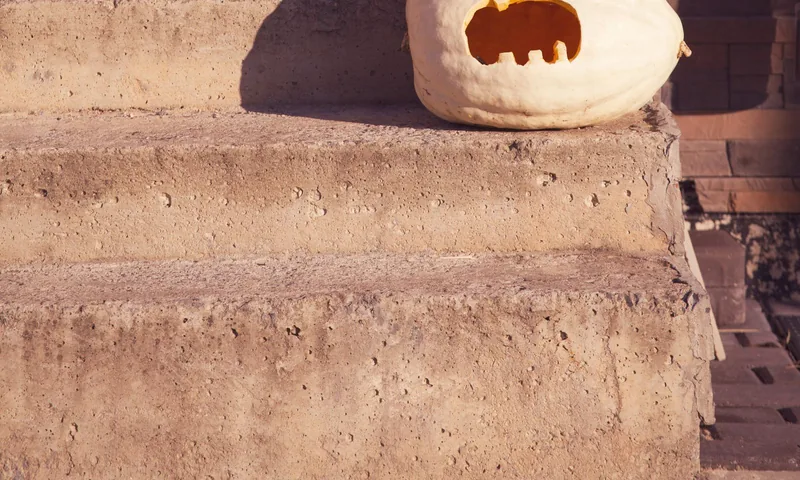
Steps with small chips and surface wear can often be patched or resurfaced with a polymer modified overlay, which costs far less than new steps. Steps that have pulled away from the house, sunk on one side or cracked through need replacement, since water running behind them can reach the foundation. Settling precast units can sometimes be lifted and reset on a new base. A contractor can say which option fits after looking at the base and the connection to the house.
Details that make steps last
Steps take more abuse than most concrete. Treads collect water, snow and deicing salt, and the edges catch shovels and boots. A slight forward pitch on each tread sheds water, and an air entrained mix resists freeze damage in cold regions. A broom or textured finish keeps the treads from turning slick when wet, while a rounded nosing on each edge resists chipping. Sealing every few years slows salt damage. Where the steps meet the house, an expansion joint and flashing at the door threshold keep water from running between the two and into the wall or the sill.
Owner work or a concrete contractor
A low, single step pad is a reasonable owner project with bagged concrete, simple forms and a weekend. Taller flights need careful layout to keep every riser equal, solid forms that will not bulge under the weight of wet concrete and reinforcement tied to the foundation where required. Precast steps need equipment to lift and place. Most owners hire both types out, and contractors often bundle removal, steps and railings into one price.
Items outside these prices
- Walkways leading to the steps.
- Stone, brick or tile cladding on the steps.
- Footings below the frost line where the code requires them.
- Permits and inspections.
- Lighting built into the steps or the railing.
- Lawn and planting repair after the work.
Concrete steps quote checklist
- Number of steps, riser height, tread depth and width.
- Poured or precast, and landing size.
- Base preparation, footings and reinforcement.
- Connection to the house foundation.
- Finish type and nonslip texture.
- Removal and disposal of the old steps.
- Railing material, height and mounting.
- Warranty on cracking and settling.
Cost data note
Step prices average Angi and Forbes Home, with the per job Typical taken as the mean of their two stated averages. Single step prices rest on HomeGuide alone, and the remaining rows use the halfway point of each range as Typical. Angi gives no date for its steps page, so the site’s reading date applies. The averaging steps are on the methodology page. Ranges stand as of October 2026, and the review interval is 3 months.
Frequently asked questions
How much do concrete steps cost?
A typical set of concrete steps costs $800 to $5,050, with $3,000 typical. Precast sets cost less than steps poured in place.
Are precast steps cheaper than poured steps?
Usually. Precast sets run $700 to $2,750, against $1,400 to $5,550 for poured steps.
What does it cost to remove old concrete steps?
Removing an old set costs $200 to $400, more when the steps are reinforced or tied to the foundation.
How much does a railing for concrete steps cost?
Railings for a full set run $300 to $600, depending on the material and the length.
How long before new concrete steps can be used?
Poured steps take light foot traffic after a day or two and reach most of their strength over the following weeks. Precast steps can be used right away.
Related concrete guides
The concrete calculators handle volume and bags for any pour. Breaking out old steps is covered in the concrete removal guide, and the walk and patio at the bottom of the steps in the sidewalk replacement guide and the concrete patio guide. Every guide is indexed on the main guides page.