By Muhammad Awais. Prices reviewed October 2026.
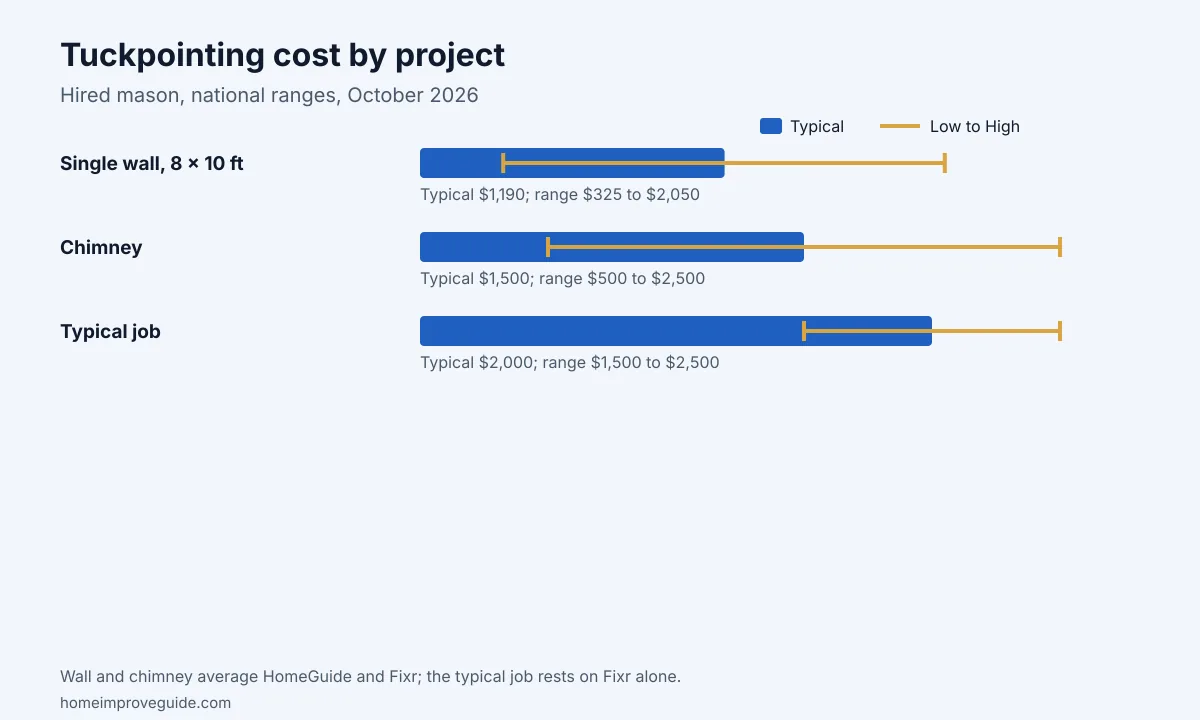
Tuckpointing cost runs $5 to $25 per square foot of brick wall nationally, the range that HomeGuide, Fixr and Forbes Home all publish, and Forbes Home puts the average at $15. Height drives the price within that range: ground level work sits near the bottom, while walls reached from scaffolding or a lift sit near the top. Fixr puts a typical job at $1,500 to $2,500, with $2,000 as its average.
| Tuckpointing item | Low | Typical | High |
|---|---|---|---|
| Tuckpointing, per sq ft | $5 | $15 | $25 |
| Typical tuckpointing job | $1,500 | $2,000 | $2,500 |
| Single wall, about 8 x 10 ft | $325 | $1,190 | $2,050 |
| Chimney | $500 | $1,500 | $2,500 |
| Whole brick house | $8,750 | $30,000 | $51,250 |
| Mason, per hour | $62.50 | $93.75 | $125 |
| Brick replacement, per sq ft | $20 | $25 | $30 |
Tuckpointing, repointing and what each means
Both terms describe replacing worn mortar between bricks. Repointing is the general job: grinding or raking out the old mortar to a set depth and packing in new mortar. Tuckpointing, strictly, adds a thin line of contrasting mortar along each joint to make old, uneven joints look crisp and straight, though many contractors use the word for any repointing. Either way, the work is slow and skilled, which is why labor makes up most of the price. Masons bill $62.50 to $125 an hour for it.
Cost by area
At the per square foot rate, common areas of wall come to:
| Wall area | Low | Typical | High |
|---|---|---|---|
| 50 sq ft | $250 | $750 | $1,250 |
| 100 sq ft | $500 | $1,500 | $2,500 |
| 200 sq ft | $1,000 | $3,000 | $5,000 |
| 400 sq ft | $2,000 | $6,000 | $10,000 |
A whole brick house is a much larger job, at $8,750 to $51,250 in the averaged range, and the two publishers behind it differ widely because house size and the share of joints needing work vary so much.
Signs the mortar needs attention
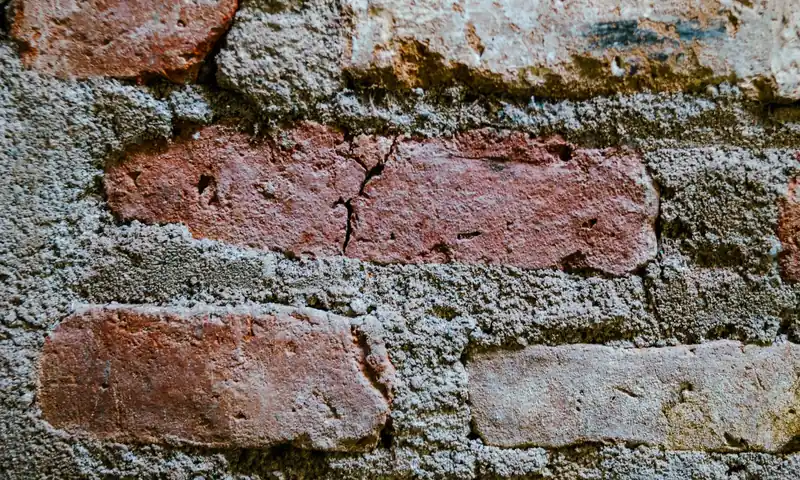
Mortar is meant to wear before the brick does, so failing joints are normal on older walls. Joints that are recessed, sandy to the touch or cracked let water into the wall. Gaps wide enough to fit a coin, bricks that move when pushed and white salt stains below the joints all point to water working through the masonry. Inside, damp spots on the inner face of exterior walls and peeling paint near windows can trace back to failed joints outside. Catching joint wear early keeps the job to repointing; left too long, water and frost loosen the bricks themselves.

Worked example: a 100 square foot section with damaged bricks
A side wall has 100 square feet of eroded joints and 10 square feet of spalled bricks that must be replaced before repointing:
- Tuckpointing at the per square foot rate: $500 to $2,500, typical $1,500.
- Brick replacement, 10 square feet at $20 to $30 per square foot: $200 to $300.
- Total: $700 to $2,800, with $1,750 typical.
The brick replacement rate comes from HomeGuide alone. Matching the color and size of old brick can take salvage or a special order, which adds time.
Mortar matters as much as the labor
New mortar must be softer than the brick and close to the original in strength. Modern Portland cement mortars are much harder than the lime mortars used on older buildings, and putting hard mortar against soft historic brick causes the brick faces to crack and flake instead of the joints, the opposite of what is wanted. A mason working on an older house tests or identifies the original mortar and matches it, often with a lime based mix. Color matters too, since a patch that stands out stays visible for decades. The mortar calculator estimates bags for repointing and small rebuilds.
How long the work takes
Repointing moves at the pace of the joints, not the size of the wall. A mason typically covers only a modest area per hour once the old mortar is cut out, and the cutting itself can take as long as the filling. Weather sets limits as well: mortar needs mild temperatures to cure, so masons avoid freezing nights and very hot, dry afternoons, and they mist fresh joints so they cure slowly. A one wall job often fits into a day or two, while a whole house can take weeks and is usually scheduled side by side, with scaffolding moved as each face is finished.
Cost factors
- Height. Scaffolding or a lift is needed above the first story, and higher walls slow the work.
- Joint width and depth. Wide or deeply eroded joints take more mortar and more time.
- Brick condition. Cracked or spalled bricks must be cut out and replaced before repointing.
- Mortar match. Historic lime mortar and custom colors cost more than standard mixes.
- Access. Plantings, decks and roofs against the wall add setup.
- Region. A typical 100 square foot job at $1,500 costs about $1,880 where masonry labor sits 25 percent over national rates, against about $1,280 where it sits 15 percent under them.
Mason or owner
A few loose joints at ground level on a garden wall are a manageable owner repair with a joint raker, a pointing trowel and a bag of mortar mix. Larger areas, anything above a ladder’s safe reach, historic brick and chimneys belong with a mason. Grinding out mortar throws off silica dust, which calls for a shroud with a vacuum, a respirator and eye protection. Poorly matched mortar or smeared brick faces are hard to undo, which is the main reason most homeowners hire this work out.
Outside these prices
- Scaffolding rental on tall walls, when billed separately.
- Rebuilding sections with loose or bulging brick.
- Cleaning the brick after the work.
- Water repellent sealers applied afterward.
- Window, flashing and gutter repairs found during the work.
- Permits where required for historic districts.
Tuckpointing quote checklist
- Area of wall in square feet and the joints included.
- Removal depth of the old mortar and the tool used.
- Mortar type, strength and color match method.
- Brick replacement count and source of matching brick.
- Scaffolding or lift, and who provides it.
- Dust control and protection of windows and plants.
- Cleanup of mortar smears on the brick faces.
- Warranty on the joints.
Cost data note
The per square foot line averages HomeGuide, Fixr and Forbes Home, and its Typical is the Forbes Home average. Project lines average HomeGuide and Fixr; the typical job and brick replacement each rest on a single publisher. The Fixr tuckpointing page dates from 2022 and is due for a refresh at the next review. See the methodology page for the steps. The ranges carry October 2026 as their date and a 3 month review interval.
Frequently asked questions
How much does tuckpointing cost per square foot?
Tuckpointing costs $5 to $25 per square foot, and Forbes Home puts the average at $15.
What does it cost to tuckpoint a chimney?
A chimney runs $500 to $2,500, depending on its height, the roof pitch and how much mortar has failed.
How often does brick need repointing?
Good mortar joints often last for decades. Exposure to driving rain, freeze cycles and poor drainage shortens that, so joints are worth checking every few years.
Is tuckpointing the same as repointing?
The terms are often used the same way. Strictly, repointing replaces mortar, and tuckpointing adds a fine contrasting line to make the joints look sharp.
What do masons charge per hour for tuckpointing?
Masons bill $62.50 to $125 an hour for repointing work, plus materials.
Related masonry guides
The masonry calculators cover bricks, blocks and mortar. The chimney repair guide prices crowns, caps and rebuilds, the stone veneer guide covers stone faces on walls, and the retaining wall guide prices block and stone walls. The guides overview lists every topic.