By Muhammad Awais. Prices reviewed October 2026.
Retaining wall cost averages $25 to $55 per square foot of wall face nationally, installed, with $40 as the midpoint of the published ranges from HomeGuide and Fixr. Wall face means the length times the exposed height, so a 30 foot wall standing 3 feet tall has 90 square feet of face. A typical project with about 100 square feet of face costs $2,250 to $10,000, with $5,480 as the typical figure.
| Wall size | Low | Typical | High |
|---|---|---|---|
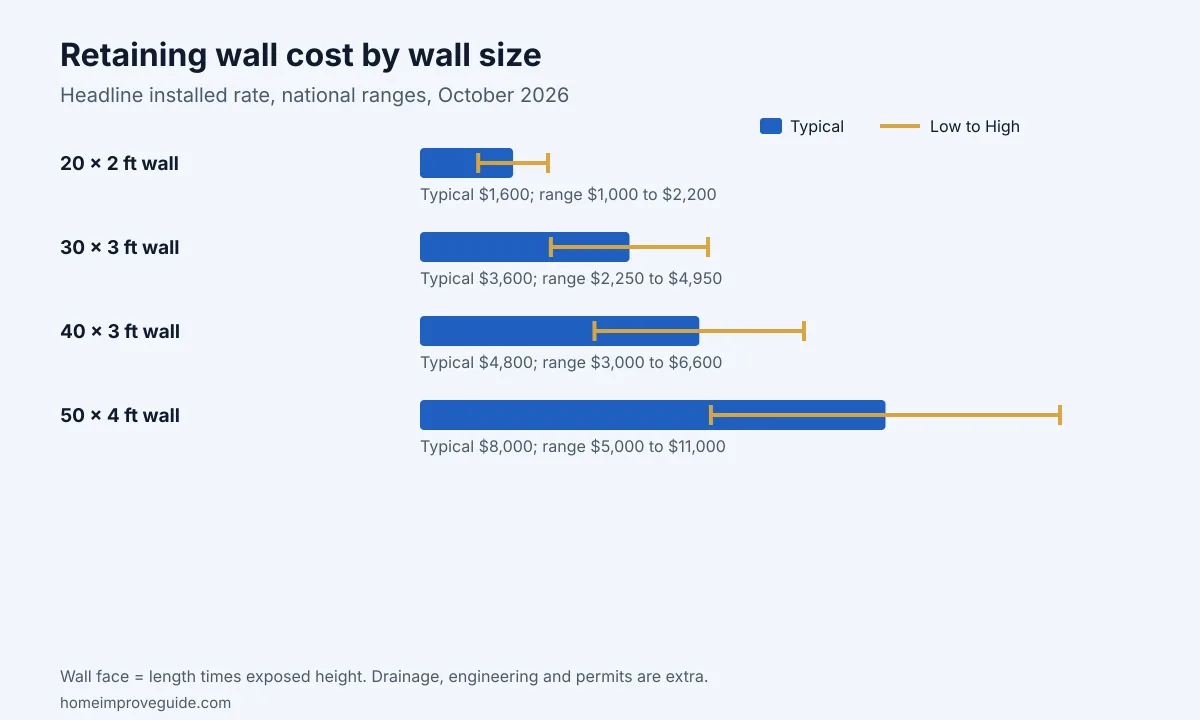
| 20 ft long, 2 ft tall (40 sq ft of face) | $1,000 | $1,600 | $2,200 |
| 30 ft long, 3 ft tall (90 sq ft of face) | $2,250 | $3,600 | $4,950 |
| 40 ft long, 3 ft tall (120 sq ft of face) | $3,000 | $4,800 | $6,600 |
| 50 ft long, 4 ft tall (200 sq ft of face) | $5,000 | $8,000 | $11,000 |
The calculator range runs $20 to $65 per square foot of face, wider than the $25 to $55 publisher headline range on this page.
Price a wall with the calculator
The retaining wall cost calculator counts segmental blocks, caps and drainage gravel for a wall of any length and height, then prices the finished wall at the calculator rate with the region chosen.
Estimated installed cost
$1,800 to $5,850
Typical $3,600
| Wall face area | 90 sq ft |
|---|---|
| Blocks per sq ft of face | 1.00 |
| Wall blocks, before waste | 90 blocks |
| Wall blocks to order, with waste | 99 blocks |
| Cap blocks | 30 caps |
| Gravel backfill | 3.33 cu yd |
| Item | Low | Typical | High |
|---|---|---|---|
| Installed wall (material and labor) | $1,800 | $3,600 | $5,850 |
Planning estimate only, not a contractor quote. Prices are United States national ranges, updated October 2026. How these estimates are built
Cost per square foot by wall material
| Material, installed per sq ft of face | Low | Typical | High |
|---|---|---|---|
| All wall types, per sq ft of face | $25 | $40 | $55 |
| Concrete block | $12.50 | $28.75 | $45 |
| Poured concrete | $25 | $33.75 | $42.50 |
| Natural stone | $20 | $58.75 | $97.50 |
| Wood or timber | $15 | $22.50 | $30 |
Timber is the least expensive to build but has the shortest life, since buried wood rots even when treated. Segmental concrete block is the common choice for garden walls and stacks without mortar. Poured concrete costs more in forms and labor but suits tall walls and tight spaces. Natural stone covers the widest range, because a dry laid fieldstone wall and a mortared, cut stone wall are very different jobs.
Publishers disagree on brick retaining walls: Fixr gives $20 to $25 per square foot of face and HomeGuide gives $30 to $60, so this page shows both ranges and no averaged figure.

Worked example: 120 square feet of block wall
A sloped back yard gets a 40 foot block wall with 3 feet of exposed height, giving 120 square feet of face, plus a perforated drain along its base.
- Wall at the headline rate: $3,000 to $6,600, typical $4,800.
- Drainage behind the wall, 40 linear feet at $60 to $70 per foot: $2,400 to $2,800, typical $2,600.
- Total before any permit: $5,400 to $9,400, with $7,400 typical.
Drainage is the line most often left out of a low bid, and it is the one that keeps the wall standing. The drainage figure comes from a single publisher, Fixr.
Height, engineering and permits
Height changes a retaining wall from a garden feature into a structure. Many codes require a permit for walls over about 4 feet of retained soil, or for any wall with a driveway, a building or a slope above it, and walls at that size usually need a design from a structural engineer. Engineering runs $500 to $2,000, and permits cost $50 to $450; both figures come from HomeGuide alone. Taller walls also add geogrid reinforcement, deeper footings and more excavation, which pushes the price per square foot toward the top of each range.
Cost factors
- Soil and water. Clay soils and wet slopes push harder on a wall and need more drainage stone and pipe.
- Excavation. Cutting into a hill to make room for the wall and its gravel zone often costs as much as the blocks.
- Access. A skid steer that reaches the site moves stone and soil in minutes; hand carrying through a gate takes days.
- Curves, steps and corners. Each adds cutting and special units.
- Caps and finish. Natural stone caps and veneer faces raise the material bill.
- Region. The 120 square foot example at the typical rate costs $4,800 nationally, about $6,000 in higher cost states (25 percent above) and about $4,080 in lower cost states (15 percent below).
Signs an existing wall is failing
A wall that leans outward at the top, bulges in the middle or shows widening cracks is losing its fight with the soil behind it. Water seeping through the face after rain, soil washing out at the base and blocks that have slid forward all point to poor drainage or a base that was never compacted. Timber walls fail from rot at ground level, where a probe or screwdriver sinks into the wood. Repairs to a short section can be modest, but a wall that has rotated or bulged along its length usually has to come down and be rebuilt with proper drainage, which adds demolition and haul away to the costs above. A failing wall below a driveway, a house or a neighbor’s yard deserves an engineer’s opinion before anyone starts taking it apart.
Building a short wall yourself
A low wall of small segmental blocks along a flower bed is a common owner project. The work is mostly digging, leveling and compacting a gravel base, then setting the first course perfectly level, since every course above follows it. Walls that hold back more than a couple of feet of soil, carry a load above them or sit near a property line are better left to a hardscape contractor, and any wall that needs an engineer’s design should be built by a crew that follows it. Calling 811 before digging is required everywhere in the country, whoever builds the wall.
Costs these ranges do not cover
- Hauling away excavated soil.
- Geogrid, plus an engineer’s design where the wall is tall or carries a load.
- Steps, lighting and seating built into the wall.
- Removing an old failed wall.
- Survey work near property lines.
- Lawn and planting repair around the finished wall.
Retaining wall quote checklist
- Wall length, exposed height and buried depth.
- Block or stone product, color and cap style.
- Base depth, gravel type and compaction method.
- Drainage stone behind the wall, drain pipe and its outlet.
- Geogrid layers where the design calls for them.
- Engineer’s design and permit responsibility.
- Soil removal, haul away and site cleanup.
- Warranty on leaning, bulging or settling.
Cost data note
Both the headline rate and the material rows draw on HomeGuide and Fixr, while Fixr and Forbes Home supply the project total; the methodology page explains how each pair becomes one range. Drainage, engineering and permit lines each rest on one publisher. The brick line is left out of the averages because the two publishers’ ranges do not overlap. The Retaining Wall Cost Calculator keeps the site’s calculator rate. Figures are current to October 2026, and a 3 month review cycle keeps them in step with the publishers.
Frequently asked questions
What do published figures say a retaining wall costs per square foot?
Published data puts a retaining wall at $25 to $55 per square foot of face installed, with $40 as the midpoint.
What does a 30 foot retaining wall cost?
A wall 30 feet long and 3 feet tall has 90 square feet of face and costs $2,250 to $4,950 at the headline rate, with $3,600 typical, before drainage and permits.
What is the cheapest retaining wall material?
Wood or timber is usually the least expensive at $15 to $30 per square foot of face, followed by concrete block, though timber walls do not last as long.
Does a retaining wall need a permit?
Many cities require a permit for walls over about 4 feet tall or walls that support a load above them. The local building department sets the rule.
Why does the calculator give a different range?
The calculator range runs $20 to $65 per square foot of face, wider than the $25 to $55 publisher headline range on this page.
More outdoor guides
The outdoor calculators cover patios, walls and yards. The paver installation guide prices a patio above or below the wall, the concrete steps guide covers steps through a terrace, and the stone veneer guide prices a stone face for a poured wall. All guides appear in the guides list.